Vietnam and Cambodia
Koh Dach, aka Silk Island
After a long bus ride from Siem Reap to Kampong Cham, a town on the Mekong River, we boarded our home for the next several days, the river cruise ship AMADara. One of our first stops was Koh Dach, aka Silk Island, and its Oknhatey Village, a coop of some 200 farmers that produces silk fabric using traditional production methods.
I was curious to learn how smooth, luxurious silk fabric somehow resulted from what was essentially worm spittle, but I was concerned that this stop could be yet another Cuckoo Clock Factory. So what does that mean? Three decades ago, I took my first group trip—a land tour through Germany, Switzerland, Austria, and Hungary—and from the first day of that tour, our guide excitedly and repeatedly promoted our visit to the Cuckoo Clock Factory. In the Black Forest of Germany, we finally arrived at the Cuckoo Clock Factory. I expected to learn something about how the clocks were made and what mechanism popped the little birdie in and out of the clock. What I got was a brief woodcarving demonstration followed by an hour of hard sell. Every cruise or land trip that I have taken since has had its version of the Cuckoo Clock Factory. Could this visit to the silk production facility be this cruise’s Cuckoo Clock Factory?
The answer is yes and no. I’ll explain in the photo discussions:
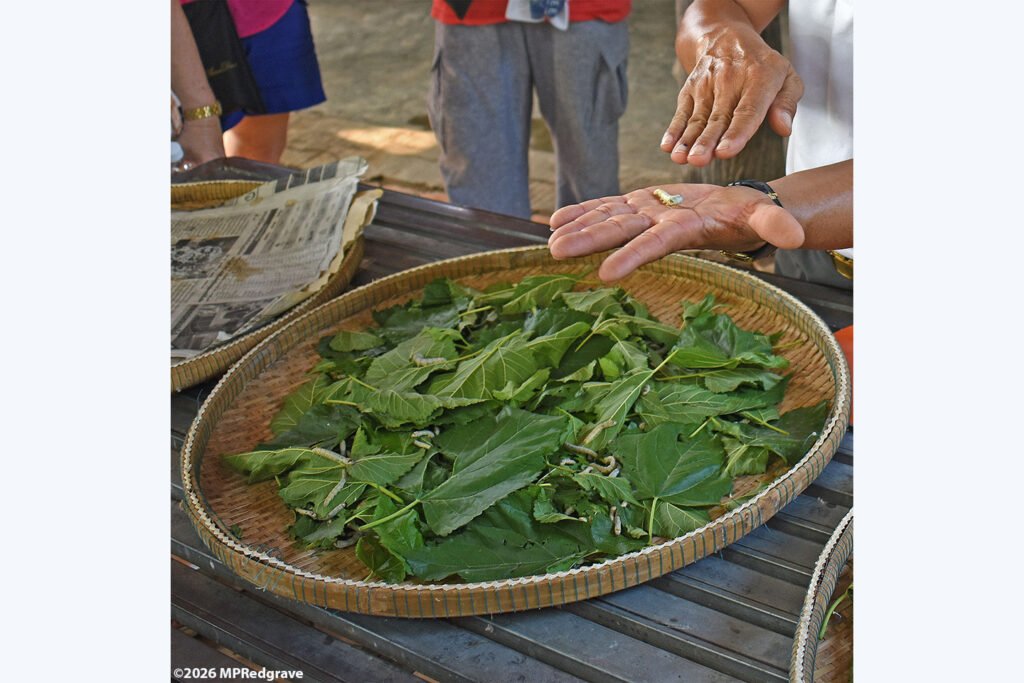
Domestic silkworms live only on mulberry leaves, and nothing else. The silkworm farmers set aside some of the silkworm pupa (in their cocoons) and place them into an enclosure. In a few days, the pupae break open their cocoons and out crawl adult silk moths. Domestic silk moths live only a couple of days—their sole function is to make baby silkworms. The flightless, fuzzy silk moths mate, the females lay a clutch of sticky eggs, and then their life is completed. The silkworm farmer then moves the tiny eggs to a basket of mulberry leaves. The eggs soon hatch and the little silkworms start to eat, and eat, and eat. They rapidly become large, fat silkworms. That’s the stage you see here.
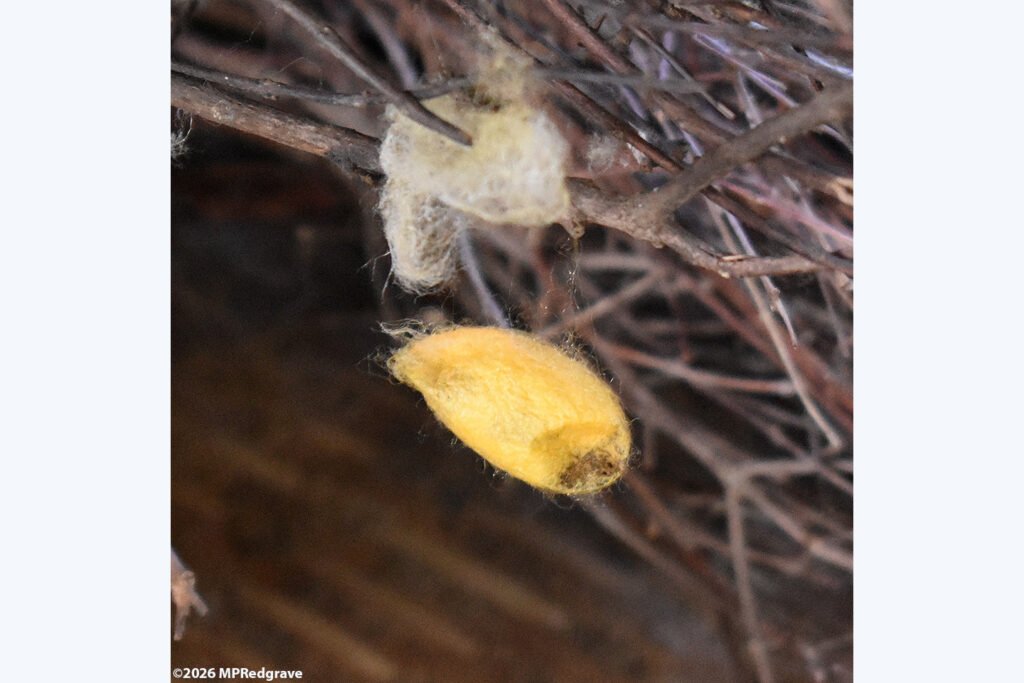
Silkworms stay in the larval (i.e., worm) stage for 3 to 4 weeks. When the worms stop eating and turn a bit darker, the farmer knows the worms are about to spin their cocoons. He moves the worms to a bundle of twigs, which provides the worms a structure to hang their cocoons on. Over the span of up to 3 days, the worm, from its salivary glands, produces a single long fiber of protein that it winds around itself, creating a cocoon that is made of pure silk. Once the cocoon is entirely closed and has turned a golden color, it is ready for harvest.

The cocoons that are harvested are immediately dropped into boiling water. That does two things: first, it kills the pupae inside the cocoon, and second, it softens the silk fiber, making it less sticky, so that it can be unwound. This worker has attached several (I count 7) of the thin raw silk fibers to the top of the spinning machine, which is pulling those fibers over the top of the spinning machine and winding them around each other to form a single silk thread. That silk thread is then wound around the “wheel” on the right. The fiber in a single cocoon is one long strand, and that one strand from one cocoon can be as long as 3000 feet!
Once a cocoon is sufficiently unwound, its now cooked pupa is freed into the water. The worker collects those pupae and saves them for human consumption. They are considered a delicacy and are commonly available in Cambodia.

The freshly wound silk threads are dyed any of dozens of colors and are then weaved into silk fabric. I don’t claim to fully understand weaving, but looking at all the threads on this loom makes me think it must take hours to set up. I did watch this worker operating the loom for a few minutes and she made it all look easy—and fast—all the while with a pleasant look on her face. I had questions to ask, but by this time I had ditched my group (I have a habit of doing that!) and there was no English being spoken among the loom operators, so I Iet those questions rest for now.
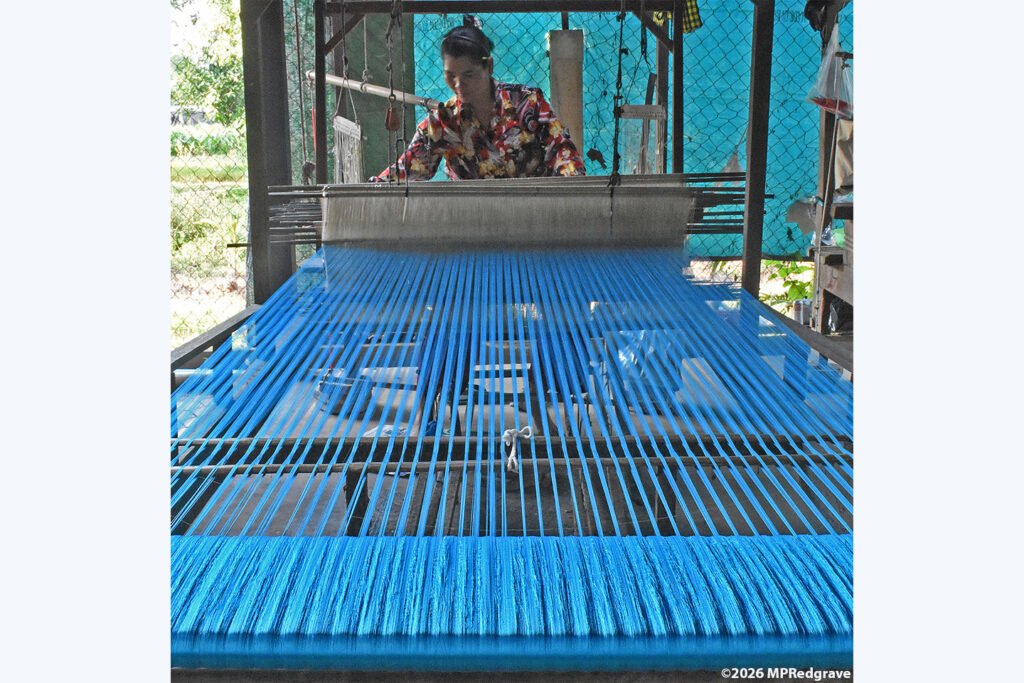
This photo looks at a loom from its end. I was struck by two things: first, what a beautiful blue the iridescent silk is, and second, how tightly the loom seems to be pulling the silk threads.
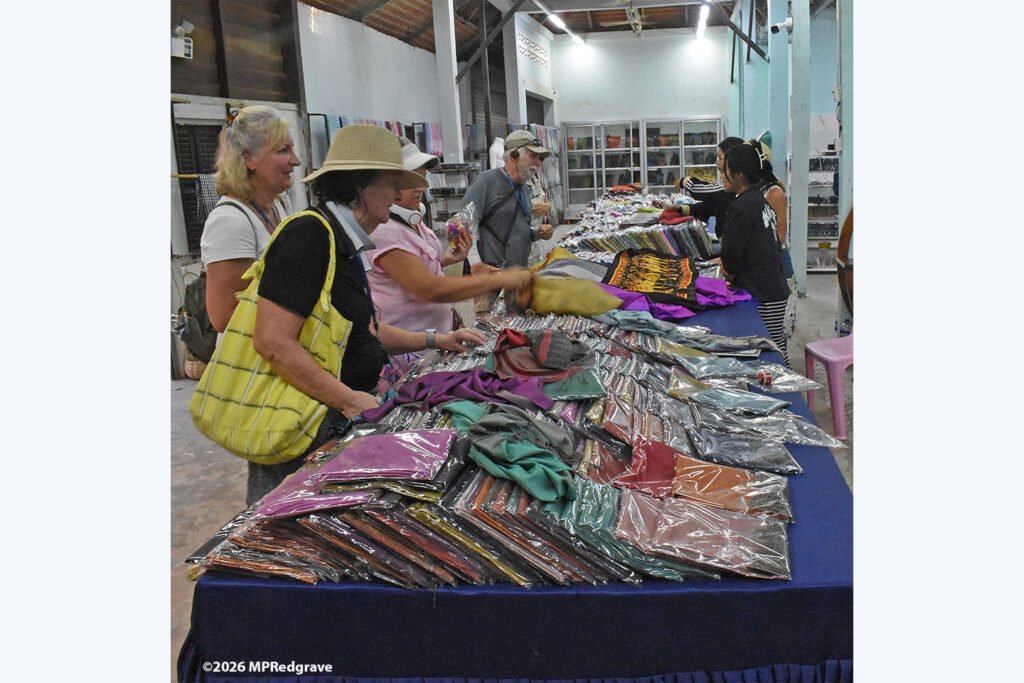
After the looms, we got led into the store. Oh boy, shades of the Cuckoo Clock Factory. Yes, we would be here for a while. A while stretched into about an hour. Can I walk back to the ship? It’s not that far—I don’t need to ride another tuk tuk! No, was the reply, stay with the group. Oh well.
My grumbling aside, there were lots and lots and lots of colors of silk for the customers.
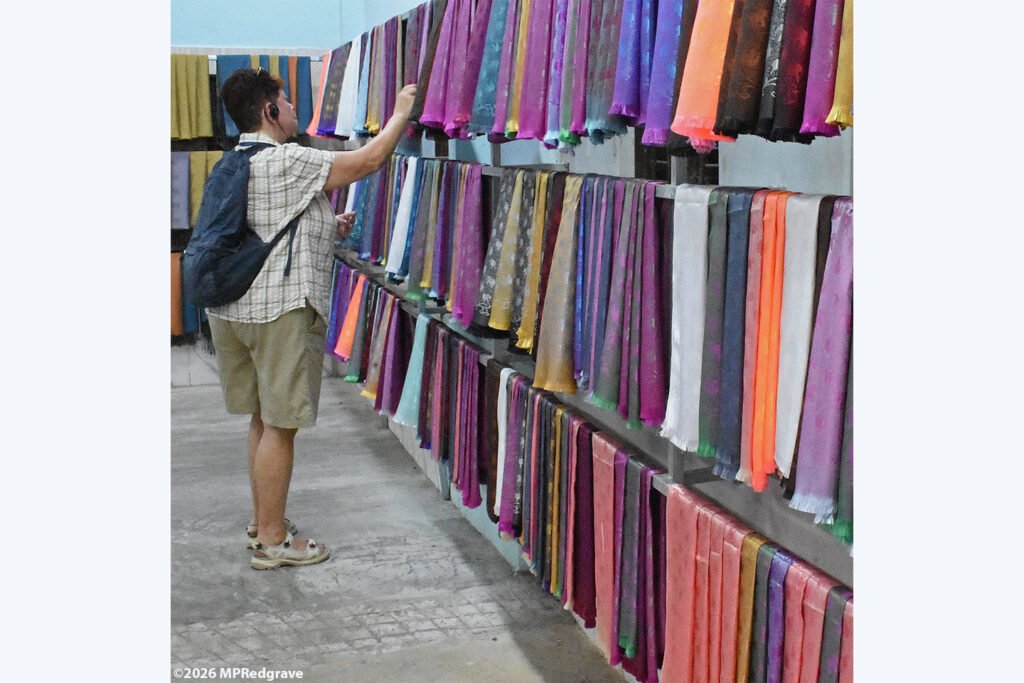
And if you didn’t find what you wanted in the wrapped silk, there was 10 times more varieties hanging from the walls of the store.
It seemed to me that they were selling lots of silk that day. I suppose that if they made enough to help them stay in business, then it made the wait more tolerable. Besides, once we started moving again, all was good again with me. I was happy to learn about how they make silk. But I really would have enjoyed a walk back to the ship….