Vietnam and Cambodia
Angkor Ban
One of our stops along the Mekong River was the small town of Angkor Ban. The waterfront at Angkor Ban is dominated by a small, modern Buddhist monastery, but the town just beyond the monastery was far more interesting to me. Angkor Ban has the remarkable distinction of being one of the few Cambodian towns that survived the brutal Khmer Rouge regime of the 1970’s.
The Khmer Rouge, in an effort to enforce their ideology of agrarian collectivism, forced town residents to relocate to rural collective farms, and then, to prevent anyone from returning, flattened those towns, either by bulldozer or by fire. Those residents who resisted relocation were sent to inhumane labor camps to be “re-educated”, or were simply disposed of (to put it as mildly as I can). And many of those who did relocate soon succumbed to starvation, deprivation, and disease. During the 4 years that the Khmer Rouge were in power, Cambodia lost fully one quarter of its population. It was a truly horrible time in Cambodia’s history.
But the houses of Angkor Ban remained standing, though, largely because the Khmer Rouge, after emptying the town of its inhabitants, used them to house Khmer Rouge soldiers. In 1979, after the Khmer Rouge were deposed, former residents—at least those who survived—were allowed to return. Through it all, though, the houses survived and today are rare examples of actual traditional Khmer houses.
Here are some photos:

Soon after we tied up in Angkor Ban, the monks and novices from Angkor Ban’s monastery arrived to bless our voyage.

Elephants are revered in Cambodia as symbols of power and divine strength. This elaborately carved and painted elephant greeted us as we crossed the monastery grounds to reach the town.

The monastery’s grounds also displayed this reclining Buddha. Many monasteries in Cambodia display statues of the Buddha in various stages of his life, all associated with its own spiritual meaning. This reclining Buddha represents the Buddha on his death bed passing from the worldly realm to Parinirvana, a state of liberation upon death from the trials and tribulations of earthly life and release from the cycles of rebirth. You’ll note the look of contentment on the Buddha’s face, even though he is in the final moments of his life.
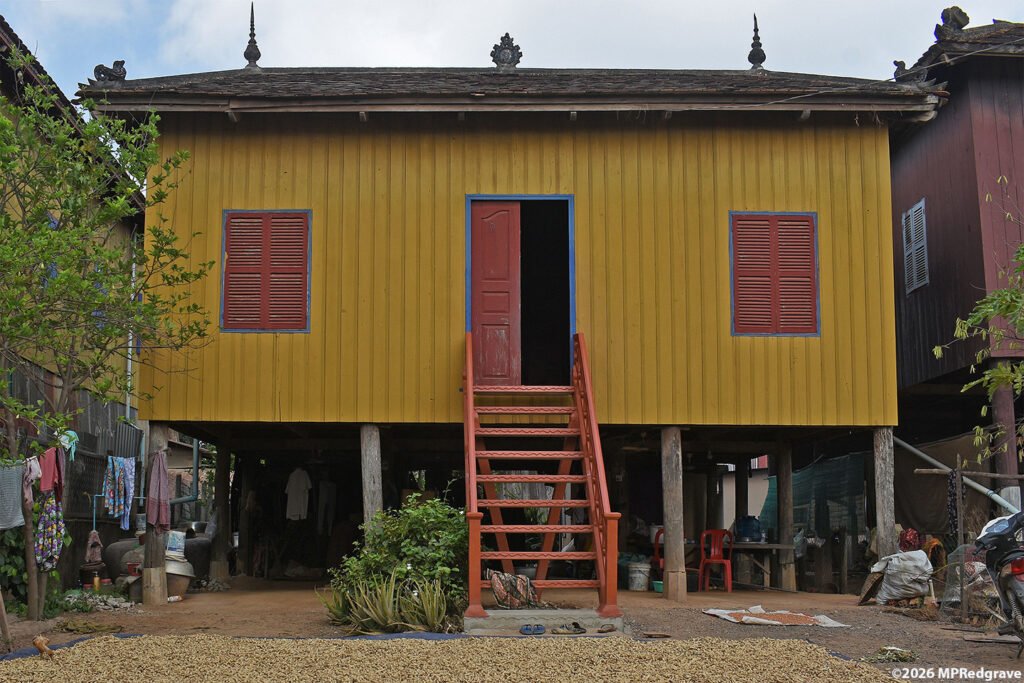
This is a traditional Khmer rural house. The main floor of the house is raised on stilts, largely to protect it from the inevitable mud and floods of the summer monsoon. The ground level, though, is used for storage and for casual living—at least when it’s dry. It’s not unusual to see a hammock or two strung under a traditional Khmer house.
The main floor is one big room, with no interior walls. Instead, the occupants may raise curtains to delineate different spaces in the house. The houses do not have windows, but instead have openings that are usually left closed with shutters. There is a central doorway in the front of the house, with a stairway that leads directly up to the doorway with no upper landing or deck. It all seems rather austere to me.
I’d like you to take note of the tan-colored grainy-looking stuff between the bottom of the stairs and the bottom edge of the photo. Those are peanuts. The owners of this house are peanut farmers and when they harvest their crop—grown in a field they own just outside of town—they spread it out onto a tarp to dry. In a few weeks, the farmers will sell the dried crop to a middle man, who will collect it and transport it to market. And while the crop is laid out in their yard, the farmers have no concern about the peanuts being disturbed or stolen. Largely because of the tradition of karma, they find it unthinkable that anyone would steal or damage their crop.

Corn is another crop that the residents of Angkor Ban grow. Like the peanuts, it is also dried in the sun. Instead of being sold to a middle man to take it to market, though, corn is more commonly either ground nearby and used for human consumption in the town or is sold to other farmers to be used as feed for cattle or other livestock.
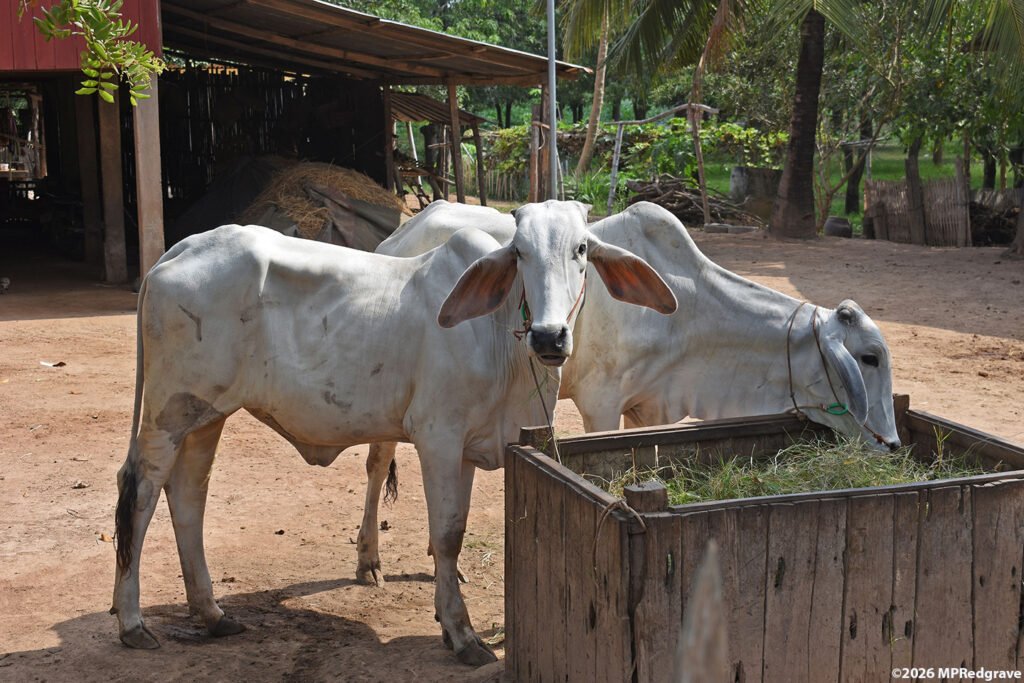
The owner of these young cows had just purchased them to pull his carts and to drag his plow and other equipment in his fields. He was aghast at the idea, raised by a member of our tour group and translated by our guide, that the cows might be used as food!
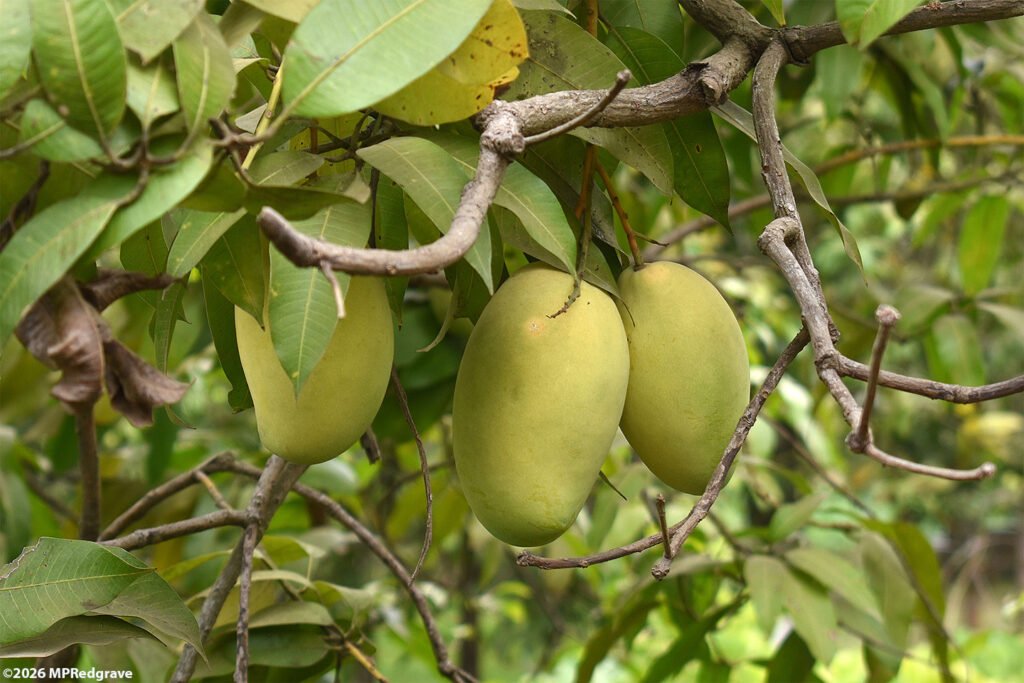
Many of the houses in Angkor Ban had at least one mango tree.

This odd-looking fruit is a jackfruit, a type of breadfruit that’s commonly grown in southeast Asia. On board the AMADara, I had the opportunity to try some jackfruit—it has a mild, but pleasant slightly sweet flavor.
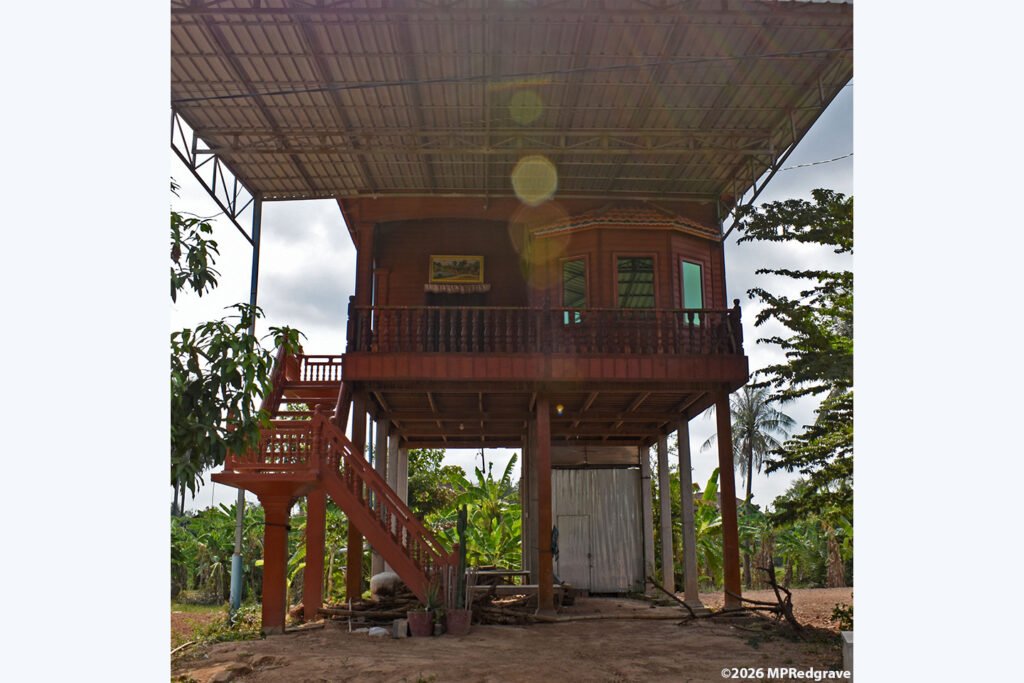
After the defeat of the Khmer Rouge, there were empty fields available almost for the asking and not enough Cambodians to farm them. As a result, Angkor Ban experienced an immigration of Chinese people to tend those fields. Though they are now integrated into Cambodian society, they did bring their own ideas about housing—and it wasn’t the traditional Khmer house. This is a Chinese house. Note the glass windows and the large deck. Inside, Chinese houses have interior walls. And, of course, all the Chinese houses in town were built post-Khmer Rouge.
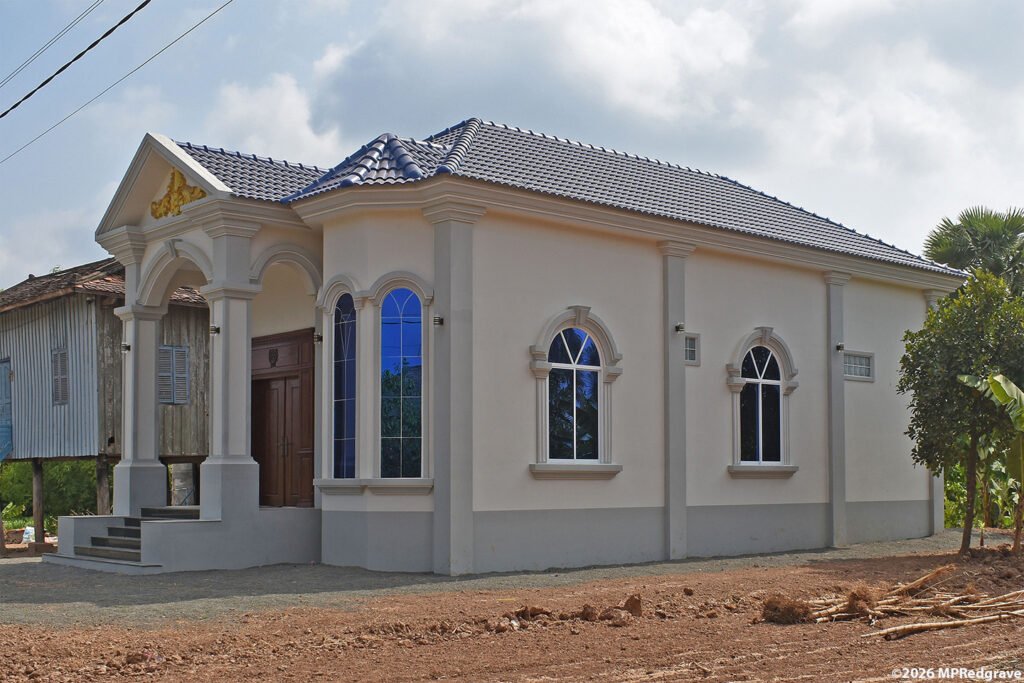
Our tour guide told the story of a group of businessmen who thought city-style houses would sell well in Angkor Ban, with their modern style and conveniences that would appeal to the town’s residents. They were wrong. They built a few of them and no one wanted them. You can buy one now, said our tour guide, for only $30,000, below the cost to build them.