Vietnam and Cambodia
Tra Su Forest and Sanctuary
My last stop before heading home was the Tra Su Forest and Sanctuary. Tra Su is 2100 acres of preserved and protected swampland in the Mekong Delta of Vietnam. The Sanctuary is crisscrossed by a web of natural channels under a forest of cajuput trees and is home to several dozen species of water birds. Tra Su offers two types of boat rides through those channels, one in a small 2-passenger sampan that slowly traverses the narrowest channels courtesy of its single paddler in the stern, while the other is in a larger 8-passenger, powered sampan goes through the wider, straighter channels of the sanctuary. The former is quiet, peaceful, and close to the water, a photographer’s dream, while the latter is more like an amusement park ride, noisy and fast, with little chance to take pictures, but still a ton of fun. Most of the photos I’m including in this post were taken from the small sampan.
I have to extend a big shout-out to Seth of Sail with Seth for doing his magic and getting the tour provider to add one more slot so I could go to Tra Su. When I signed up for this Sail with Seth southeast Asian adventure, my main goal was to visit Angkor Wat, but when I read about Tra Su in AMAWaterways’ excursion descriptions, I was sold that I wanted to see Tra Su as well. You can imagine my disappointment when I went to sign up for it and found that it was already completely booked! I mentioned this to Seth and he simply said not to worry, he would see what he could do. I worried anyway, but Seth came through! And for that, I am forever grateful!
Here are some of the photos I took in Tra Su:
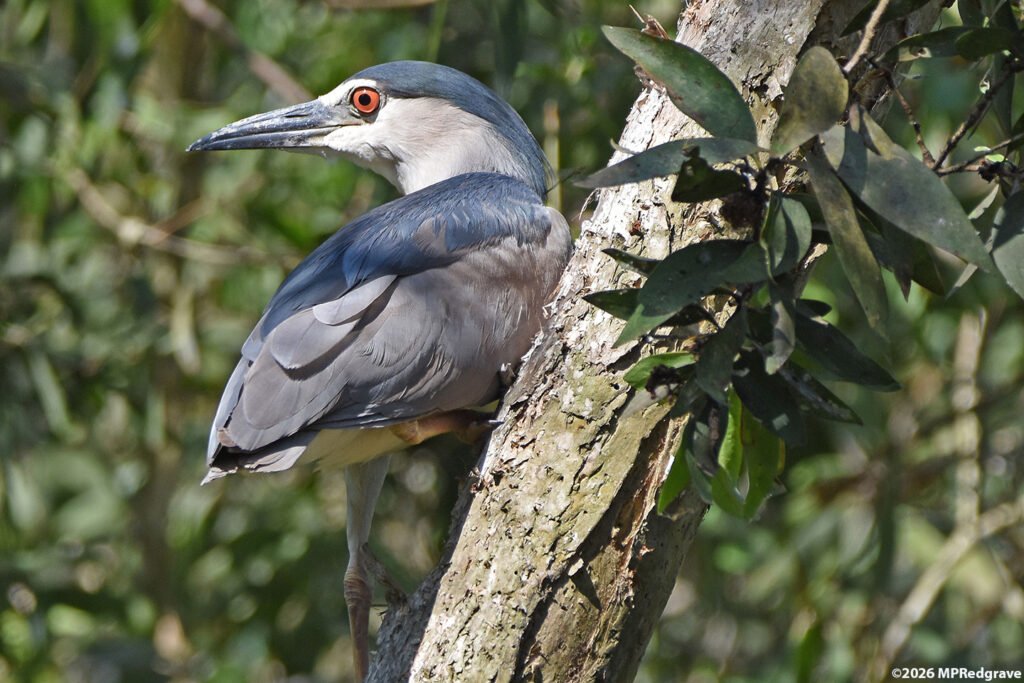
This is a Black-Crowned Night Heron, a smaller-than-typical heron that it very common at Tra Su. Yes, this example’s crown is blue, but I gather that’s a normal variant of this species.
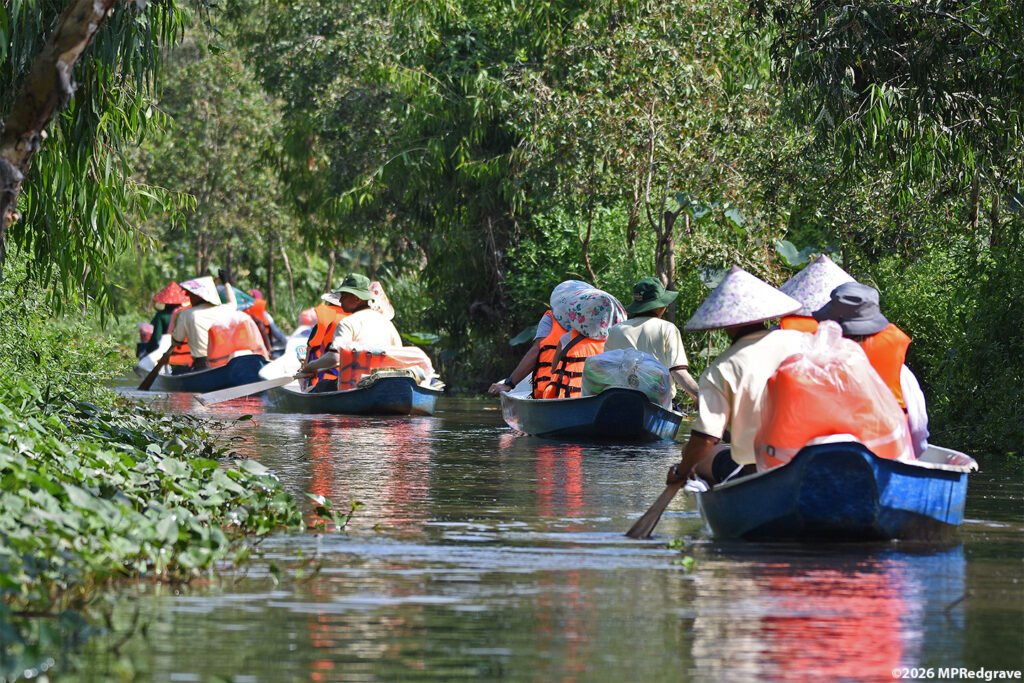
These 2-passenger paddled sampans are the best platform for seeing the animals and plants in Tra Su. Most of the small, meandering channels we visited in the small sampan were lined with water spinach, the plant you see floating on the water in this picture.
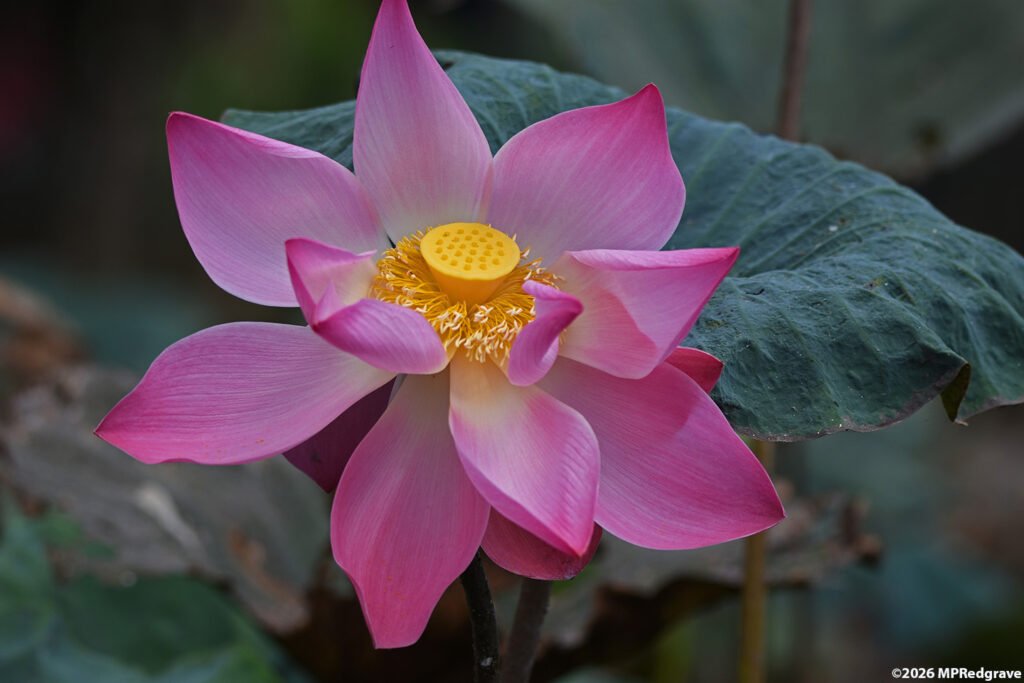
Growing through the water spinach nearer to dry land (what passes for dry land in a swamp!), one can occasionally see a lotus flower.
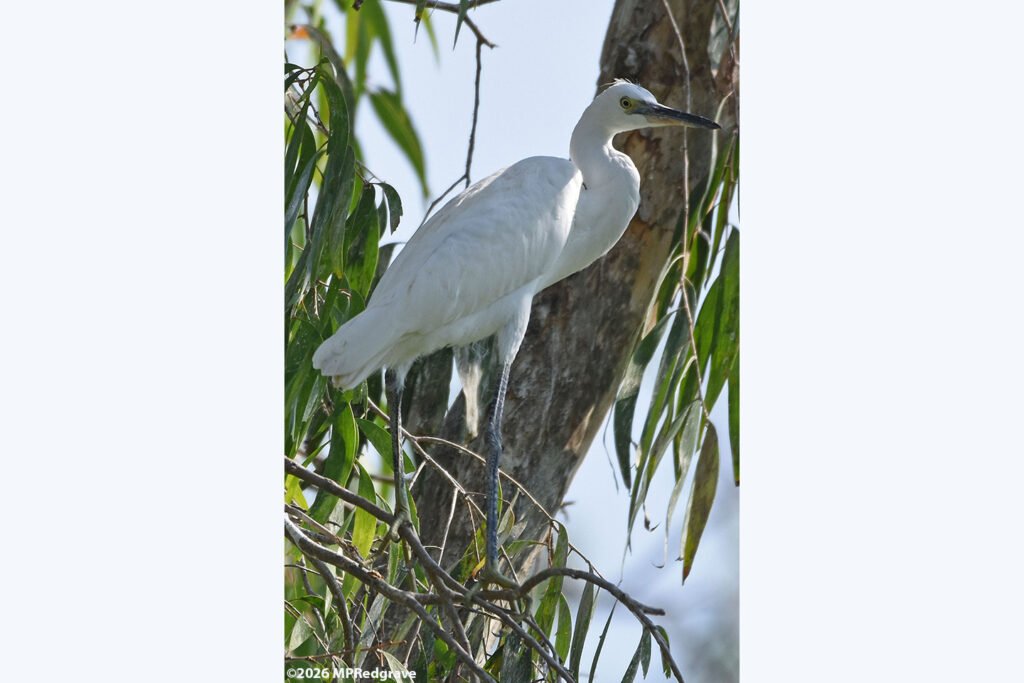
This is a Little Egret, the second most common bird I saw at Tra Su.
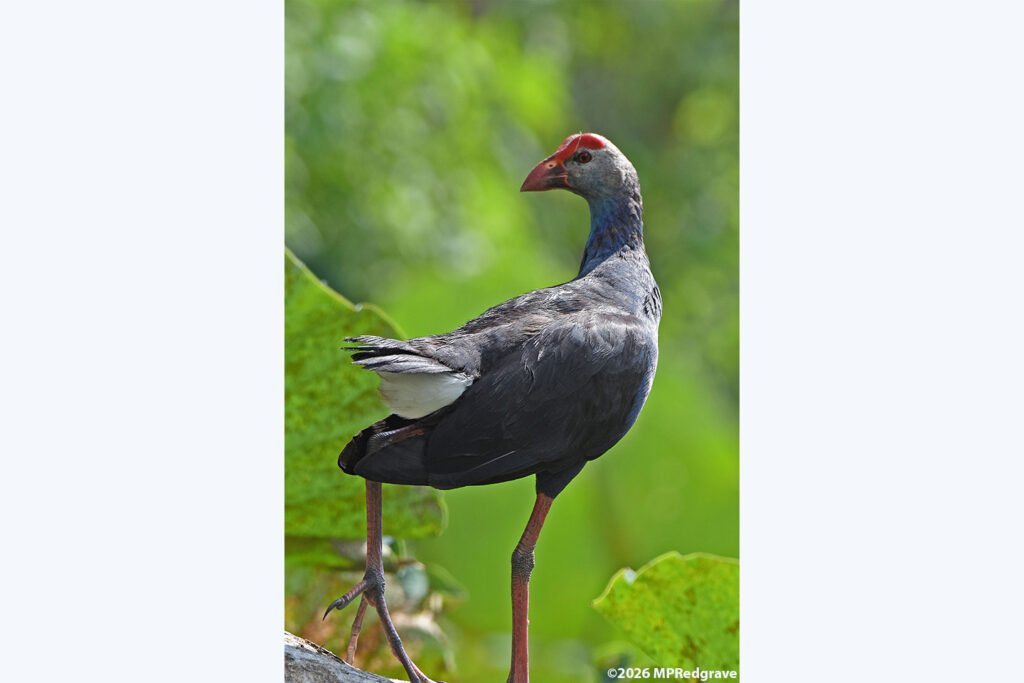
This is a Grey-Headed Swamphen. These birds are far less common at Tra Su than are the Black-Crowned Night Heron or the Little Egret. I was lucky to see this one.

All of the channels at Tra Su are lined with cajuput trees. These myrtles have adapted to having their roots submerged and they tolerate the frequent flooding that happens in the Mekong’s delta. The wider channels, like this one, have faster-flowing water (and faster moving sampan wakes) that erodes the banks back to the larger, more erosion-resistant trees that often arch over the channel to form a green tunnel. In the smaller channels, the large trees are typically several meters inland from the bank and the cajuputs near or in the water are sapling-sized.

Here’s another Black-Crowned Night Heron.

This is a close-up portrait of a Little Egret.

A lotus flower not quite fully opened.

And a lotus flower that is fully opened.

I managed to capture this image of a Black-Crowned Night Heron in flight.
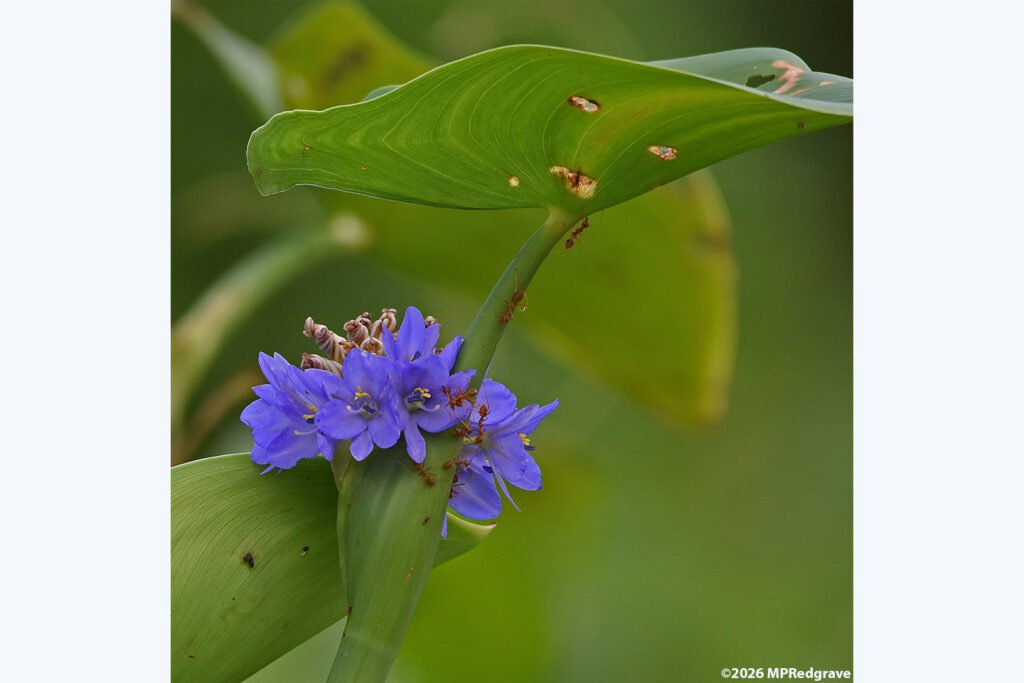
This plant is known as the Dau Mac in Vietnamese, but is also known as the Arrowleaf False Pickeralweed in the US. The Florida Department of Agriculture classifies it as a "Noxious Weed" and prohibits its importation into the state because its unchecked growth outside of its native range chokes waterways.
It is native to the Mekong delta, where its spread is kept in check by a combination of endemic fungal infections and seed-germination inhibiting compounds secreted into the water by other native species (a process called allelopathy—boy, does that bring back memories from the Chemical Ecology class I took—yikes!—50 years ago!). It also plays host to native creatures of the delta. Look closely—those little reddish-orange splotches are weaver ants. Weaver ants don’t feed on dau mac, but notice that this dau mac has a few spots on its leaf that might have been caused by something else feeding on it. My guess is that the weaver ants attacked and maybe ate whatever was feeding on the dau mac leaf.
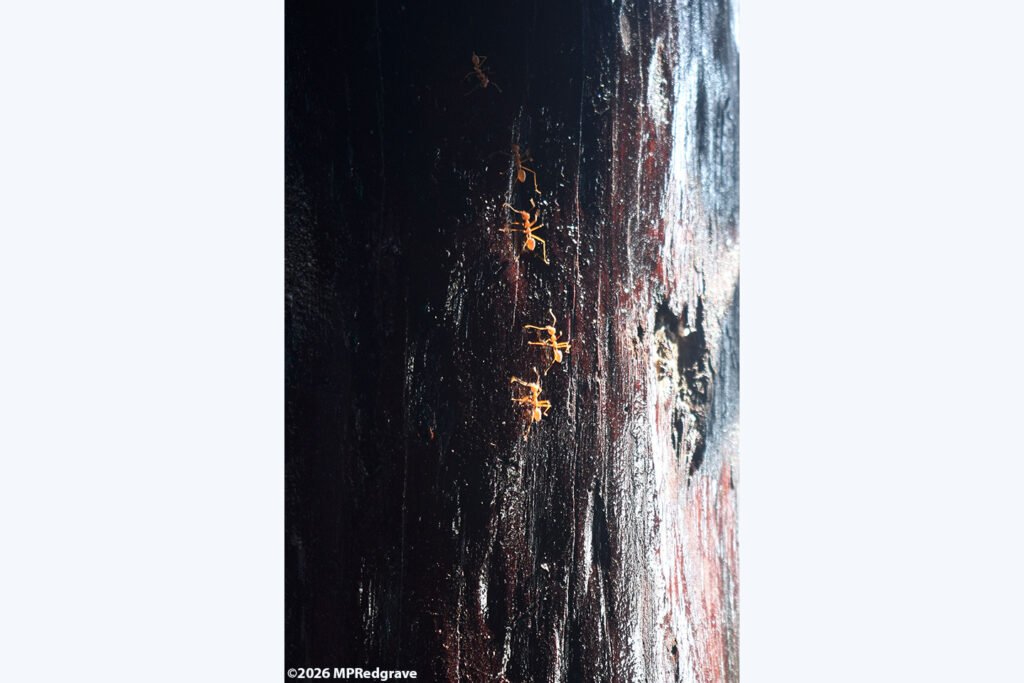
What you see here are weaver ants (kien vang in Vietnamese) climbing the trunk of a cajuput tree. These ants live in the upper reaches of the tree, where they build large nests using the tree’s leaves bound together with silk that the ants' larvae secrete. The ants actively patrol the tree and its surroundings to protect it by attacking and removing all manner of insects that would otherwise feed on the tree.
Farmers have learned to take advantage of this behavior by introducing weaver ants to crop trees, specifically citrus, mango, and cashew trees. Studies suggest that this method of pest control is as effective as the use synthetic pesticides.

Tra Su has an observation platform at 23 meters (call it 75 feet) above the ground. Of course, I had to climb to the top! From there, in this view looking north to the Cambodian highlands, I saw this odd clump of leaves (inside the white box I’ve drawn on the left) near the top of a cajuput tree. It’s a weaver ant nest. There are hundreds, if not thousands, of these nests high up in the cajuput trees. Once I knew what to look for, I saw them everywhere.