Vietnam and Cambodia
Ta Prohm (the Tomb Raider Temple)
Just to the east of Angkor Thom and The Bayon, we visited a site now known as Ta Prohm, a small group of structures that Jayavarman VII had built during his ambitious building campaign in the late 12th-early 13th centuries. Rajavihara—the Royal Monastery—as Jayavarman VII called Ta Prohm, was created to be a Buddhist monastery and school. It soon developed, under Jayavarman VII’s rule, into a thriving center for the arts and education that he dedicated to the memory of his mother, Queen Sri Jayarajacudamani. After Jayavarman VII’s death, though, Rajavihara lost support from subsequent Khmer kings and gradually fell into disuse and neglect, and was completely abandoned when the Khmer Empire collapsed in the 15th century.
The structures at Ta Prohm were built using the hasty construction techniques and small stones typical of Jayavarman VII’s buildings. The structures did not fare well during their 5 centuries of abandonment. The builders did not use mortar between the stones, so many walls and galleries fell. In some places, though, seeds of Spung trees lodged in the roof tiles and sprouted. The Spung has the unusual habit of sending its roots outwards, buttressing the tree’s base, and then downward until the roots reach soil. Those Spung trees that sprouted on a Ta Prohm roof grew their roots over the roof to its edge, then downward to the soil many feet below. Over time, those roots became quite large, often in fantastical shapes, so that now there are several tall, stout Spung trees growing on top of a Ta Prohm roof with large roots that wind over the edge of the roof before diving down into the soil.
Now that would be an interesting curiosity to see, but probably wouldn’t have made Ta Prohm famous or all that popular. In 2001, though, Ta Prohm and the Spung roots were featured in the Hollywood adventure movie “Lara Croft: Tomb Raider”. Suddenly, Ta Prohm was famous, was nicknamed the Tomb Raider Temple, and became the most popular tourist destination in the Angkor plain!
Here are some photos:
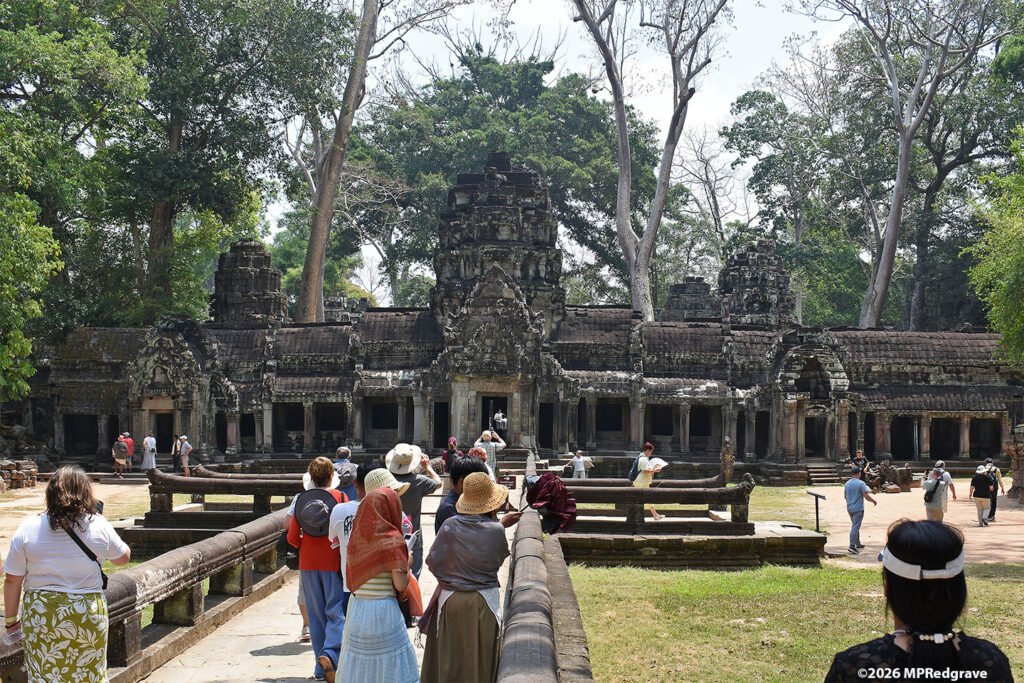
Here I and some of my Sail with Seth compatriots are approaching the west-side entry to Ta Prohm. Take note of the large, white-barked trees that seem to be growing right out of Ta Prohm—they kind of are!

As at The Bayon, Ta Prohm also has several 4-faced towers representing the Bodhisattva Avalokitesvara, a compassionate spiritual being who delayed his own attainment of Nirvana to help others reach that realm. On each tower (this one is from the entry gate just behind where I took the last photo), the 4 faces, each facing exactly north, east, south, or west, represent the Bodhisattva’s omniscience, divine authority, infinite mercy, and spiritual oversight. Also as at The Bayon, the likeness of the Bodhisattva is Jayavarman VII himself. An addition to the towers at Ta Prohm is the row of smaller figures below the faces of the Bodhisattva. It’s thought that these represent asperas, celestial nymphs who dance for the pleasure of the gods, Jayavarman VII’s nod to his intention to make Rajavihara (Jayavarman’s original name for Ta Prohm) a center for the performing arts as well as a home and school for his Buddhist monks.
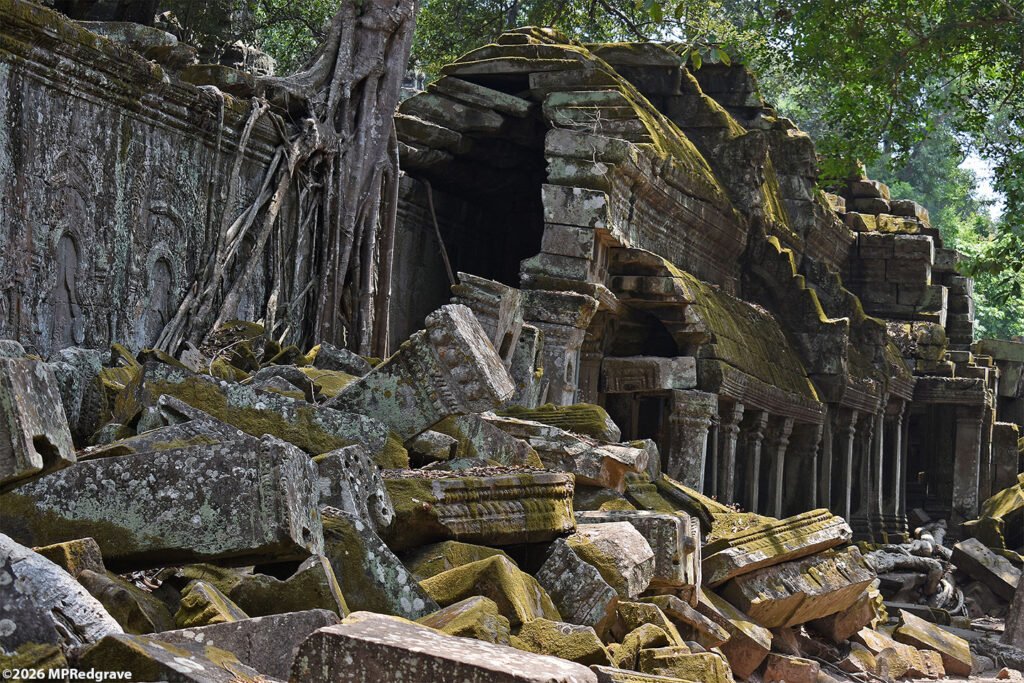
In the late 12th and early 13th centuries, Jayavarman VII conducted a grand building program with multiple structures being built simultaneously. He wanted a lot of structures built quickly, so the builders cut corners to make that happen. Ta Prohm is a result of that quick and relatively slipshod construction. For example, the builders used small stones and fit them together without any mortar—definitely not a recipe for durability. As a result, much of Ta Prohm has fallen down, leaving piles of carved stones where a wall or a gallery once stood.
Notice the tree perched on top of the wall that was once the interior wall of a gallery. It’s a fairly young Spung tree whose roots now extend down the sides of the wall and into the ground below. Those roots have stabilized the wall, basically embracing the wall and anchoring it to the earth below. When the tree first sprouted near the top of the gallery’s wall, though, its roots likely invaded the unmortared spaces between the stones of the gallery, loosening those stones and hastening the gallery’s collapse.
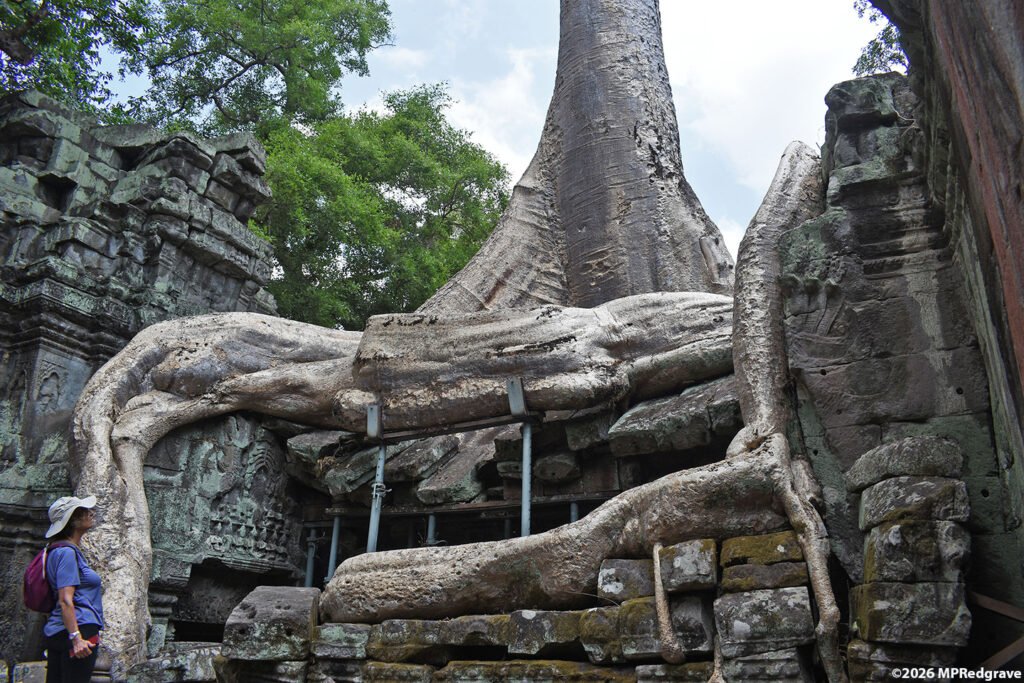
This old and very large Spung tree has sent two immense roots (that we can see here—there are likely more roots that we can’t see) out from its base on the top of the building, along the tops of walls (one now gone and replaced by after-the-fact support jacks!), and down into the soil. This tree is impressive because of its size and the circuitous path taken by its roots, but it is also famous. This exact spot was featured in the 2001 adventure movie, “Lara Croft: Tomb Raider” and transformed Ta Prohm from a curiosity to a must-see for visitors to the Angkor area.

The fine folks at APSARA (Authority for the Protection and Management of Angkor and the Region of Siem Reap), who manage Ta Prohm, recognize that lots of people will want to have their pictures taken in front of the Tomb Raider Tree. They have built a platform next to the tree so that one can not only see it up close, but also be photographed in front of it, all the while causing no further disintegration of Ta Prohm and the Tree that crowds of people could cause.
The gentleman in this shot having his picture taken is none other than Seth Wayne, owner and driving force behind Sail with Seth.
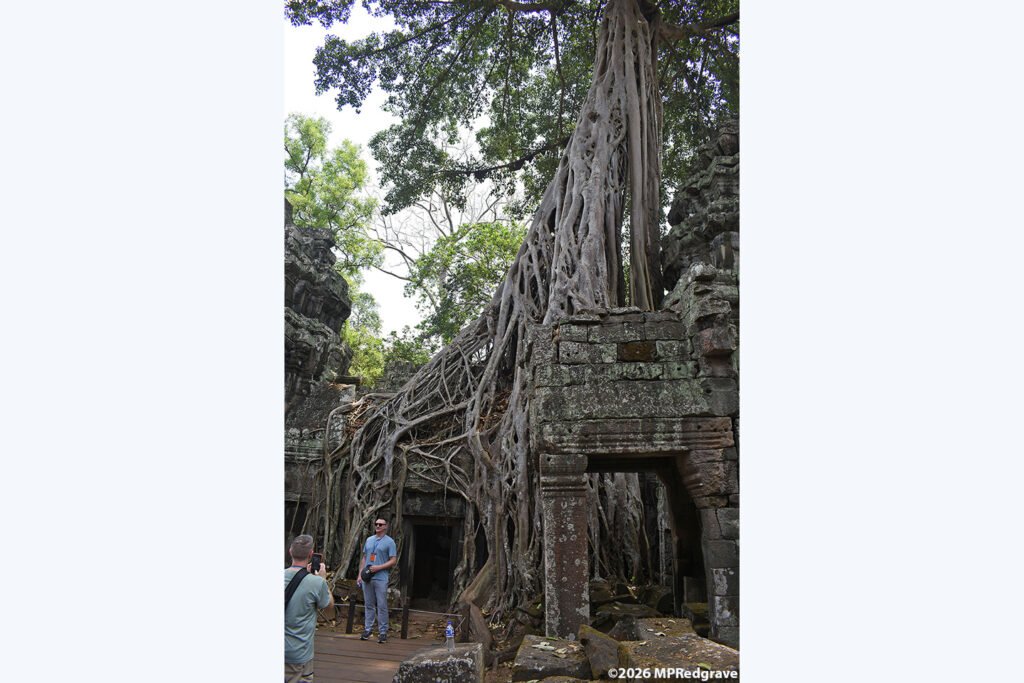
The tree in this photo is not a Spung tree, but is a type of strangler fig, the Chinese Banyan. I suspect that a Spung tree may have stood on this spot at one time, but it is no longer there. Why would I say that? It all has to do with the life cycle of a strangler fig.
Strangler figs start as a seed dropped by an animal that has eaten a fig. That seed typically sprouts in an upper crotch of a tall tree (like a Spung). At first, the new strangler fig plant is entirely benign, doing no damage to the host tree at all. Soon, the strangler fig plant sends out thin, but tough, roots that stick to the host tree and eventually reach the ground. Once that happens, the new fig plant can extract moisture and nutrients from the soil and its growth accelerates. In time, the fig has sent down so many roots that it forms a mesh of roots all around the host tree. Those roots interweave and become woody, forming a very broad and stable base for the fig plant. At this point, the fig sends shoots up the host tree, eventually completely covering the canopy of the host tree with its own leaves. As a result, the host tree can no longer effectively photosynthesize and it becomes progressively weaker and dies. The host tree then rots and disintegrates into the soil, giving up its nutrients to the strangler fig.
And that’s what has happened here. The Spung tree is gone and all that’s left is the broad, stable, mesh of roots of the Chinese Banyan.
I wonder if Brandon, an officer with Sail with Seth, who’s getting his picture taken in front of the Banyan, knows that he’s standing next to an aggressive predatory species?

Of all the Spung trees I saw at Ta Prohm, I found this one the most impressive! What a magnificent array of otherworldly looking roots. They’re just a little bit creepy, and I like that!

This Spung tree is smaller and, I think, much younger than most of the others at Ta Prohm. Its roots are thinner and it does not stand as tall as older individuals. It makes me think that new Spung trees are still happening at Ta Prohm. Should I ever go back, I would look for much younger examples. It would be a shame if ASPARA were culling new sprouts.

Enough tree talk, now for something completely different. This is the famous Dinosaur of Ta Prohm. It is part of a larger bas relief carving in one of the walls at Ta Prohm. Because of its passing resemblance to a Stegosaurus, there are those who claim that it is evidence that man co-existed with the dinosaurs. Others think that claim is misinformed, saying that the shapes next to the animal’s back are actually lotus petals, as seen in other animal depictions on the same wall. Besides, they say, if you look at the animal without the plates, it doesn’t remotely resemble a Stegosaurus. But then, it doesn’t resemble any known animal. Yet others suggest it is just the carver’s flight of fancy, an animal the artist made up. Still others have suggested it is a modern hoax, placed there before its “discovery” in 1997, for reasons unknown.
I leave it up to you to decide what you think of the Dinosaur of Ta Prohm.