Vietnam and Cambodia
Khmer Rouge Genocide
WARNING: This post includes photos from my visit to a Khmer Rouge security prison and a killing field. Some of the photos and discussions are graphic and you may find them disturbing. Please use your discretion in choosing whether or not to view this post.
––––––––––––––––––––––––––––
The Khmer Rouge, led by Pol Pot, seized control of Cambodia in April 1975 after winning a civil war against the Cambodian government (the Khmer Republic, led by Lon Nol, who had seized power 5 years before in a coup that ousted King Sihanouk). The Khmer Rouge quickly implemented their extreme version of agrarian socialism under totalitarian and repressive leadership. Their policy was to de-urbanize Cambodian society and forcibly move everyone to state-run collective farms. Cities and towns were emptied out.
It was very dangerous to resist—the Khmer Rouge government was intolerant. Society’s elite were assumed to be “counter-revolutionary,” as were those with an education. Teachers, engineers, doctors, and other professionals were marked for “re-education.” The Khmer Rouge quickly came to see foreign agents in anyone who questioned them. They also became profoundly xenophobic. Persons of anything other than Khmer ethnicity were suspected of having foreign loyalties and therefore were counter-revolutionary.
The people who were designated counter-revolutionary were sent to one of 150-200 security prisons, nominally for interrogation and re-education. In truth, these were torture and execution centers—very few people emerged from a security prison or its associated killing field. By the time the Vietnamese drove the Khmer Rouge out of power in 1979, about 25% of Cambodia’s population of 8 million people had died at the hands of the Khmer Rouge. Many died from starvation and disease at the collective farms, but most of the nation’s educated Khmer and ethnic minorities died in the security prisons and killing fields.
We visited the Tuol Sleng Genocide Museum, known by the Khmer Rouge as S-21 (i.e., Security Prison #21) and the Choeung Ek Genocidal Center in Phnom Penh.
Again, some of the photos and discussions that follow are graphic and disturbing. I present them here in the spirit that this story must be told in the hope that such horrific human behavior is never repeated. If you wish to skip this page, you can follow this link, Oudong and the Vipassana Dhura Buddhist Centre, to go to the next page in my travel story.
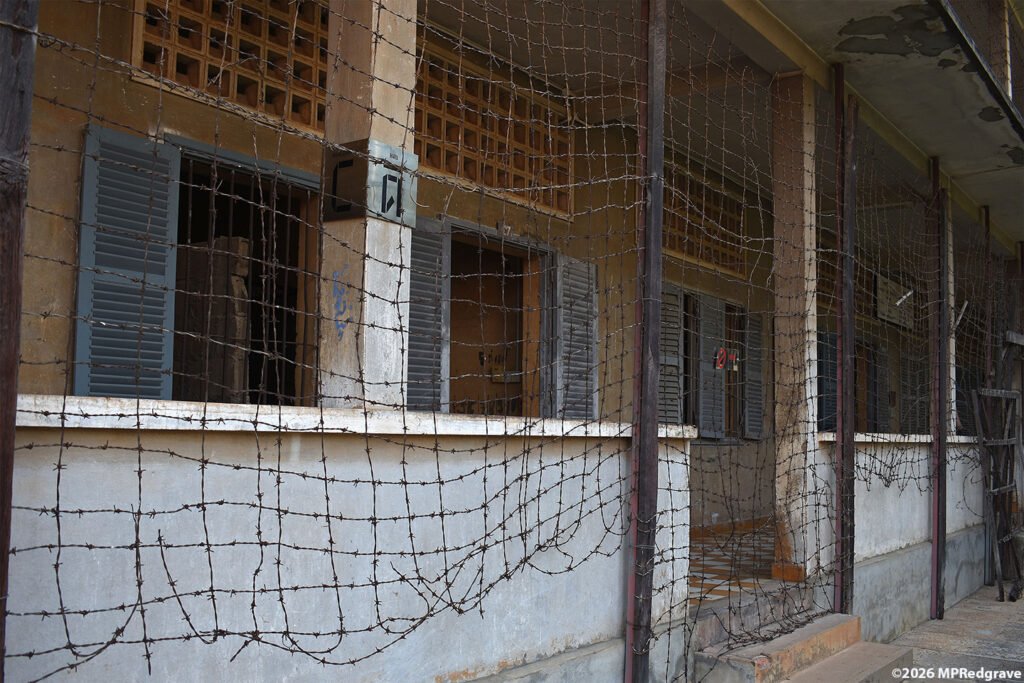
Tuol Sleng was a high school that the Khmer Rouge converted into a prison. The barbed wire was hung on the building not to keep the prisoners in, but rather to prevent them from jumping to their deaths.

A cell at S21. It measures maybe 3 feet by 4 feet and had no facilities at all.

This renders me speechless. I have nothing to add...

This is a modern sculpture in the courtyard of S21 done by Khmer-French sculptor Ing Séra. It is entitled “To Those Who Are No Longer Here.”
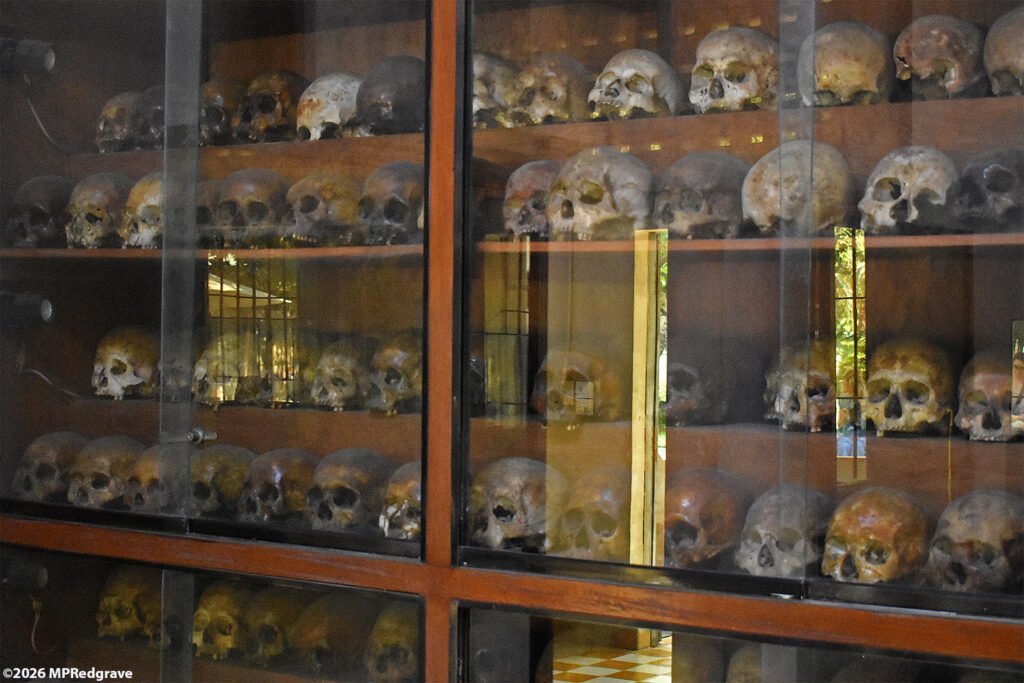
This is an extraordinarily macabre cabinet, left as found at S21. The brutality sickens me.

This is a memorial statue near the entry of Choeunk Ek Genocidal Center, the killing field associated with S21.

These bones were left exposed as found after excavation at Choeunk Ek.
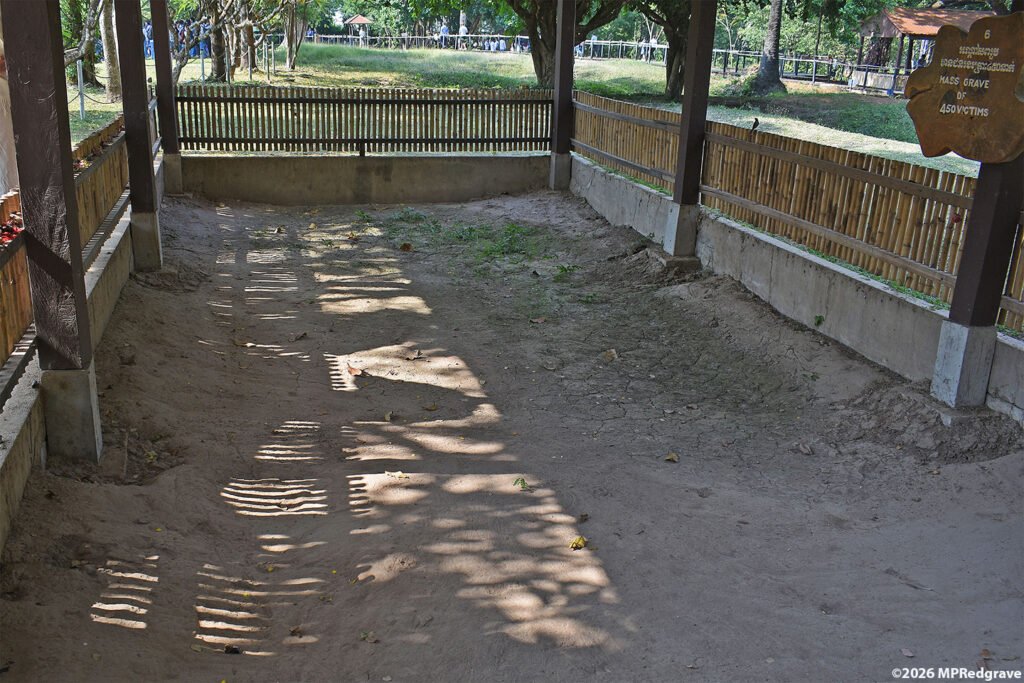
This mass grave, one of several dozen at Choeunk Ek, held the remains of over 450 victims. The Khmer Rouge would have the victim kneel and then lean over the edge of the hole, and would then strike them over the head with a heavy object. Just brutal.