Antarctica, Argentina, Uruguay, and Brazil
Antarctica, Pléneau Island
We spent the afternoon of our second full day in Antarctica exploring icebergs near Pléneau Island at the south end of the Lemaire Channel. I had never really paid much attention to icebergs, other than to consider them hazards to navigation that can sink ships, but this day opened my eyes and piqued my interest about them.
There are basically two kinds of icebergs—tabular icebergs and, well, everything else. Let's call the latter glacial icebergs. Tabular icebergs are chunks of ice that break off of an ice shelf. An ice shelf forms over water when the water and the air are so cold that the surface of the water freezes and snow that falls onto the ice congeals into sheets of ice. More and more snow falls on the ice sheets, thickening the sheet over the years and compressing the ice below it. When a piece of an ice shelf breaks off, it becomes a tabular iceberg, so named because its top (initially anyway) is flat, like a table.
These tabular icebergs drift north with the currents and sometimes these currents bring them into the channels and bays between the islands we were exploring. By the time they get to the Antarctic Peninsula, though, they bear little resemblance to their former selves, having eroded into fantastical shapes.
Glacial icebergs are chunks of ice that fall off the face of glaciers in the process of calving. Most commonly the ice shatters into small chunks as the calved ice hits the water. From that point, glacial icebergs age in exactly the same ways as do tabular icebergs, the only difference being that they are (usually) much smaller.
How the icebergs change as they age is a story unto itself. All icebergs float, which is simply the result that ice is only 89% as dense as is water. What that also means is that 89% of an iceberg is below the water—what we see above water is only about 11% of the whole iceberg. But icebergs melt, fracture, absorb sunlight, get hit by waves, and are affected in dozens of other ways that cause the iceberg to constantly change.
Icebergs, like anything else that floats, have a center of mass and a center of buoyancy. When it's floating stably, that center of mass is directly below the center of buoyancy. In an iceberg, both are constantly changing as the iceberg melts and fractures. No matter what melting or fracturing happens, the iceberg will always shift so that the center of mass is directly below the center of buoyancy. That's often a gradual process, but it can be rapid and dramatic. Say, for example, a large chunk of the ice calves off the side of the iceberg. The weight of the calved ice no longer needs to be supported by the buoyancy of the underwater ice, so the iceberg rebounds upward. At the same time, the end of the iceberg where the calved ice used to be is now lighter, so the iceberg rolls toward the now heavier end of the iceberg. If the new center of mass ends up below the new center of buoyancy, then the iceberg will stabilize. Think, though, about what will happen if the center of mass now ends up above the center of buoyancy. That situation is inherently unstable and the whole iceberg will roll over. What was the top of the iceberg goes underwater and what was underwater is now above water.
This is just (excuse the pun!) the tip of the iceberg about what can shape icebergs. For example, in polar regions the air is typically colder than the water, so most of the erosion takes place under the surface. The iceberg's centers can shift and the iceberg can roll or flip without any significant changes in what was originally above the water. There are any of a skajillion erosions that can and do happen to icebergs.
The take-home message is that the whole process of iceberg aging is very complex, but it is utterly fascinating to think about how an iceberg ended up looking how it looks now. And do look now, because it won't continue to look that way for long!
Here are some photos:

One of my Zodiac mates dubbed this iceberg "The Colisseum" because the vertical striations on the left reminded her of the famous structure in Rome. I can certainly see it. This is a highly eroded tabular iceberg. The part that was above water was nearly circular, but you can see that much of the wall near us and to the right had calved away, leaving just a short segment still standing. When the sections that fell were no longer supported by the iceberg, that side of the iceberg became lighter and the entire iceberg rose and tilted to the left. The horizontal stripes on the remaining horizontal segment suggest its very top had been at the waterline not long ago, and that the iceberg had been tilted compared to the way it was at the time of the picture. When the wall collapsed, the remaining segment was thrust upwards out of the water and the entire glacier tilted to the left. The distance between the lower two lines in that wall segment suggest that the collapse was sudden.
The vertical striations were probably caused by ice melt running down the side of the iceberg. That they were vertical at the time of the photo suggests they were very recent and perhaps caused by sunlight melting the iceberg above them. It would have been interesting to revisit the iceberg later to see how it had changed.

This section of glacier has recently calved. Notice the ice rubble at the foot of the bluish section. The calving probably released tons of fresh ice into the water, creating hundreds (or thousands) of small icebergs. These glacial icebergs, while smaller than their tabular cousins, age in exactly the same process as do the tabular icebergs.
So, you may ask, why is the freshly exposed ice blue? The answer has to do with the crystalline structure of the ice and how it absorbs light. When snow falls on a glacier, its weight presses down on the ice below. As time goes by, and more and more snow accumulates, the weight of the snow presses the gas out of the ice and forces the ice to rearrange itself into a more organized and compact crystalline structure. This structure is excellent at absorbing long wavelengths of light (i.e., the reds, yellow, and so on), but absorbs the short wavelengths (i.e., the blues) poorly. As a result, the blues get reflected and the reds, etc., do not. So it is predominately blue light that reaches our eyes, and we perceive the newly exposed ice as blue.
You may notice that some areas of the ice face are bluer than others. The compact crystalline ice structure isn’t uniform throughout the ice, but is mixed with the more gas-rich structure. The bluer the area, the denser the concentrations of the crystalline structure, the less blue, the less dense.
Finally, why does a newly exposed face turn white within a few hours? Within moments of an ice face being exposed, cracks start to form in the face as a result of the pressure on it being released. These cracks allow gas to seep into the ice and form small bubbles, which in turn break down the compact crystalline structure and thereby stop the absorption of the long wavelength light. When that happens, we perceive the ice as white. Cool, don’t you think?

This tabular iceberg had an almost faceted surface to it and an arch in the middle. I don't know how or why, but I suspect the end near to us was under water and then something happened to roll the iceberg on its side. But that's just a guess. What do you think?

This tabular iceberg's history was complicated, to say the least! The angle of the waterline on the part to the right of the arch and the waterline on the leftmost part, combined with the ragged faces at the left and center of the iceberg where it appears calving happened, suggest to me that the whole iceberg has risen recently on the left and sunk slightly on the far right. But how the arch formed, I have no idea.
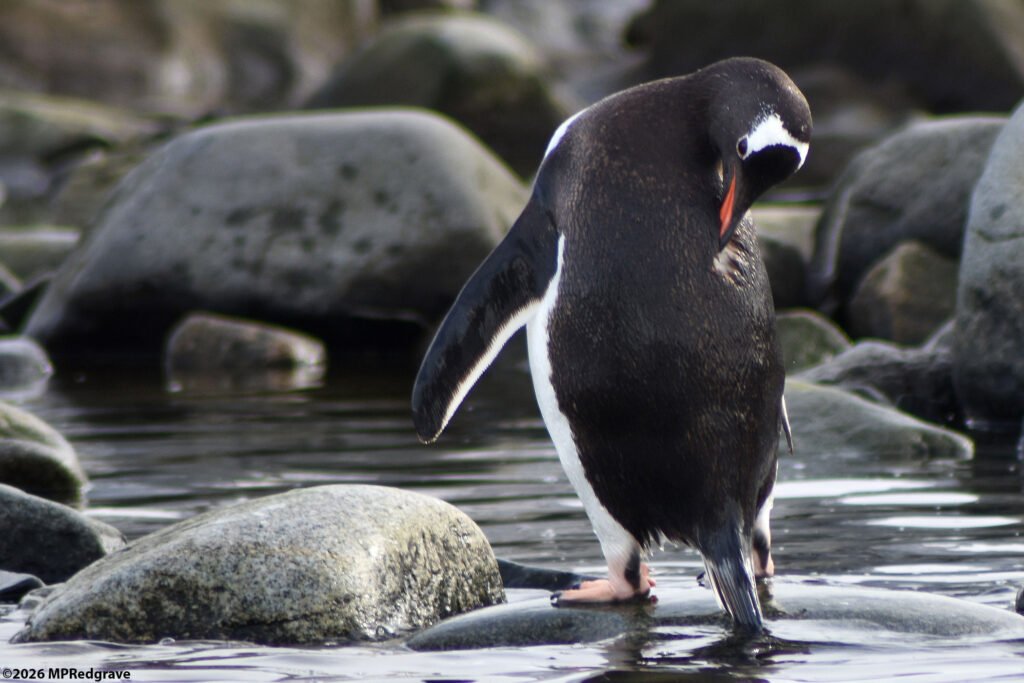
All this iceberg discussion is pretty heavy, so I thought I'd include this photo I took from the Zodiac of yet another Gentoo penguin displaying the Gentoo's phenomenally agile neck. I'm envious.