Vietnam and Cambodia
Phnom Penh Tuk Tuk Tour
Before leaving Phnom Penh, I joined my Sail with Seth colleagues for an early evening tuk tuk tour of the city.
Tuk tuks in Cambodia are not the purpose-built tuk tuks one may see in most of the world. Those tuk tuks are larger and faster with enclosed driver and passenger spaces, and sometimes even doors. Cambodian tuk tuks, on the other hand, are essentially carts attached to the back of a small motorcycle. The carts have sort-of comfortable forward- and rearward-facing seats, with just enough space for 4 persons, and an overhead canopy for protection from the mighty Cambodian sunshine. They are an absolute blast to ride in! Happily, I never felt particularly worried about my safety in the tuk tuk—the traffic in Phnom Penh seemed much better behaved and less chaotic than what we saw in Hanoi!
Here are some photos:
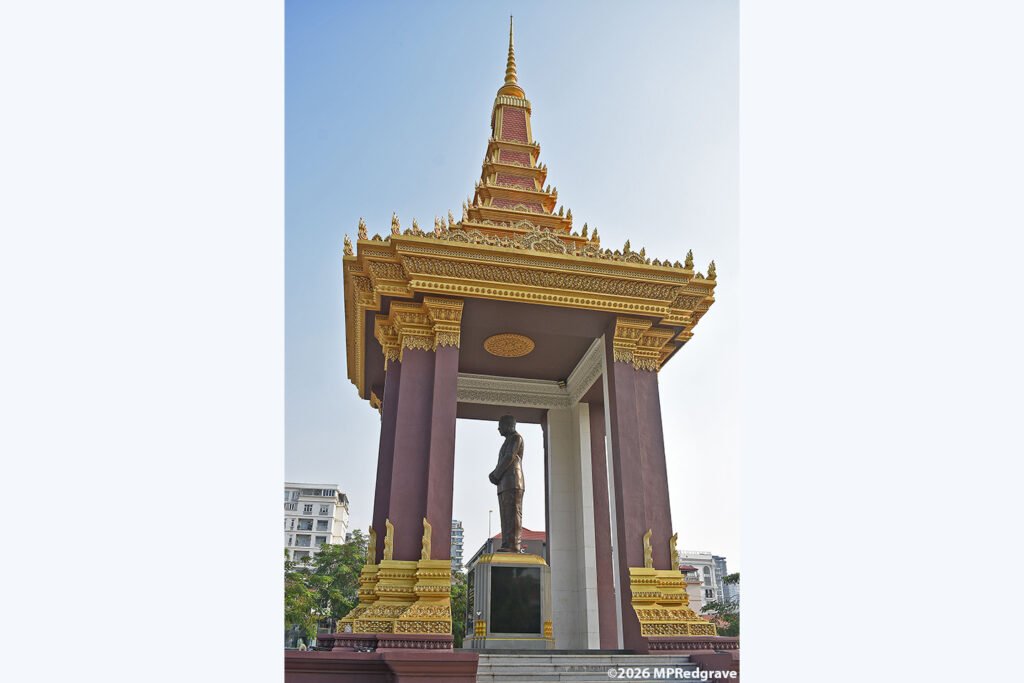
Our first stop was a visit to Phnom Penh’s Neah Banh Teuk Park and the Statue of His Majesty Preah Bat Samdech Preah Norodom Sihanouk. This stupa commemorates King Norodom Sihanouk, the much revered twice King of Cambodia who was instrumental in the creation of the present Kingdom of Cambodia. I think it’s fair to say that Sihanouk was modern Cambodia’s most significant leader. I’ll go into detail below, if you’re interested, otherwise you can scroll down to the next photo.
Sihanouk was first elevated to the throne in 1941 upon the death of his grandfather. This happened when Cambodia was under French colonial rule, so his authority was limited. Japan had occupied Cambodia, but because French Indochina was under the administration of Vichy France, a client state of Germany, which was allied with Japan, Sihanouk used his influence on his French overlords to protect his people from suffering the atrocities the Japanese had inflicted on the people of other lands they had conquered.
In 1945, Japan overthrew the French colonial rule, whereupon Sihanouk declared the independent Kingdom of Kampuchea (the Khmer name for Cambodia) and allied the country with Japan. That turned out to be a mistake when Japan was defeated and the allies restored French Indochina and its rule over Cambodia. Again, Cambodia became subjected to French colonial rule, but Sihanouk managed to retain the throne. He continued to work toward independence, but insisted it be done peacefully. He finally achieved his goal in 1953, when he secured independence from France and formed the State of Cambodia.
In 1955, Sihanouk abdicated the throne (in favor of his father) so that he could participate in politics. Later that year, his party won a general election and Sihanouk became the prime minister of Cambodia. As prime minister, and later Chief-of-State, he kept Cambodia strictly neutral. That lasted until 1970, when a revolt led by then prime minister Lon Nol ousted Sihanouk. Lon Nol renamed the country the Khmer Republic, forced the royal family to leave Cambodia, and abandoned Sihanouk’s policy of neutrality, aligning Cambodia with anti-communist South Vietnam and the United States.
Sihanouk fled to China and formed a government-in-exile. He aligned this government with the only credible anti-Lon Nol force in Cambodia, the Khmer Rouge. When the Khmer Rouge seized power in 1975, Sihanouk returned to Cambodia, initially as head of state. By 1976, though, he had become so disillusioned with the Khmer Rouge that he disavowed any connection to them. The Khmer Rouge arrested him and placed him under house arrest until they were deposed by the Vietnamese in 1979.
During his house arrest, Sihanouk’s disillusionment had spread to include communism in general, not just the Khmer Rouge version of it. The communist Vietnamese who had ousted the Khmer Rouge formed a puppet communist government in Cambodia, the People's Republic of Kampuchea. Sihanouk opposed that government, and was again forced to flee the country. In exile, he formed, in cooperation with other Cambodian anti-communist and anti-Vietnamese political groups, the Coalition Government of Democratic Kampuchea. He deftly used his former position as the Khmer Rouge head of state—the UN and most governments had recognized the Khmer Rouge as the legitimate government of Cambodia—to gain international recognition for his coalition as the legitimate government of Cambodia.
After a decade of pressure from international sanctions and negotiations led by Sihanouk, in 1990 the Vietnamese-backed People’s Republic of Kampuchea agreed to cede power to the Supreme National Council of Cambodia, with Sihanouk as its president. The Council’s primary purpose was to form an enduring government for Cambodia. Under UN oversight, in 1993 a general election was held that created a constitutional monarchy. The new government declared the country the Kingdom of Cambodia and reinstated Sihanouk as king.
Sihanouk remained on the throne until 2004, when he abdicated once again, just days short of his 82nd birthday. He abdicated this second time, not to fight new political battles, but rather to have a quiet retirement. Sihanouk died two weeks before his 90th birthday in 2012, after a lifetime of service to the Cambodian people.
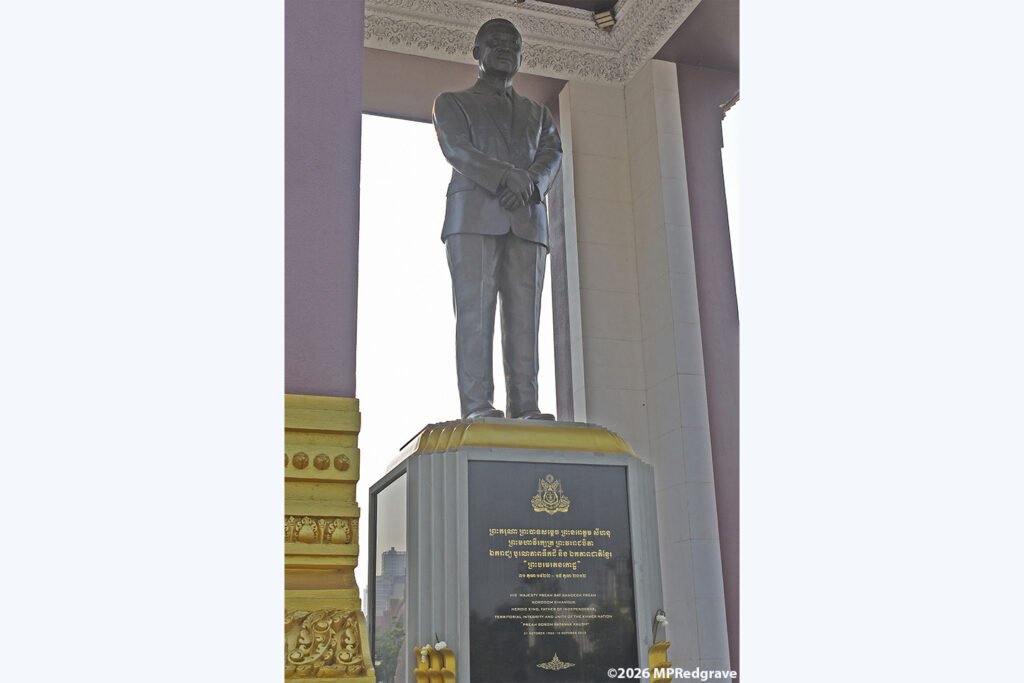
King Norodom Sihanouk’s statue at Neah Banh Teuk Park.
The writing on his pedestal says:
His Majesty King Norodom Sihanouk, the Great Hero, the Father of the Kingdom
Independence, Territorial Integrity and National Unity of Cambodia
"The Jewel of the Temple"
October 31, 1922 - October 15, 2012

This is the Wat Phnom Temple. It sits on the top of what is reputed to be an artificial hill—a “Phnom” in Khmer. Legend has it that on this site in 1372, a wealthy lady named Penh had the hill created and a Buddhist/Hindu temple built at its peak. The act of building the temple founded the city of Phnom Penh (literally Penh’s Hill).
By the way, the name of the temple, Wat Phnom, just means the Temple (Wat) on the Hill (Phnom).
The site has become symbolic of the city. It attracts thousands of visitors, most of whom, it seemed, were visiting the evening we were there. I waited for a lull in the crowd to get this photo of the entry stairs to the temple.
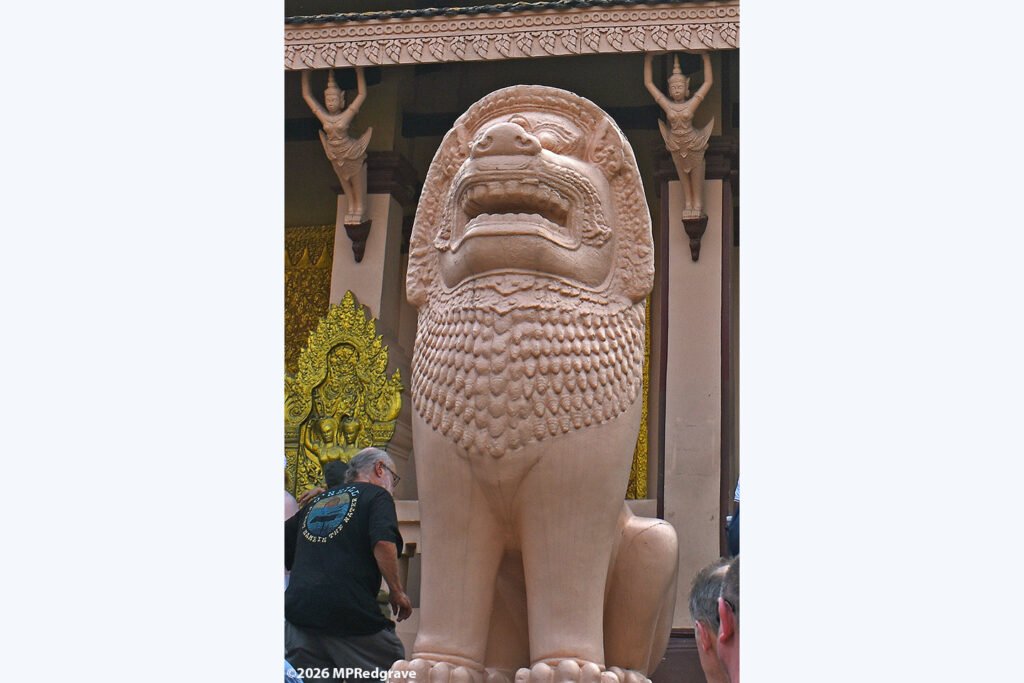
This is a singha guarding Wat Phnom. In these posts, I’ve shown you lots of nagas, but many of the temples are also guarded by singhas. These are mythical lion-like creatures whose job is to look so fearsome that they scare demons and evil spirits away from the temple.
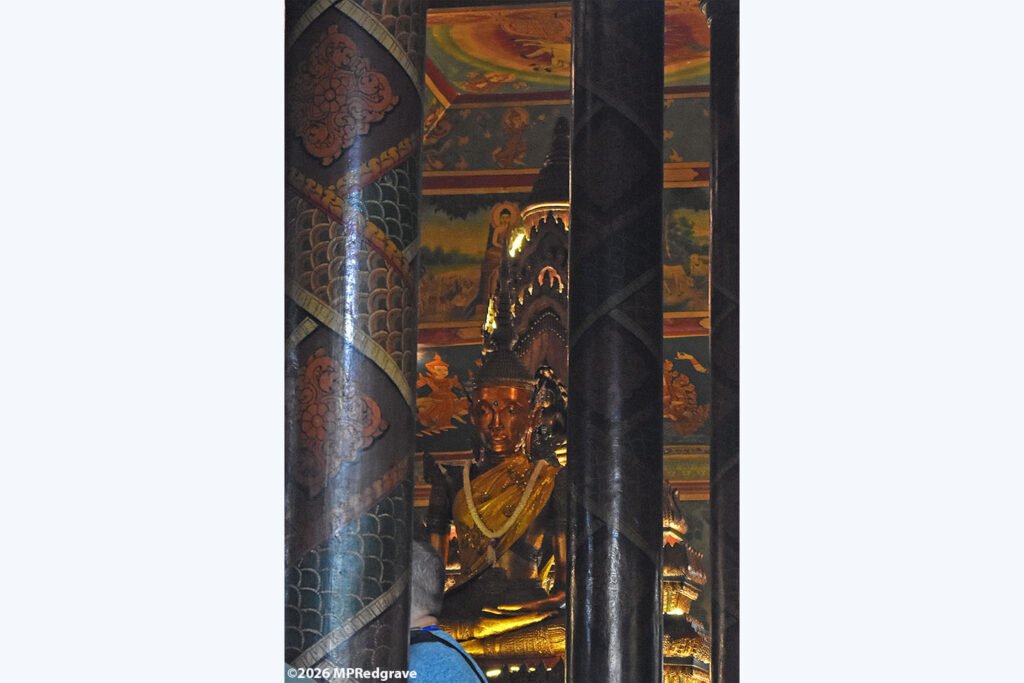
Like so many places of religious or historical significance in Cambodia, we were told that photography was not allowed inside Wat Phnom. Nobody said photographing the inside from the outside wasn’t allowed. Wat Phnom is a small temple, and from the entry I saw this view, luckily without a sea of heads in the way. I took my chance!
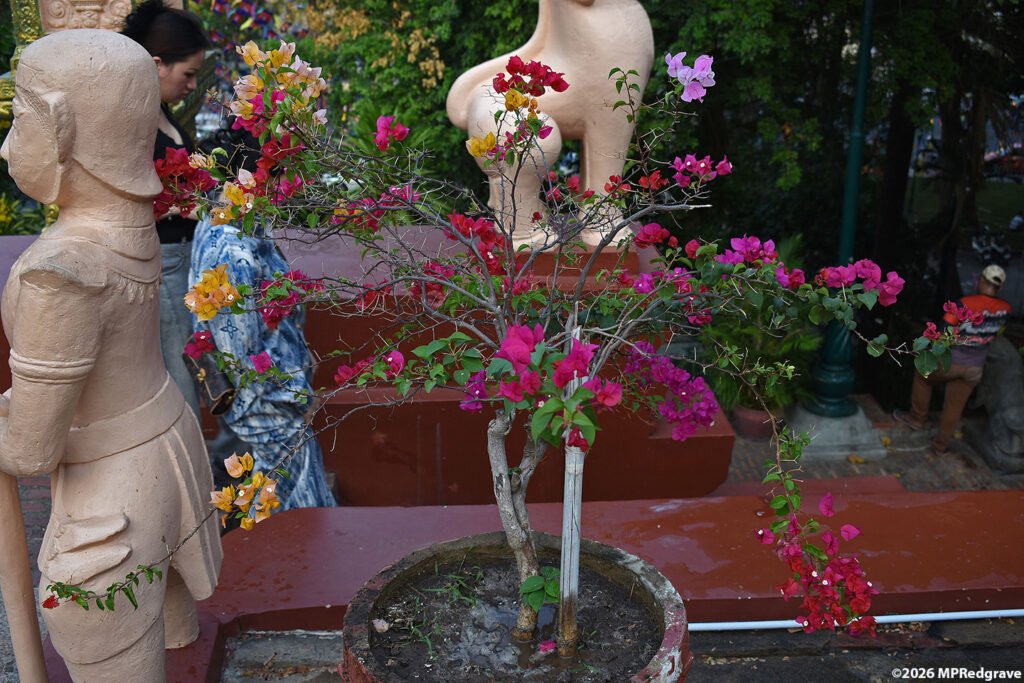
This picture is for Mary. She loves bougainvilleas. At Wat Phnom, I saw this example that had multiple colors, all from one bougainvillea plant. I see fuschia, pink, red, and orange. It was a single rootstock—I have no idea how the monks (who maintain Wat Phnom) accomplished so many colors on one plant.
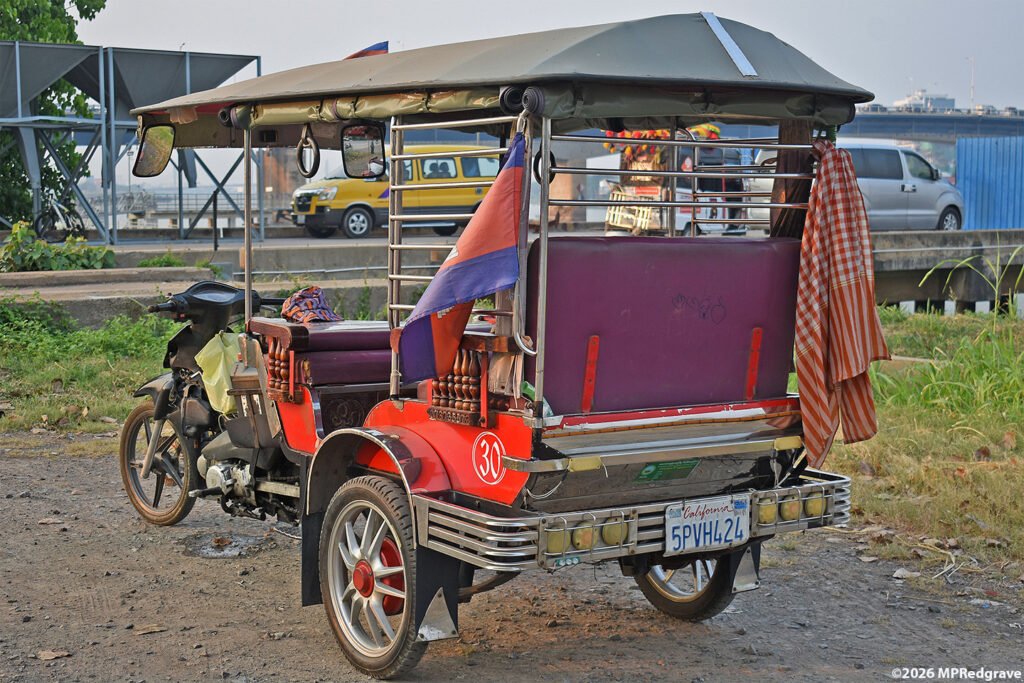
I had to include a picture of a Cambodian tuk tuk for you. What? Wait a minute! I could have sworn we were in Phnom Penh…. Do you see it, too??