Antarctica, Argentina, Uruguay, and Brazil
Iguaçu Falls, Brazilian Side
The next day—our last full day in South America—we crossed the border into Brazil in order to see Iguaçu Falls (the river is known as the Iguaçu in Brazil) from the Brazilian side. We did that two ways, first by seeing the Falls from the high overlooks that the Brazilians favor, and then by seeing the Falls from the river itself. In the case of the latter, we boarded a boat and traveled upstream to see the Falls from below—and I do mean below, as in directly below!
The day after that, we flew back to Buenos Aires and then onward back to wherever home might be. But before that first flight left Puerto Iguazú for Buenos Aires, we made a brief visit to an overlook to see the point where the Iguazú River joins the mighty Paraná, which incidentally is also the point where the borders of three nations join.
Here are some photos:

This Brazilian-side panoramic view of a portion of Iguaçu Falls shows the two-stepped waterfalls that typify the Falls. You’ll notice that the Falls first plunge a relatively shorter distance (about 35meters—call it 115 feet) to a shelf, and then plunge again a longer distance (about 50 meters—call it 165 feet) from the shelf to the base of the Falls. That happens because underlying the Falls there are three distinct layers of basalt rock (the so-called Serra Geral formation) laid down around 250,000,000 years ago, give or take a few million years. Each layer is characterized by harder, more erosion-resistant rock at its top. Downstream of the Falls, only the lowest of the 3 layers remains—it forms the bed of the River downstream of the Falls—but upstream of the Falls, the Iguaçu River flows over the highest of the layers.
The Falls aren’t static, though. The edges of both layers are eroding upstream at about ¾ of an inch a year. That means that in my lifetime, the Falls have moved just over 50 feet upstream. Since Europeans first laid eye on the Falls nearly 500 years ago, the Falls were some 350 feet upstream from where they are now.
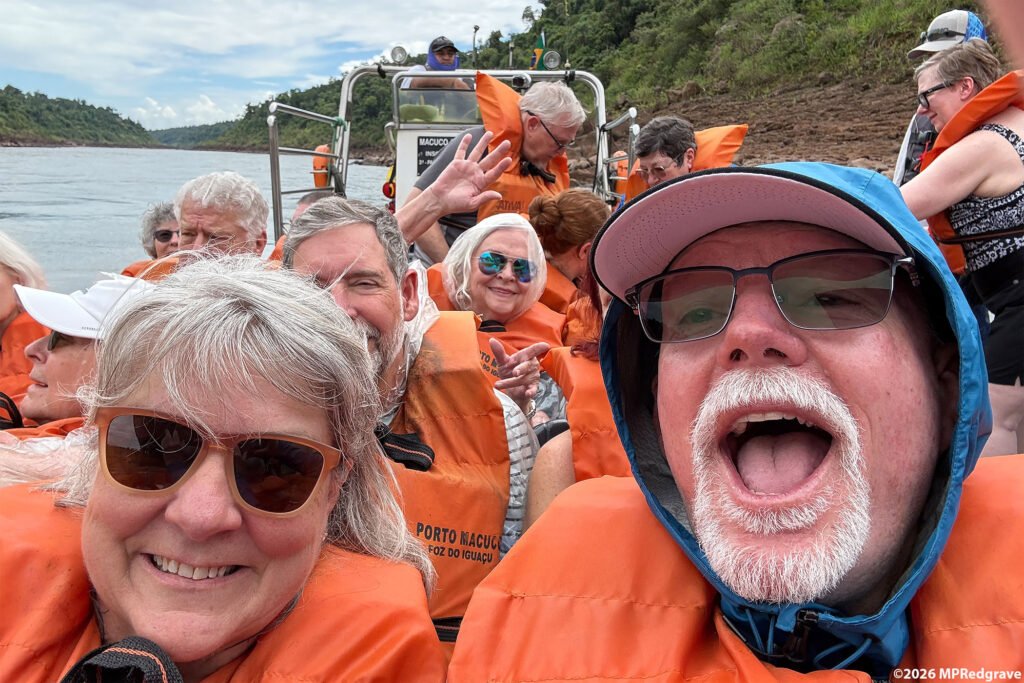
On the Brazilian side of the Iguaçu River, you can take a boat ride up the river and see the Falls from below. They had warned us that we would get a bit wet. I was okay with that, the temperature was in the mid-80’s F (call it 30ish° C), so it wouldn’t be cold and it was warm enough to dry off. Still, I stashed a change of clothes in my backpack and left that on the bus, just in case I might need it.
The boat was basically a big Zodiac, and I now had plenty of experience with those. So I put on my light rain jacket with the hood up, donned my life preserver, stuck my backside on the float and swung my legs in. I got a primo seat—left end of the second row. Bring it on! Let’s go!!
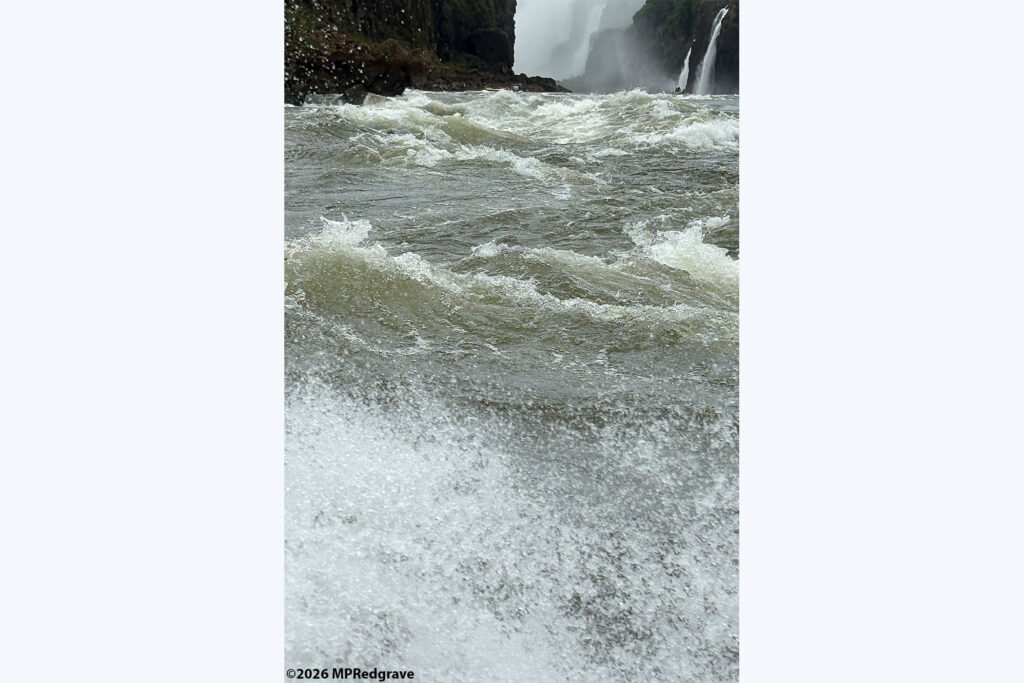
As we headed upriver, it wasn’t long before we encountered some rapids. And then some more. Oh, this is gonna be fun!

It wasn’t long before we reached the Falls. That ride wasn’t bad, though Zodiacs can be pretty bouncy in the rough water. And from here below the Falls you can easily see their 2 steps.

After we puttered around the base of the Falls for a few minutes, our driver turned toward one of the cascades and went right through it! Not behind it, or around it, but through it! A bit wet indeed, we all got drenched!
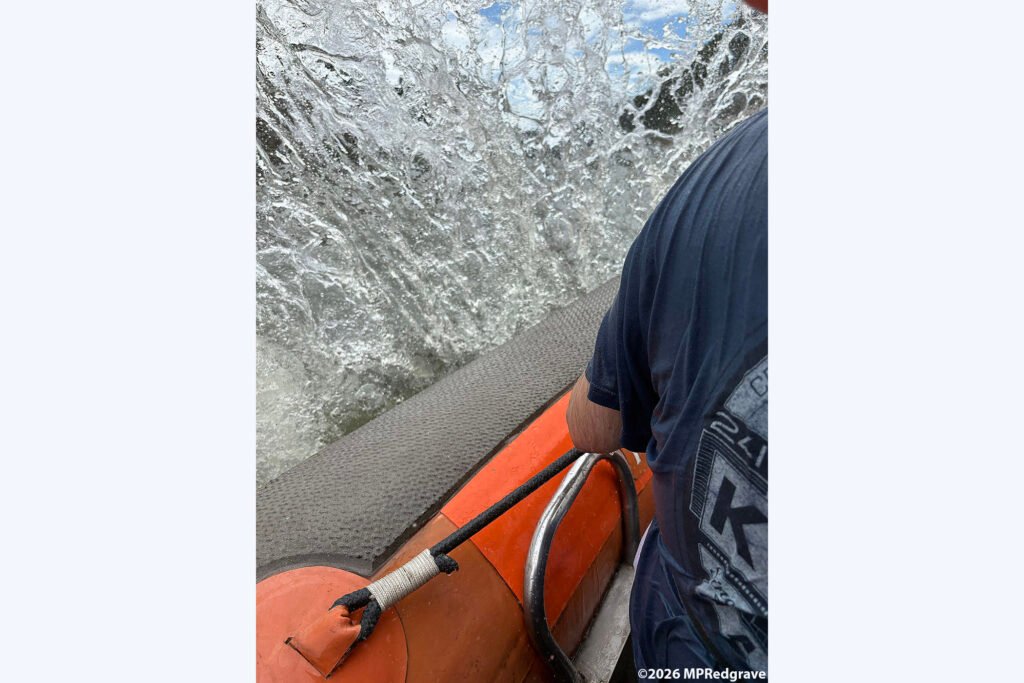
As we headed back to the dock a couple of miles down the river, we had to go back through the rapids. This time our driver wasn’t gentle with it—he deliberately drove the nose of the boat down into the waves, creating a huge splash of water that came straight up out of the water over the bow, and then drenched us all over again. Our driver was a sadist—he did that 4 or 5 times. It was a blast!
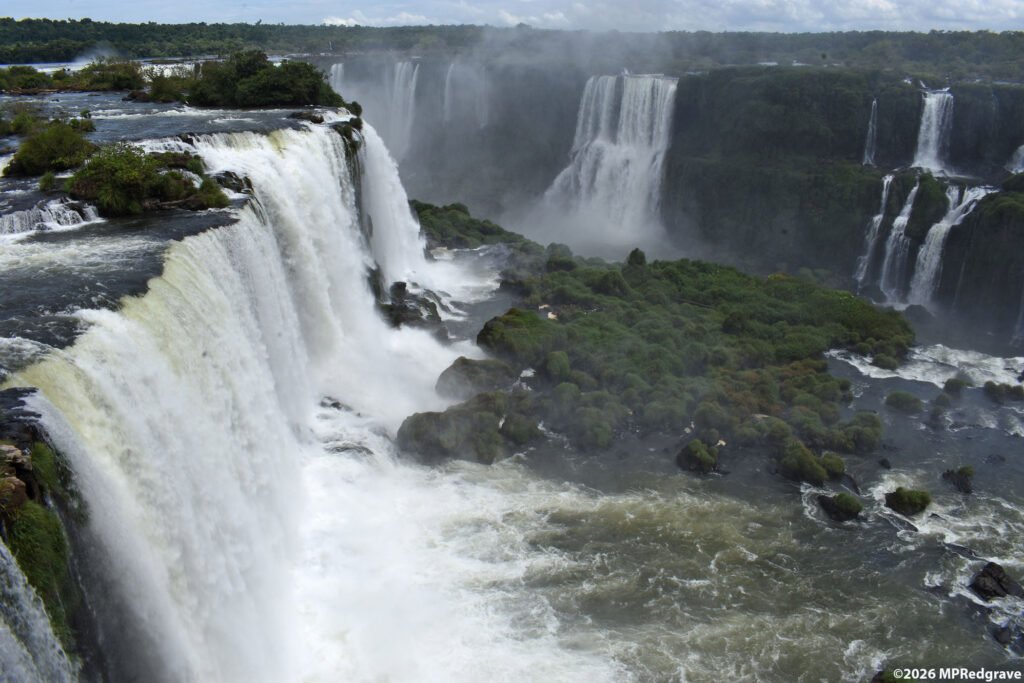
Thankful for my change of clothes, I was happy the bus took us upriver for one last view of the Falls.

The Iguazu River, as we English speakers call it, forms the border between Argentina and Brazil. This is the River as seen from the bridge that heads to the Argentinian border control station (and the 3½ hour wait we had there that night waiting for permission to cross back into Argentina!). On the left side of the river, that’s Argentina’s Río Iguazú, while on the right, it’s Brazil’s Rio Iguaçu.