Vietnam and Cambodia
Hanoi, Water Puppet Theatre
We ended our day exploring Hanoi's Old Quarter with a visit to the Thang Long Water Puppet Theatre. Here are some photos:

After leading us though the Old Quarter of Hanoi, Rose, our intrepid guide, led us to the self-described world famous Thang Long Water Puppet Theatre.

Water puppetry is a traditional art form in northern Vietnam. The first known references to water puppetry in Vietnam are from the 11th century. It’s thought that rice farmers of the time used puppets to entertain each other when the paddies were flooded, and the practice stuck. Eventually, professional troupes of puppeteers formed and formalized the practice into an art form.
In today’s form, the performances have moved out of the paddies and into indoor theatres. Traditionally, the “stage” is a roughly square waist-deep pool, of which about 60% is visible to the audience, while the other 40% is hidden behind a screen that has been painted to look like a temple wall. Stage props above and to the either side of the stage are made to look like the exterior of a temple. Behind the temple wall screen, puppeteers stand in the water and control the movements of the puppets by way of bamboo poles and lines that they keep underwater to maintain the illusion that the puppets are moving independently on, under, and sometimes above the water’s surface.
The puppets are carved out of wood, painted, then lacquered to a highly reflective finish. The lacquer protects the wood from the water and makes them reflect in the water’s surface. It also makes them very difficult to photograph at all well!
On either side of the stage are platforms that support the orchestra, made up of traditional Vietnamese instruments and singers that support the action in the water.
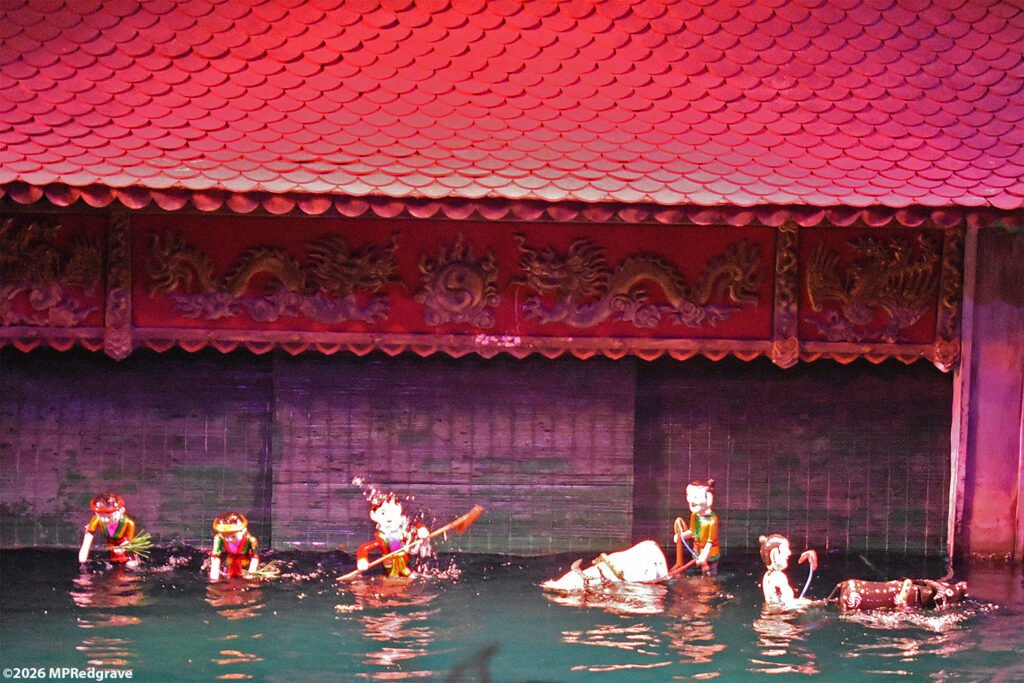
Two farmers are driving their cattle through the paddy while 3 others are tending to the crop. At least I think that’s what’s going on—I never did quite catch on to the storyline. The story is narrated by a character named Chu Teu (Uncle Laugh), but that narration is in Vietnamese.
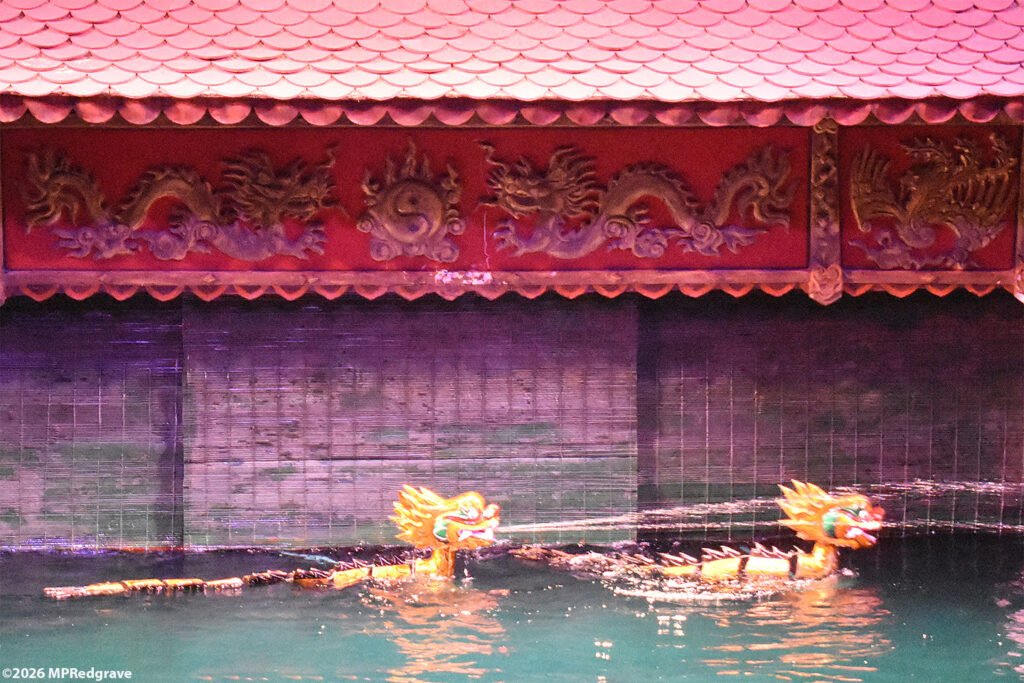
At one point, a pair of dragons came out and did a synchronized swim from side to side, while one of them spat water along the way. Pretty cool, and definitely fun to watch, but I haven’t any idea how that fit into the story.

I was fascinated by the orchestra and the exotic sounds it made. All of the pieces were traditional Vietnamese instruments, but to my Western ears they sounded foreign, new, and very interesting.
On the left-side platform, there were 4 players and 4 instruments. The most familiar instrument was the flute—the player actually had several flutes that I’m guessing had different pitch ranges—though it was a bamboo flute that produced a higher, sweeter, yet simpler tone than do the C flutes commonly played in western music. Next was percussion, a drum set laid out very similarly to a western drum set, but with drums that produced a much rounder, more complex sound. Between those was a tall 2-stringed instrument that its player stroked with a bow like a cello, though its tone was much higher and thinner than a cello. After consulting Google, I’m guessing it was a dan ngi.
By far the most interesting to me, though, was the sound of the odd instrument played by the fourth player—it was a single-stringed something that somehow produced such a wide pitch range that I had trouble believing such a range of sounds could come from a single instrument. The player would pluck or stroke the single string with her right hand, all the while moving a vertical stick in her left hand to change pitch, from low moans to shrill high tweets, but all in a continuous sweep of pitch. She would stop briefly on a note—pitch perfect!—only to swoop to another note, and then to another. And somehow she could change the voice of the instrument from something other-worldly to a voice that almost sounded human. I was mesmerized! Only later, when I was back at the hotel and fired up Google, did I discover that this fabulous mystery instrument is the dan bau, and that it has been played in Vietnam for over 1000 years!

On the right-side platform there were 5 members of the orchestra, 3 instrumentalists and 2 singers. The two players in the rear were playing different types of zithers. The rearmost, I’m pretty sure, was playing a 16-string zither on its own stand, while the player just to her left appeared to be playing smaller zither in her lap. The middle player swapped between three lutes during the performance, a moon lute (on the floor to his right, a dan nguyet), a three-string lute (a dan day) that he’s playing in the photo, and a two-string lute (on the floor to his left, a dan sen).
The 2 singers, sitting at the front of the platform, were the multi-taskers of the orchestra. They would sing short songs (in the traditional Vietnamese cheo operatic style) at various points during the performance, would occasionally answer the narrator with on-key words, hoots, and yips, and would from time-to-time supplement the other instrumentation by striking a sound block (as the singer in green is doing in the photo) or by tapping on a simple drum.
I enjoyed hearing the music and these new-to-me instruments thoroughly! Even if I never did understand what the story was that was being played out onstage (in the water?), the music was a delight!