Vietnam and Cambodia
Hanoi, Exploring the City
My second day in Hanoi is when I joined another Sail with Seth adventure. I honestly would have been a bit reluctant to travel in Southeast Asia alone, mostly because I know almost nothing about the languages there and maybe, just maybe, I’m not as brave as I used to be. South America? Sure, I can stumble around in Spanish enough to make sense of signs and have simple conversations. Europe? You bet, there’s often someone around who knows English and at least the alphabet looks familiar (in most places, anyway). Southeast Asia? The languages and signs there might as well be in Martian.
So if I were going to go to Southeast Asia, it would have to be within the bubble of group travel. And, if I’m gonna go group, Sail with Seth is my first choice. Seth always brings that little bit extra to his SwS adventures, be it private tours, meals, or swag, to say nothing of his unmatched personalized service. And, I must add, it’s not a small thing that I always see friends that I have traveled with before on past SwS adventures. When I saw that Sail with Seth was offering a trip to southeast Asia, I felt very comfortable choosing to go—it would give me the opportunity to visit some places I’ve wanted to see, but wondered whether I ever would.
Travel and accommodations for this trip were provided by AMAWaterways. Our first excursion as a group was AMA’s city tour of Hanoi. Here are some photos:

The first stop on our Hanoi city tour was the Tran Quoc Pagoda, a Buddhist temple that sits on the tiny island of Kim Ngu (Golden Fish in English) in Hanoi’s Ho Tay (West Lake). Tran Quoc is the oldest pagoda in Hanoi, being first established on the banks of the nearby Song Hong (Red River) in about 545. For centuries, the pagoda suffered from repeated flooding and was finally moved to Kim Ngu in 1615. The most outstanding feature of Tran Quoc Pagoda today is the Bao Thap (Precious Tower), a 15-meter-tall (call it just under 50 feet) tower built in 1998. The Bao Thap has 11 levels, with each level having 6 sides, and each side has an arch containing a gemstone statue of the Amitabha Buddha (that’s 66 buddhas!). Each of the 11 levels represents a stage in the Mahayana Buddhist’s path to achieving full enlightenment. At the very top, the tower has a 9-tiered stone lotus pedestal that represents spiritual ascension.

Our next stop was the nearby John McCain Memorial. Originally, this monument was a celebration of victory in what we call the Vietnam War. It portrays an American pilot—John McCain—surrendering after being shot down over Hanoi in 1967. McCain, a US Navy lieutenant, subsequently spent 5½ years in the infamous “Hanoi Hilton” prison until he was released in 1973. Almost 2 decades later, while he was serving as a US senator from Arizona, McCain played a pivotal role in normalizing relations between the United States and Vietnam. Since that time, McCain’s reputation in Vietnam has shifted from being an enemy to being a man of peace and conciliation, a man of great honor and integrity. Likewise, the meaning of the monument to the Vietnamese has shifted from being a symbol of wartime victory to being a commemoration of a man they admire and respect. To this day, since McCain’s death it is not unusual to see Vietnamese and Americans alike leaving flowers on his memorial.

I mentioned in my last post that 90% of the traffic in Vietnam is made up of motorbikes. The Vietnamese use these little lightweight 100cc, 8-horsepower vehicles—that are barely more than powered bicycles—for nearly all their transportation needs. It’s not unusual to see families of 3 or 4 riding together on one! I actually saw a couple of instances where Dad, Mom, and their 3 kids (!!!) were riding together on one of these miniature workhorses! And they also use them to haul cargo of all descriptions, from foodstuffs to workman’s supplies (ladders included!) to boxed goods. I even saw one that was hauling a refrigerator! And that’s to say nothing of the one I saw towing a fully grown boar in a cage-trailer! That animal must have weighed 8 or 10 times what the motorbike weighed. Call me impressed!
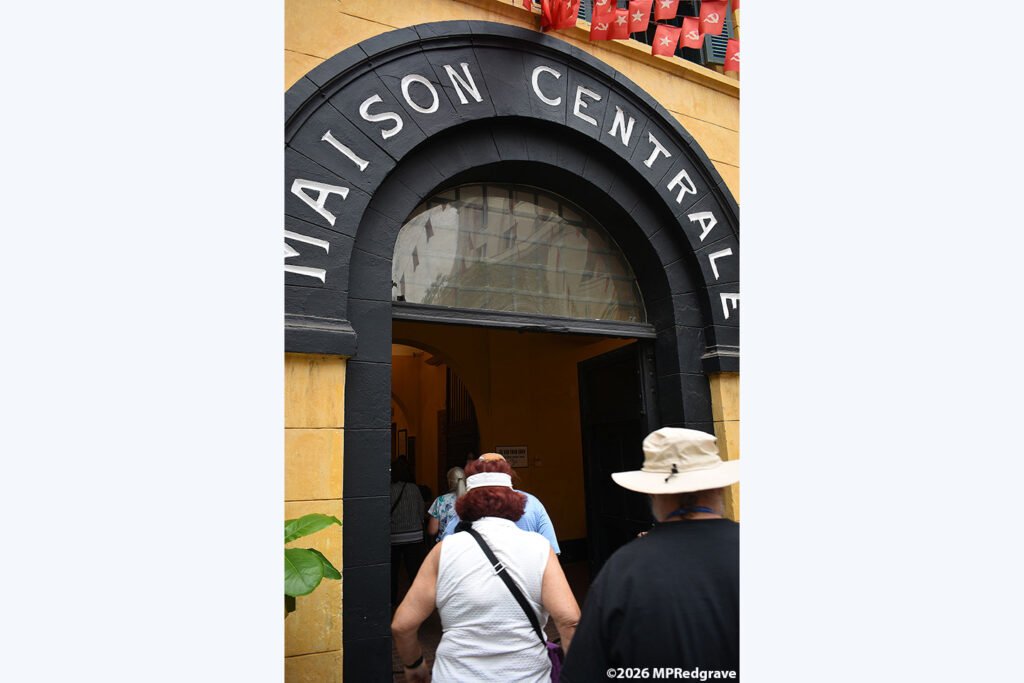
This may look like the entry to some fancy French restaurant, but no, it is the entry to Hoa Lo, aka the “Hanoi Hilton,” the infamous prison used by the Vietnamese to imprison US combatants during the Vietnam War. The building was originally built by the French between 1896 and 1901 to imprison political dissidents, i.e., those Vietnamese who objected publicly to the colonial rule of French Indochina. The French dubbed it “Maison Centrale” (Central House in English), a name the French still use to house their worst prisoners in France. The prison was designed to hold 600 prisoners, but from the beginning housed many more (over 2000 by the time the French were driven out of Vietnam in 1954) in deplorable crowded conditions. Documents from that time tell us that torture and execution were common during the French rule.
After the collapse of French Indochina, the Vietnamese continued to use the prison, this time to house common criminals from the streets of Hanoi. When the Vietnam War started, though, the Vietnamese moved out the Vietnamese prisoners to make room for captured American officers, mostly pilots. The Vietnamese then and now claim that the American prisoners were housed in accordance with the Geneva Conventions and that no torture took place, but the accounts of those prisoners—including John McCain—starkly contradict those claims.
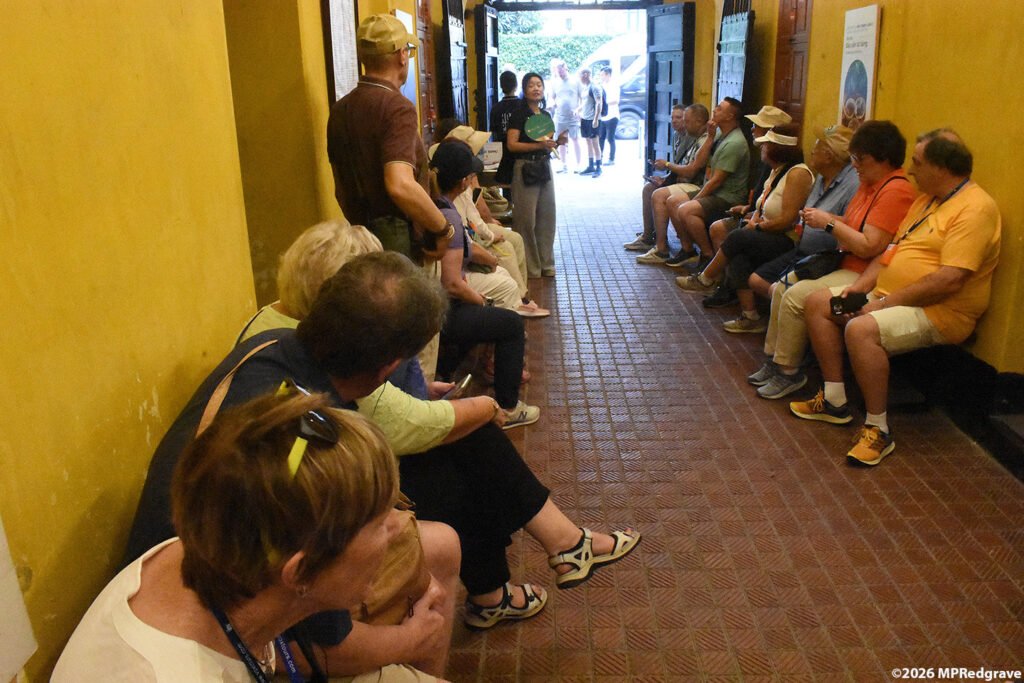
In the entry hall of Hoa Lo, or “Hanoi Hilton”, our excellent guide, Rose, a native of Hanoi, briefs us on the history of the prison as we await permission to enter.

This is a typical cell at Hoa Lo (the “Hanoi Hilton”). Cells measured approximately 5 feet by 8 feet and housed anywhere from 1 to 4 prisoners during the Vietnam War. During the French Indochina years, it’s said that as many as 8 prisoners would share a cell, and that they were often shackled together without any access to sanitary facilities. Each regular cell had a single small glassless barred window high on one wall. The prison also had solitary confinement cells that were smaller than the regular cells and had no windows, as well as larger group confinement rooms where large numbers of prisoners were shackled shoulder-to-shoulder on the floor. The barbarity of the conditions under French rule defies understanding.

This aerial photo of Hoa Lo shows just how large a prison it was. Today, only a small part of the prison still stands, essentially the section between numbers 7 and 5 in the photo (from the far left corner to the corner at the top), and what remains has been converted into a museum. The rest of the building was razed in the 1990s to make way for a modern high-rise.

Torture and executions were common during the French rule. This is the device they would use to carry out those executions—a guillotine.

This small courtyard behind Hoa Lo prison commemorates the inhumane treatment Vietnamese dissidents received under the rule of French Indochina.
After our somber visit to Hoa Lo (“Hanoi Hilton”), we could all use a visit to something more uplifting, and Hanoi delivered. Our next stop was Van Mieu (Temple of Literature), a temple dedicated to Confucius, the great Chinese philosopher and teacher. In the 11th century, the imperial family of Vietnam, who subscribed to Confucianism, created Van Mieu to be a center of education and literacy in the Confucian tradition. On the grounds of Van Mieu, they established the Quoc Tu Giam (the Imperial Academy), to be a center of learning for Vietnam’s elites, specifically for the royal family, the emperor’s bureaucrats, and related nobles. Quoc Tu Giam educated Vietnam’s elites for 700 years, from 1076 until 1779.
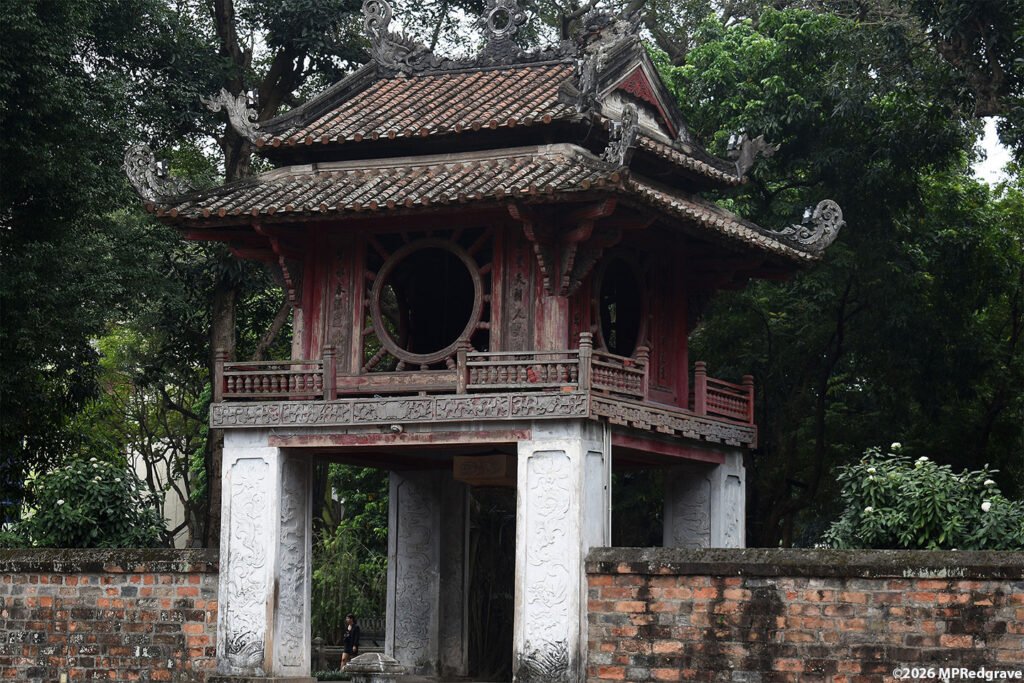
The grounds of Van Mieu include 5 courtyards with ornate pavilions between the courtyards. This structure is the Khue Van Cac, the pavilion between the 1st and 2nd courtyards. It is considered to be the official entry into Van Mieu and is one of the symbols of Hanoi, appearing on Hanoi’s city seal and on Vietnamese currency.
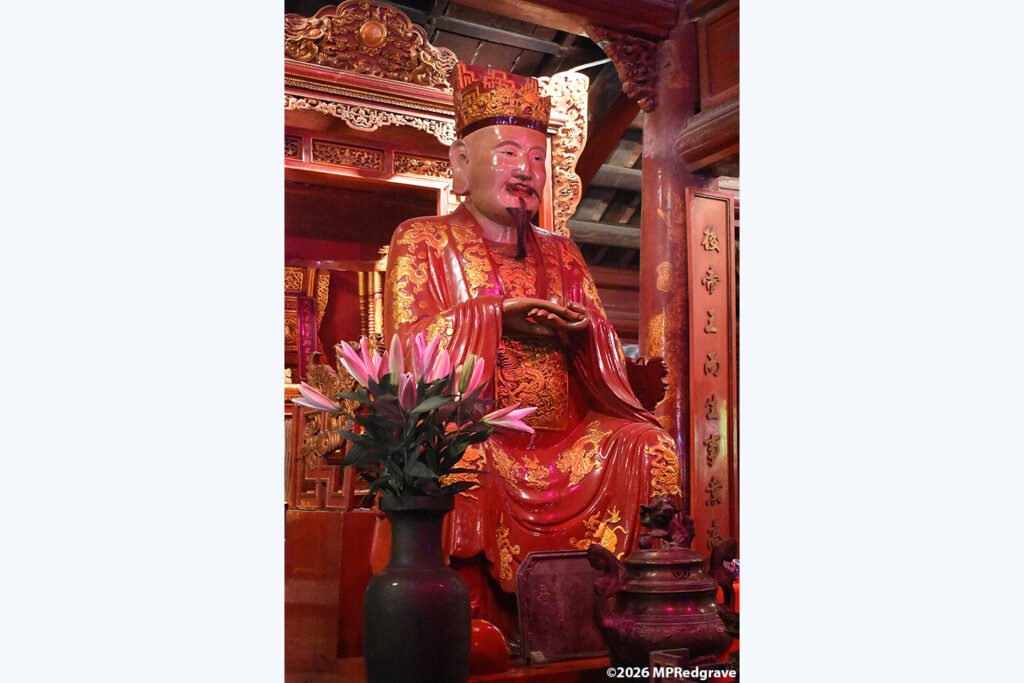
This is the altar to Confucius in Van Mieu’s 4th courtyard. The philosophy and teachings of Confucius are honored at Van Mieu. Confucius, who lived in Zou (now Qufu), Shandong, China, in the 6th and 5th centuries BCE, taught that one’s life should adhere to the Five Key Virtues: benevolence, righteousness, propriety, wisdom, and sincerity. Confucianism is not a religion per se, but is instead a way of life or a code of behavior that holds the Five Key Virtues as sacred, and has the goal of living a virtuous life.
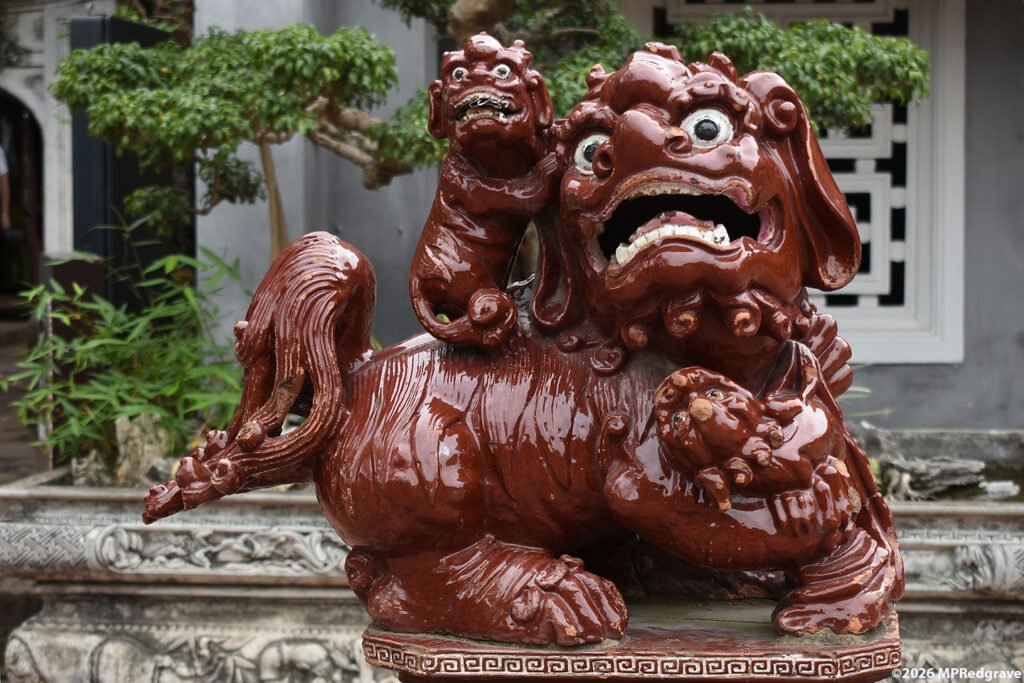
This is Ky Lan, a Vietnamese unicorn. In Vietnamese mythology, a unicorn is not a horse-like creature with a single horn, but is instead a creature with a dragon’s head, dog or lion’s face, stocky body, and almost-human-like hands. It is at the same time a very gentle creature and fiercely protective of its young. Ky Lan represents intelligence, prosperity, and peace. It is one of Vietnam’s 4 sacred mythical animals, the others being Long (dragon, representing authority and the king’s divine power), Quy (turtle, representing wisdom, stability, and longevity), and Phuong (phoenix, representing grace, nobility, and beauty).
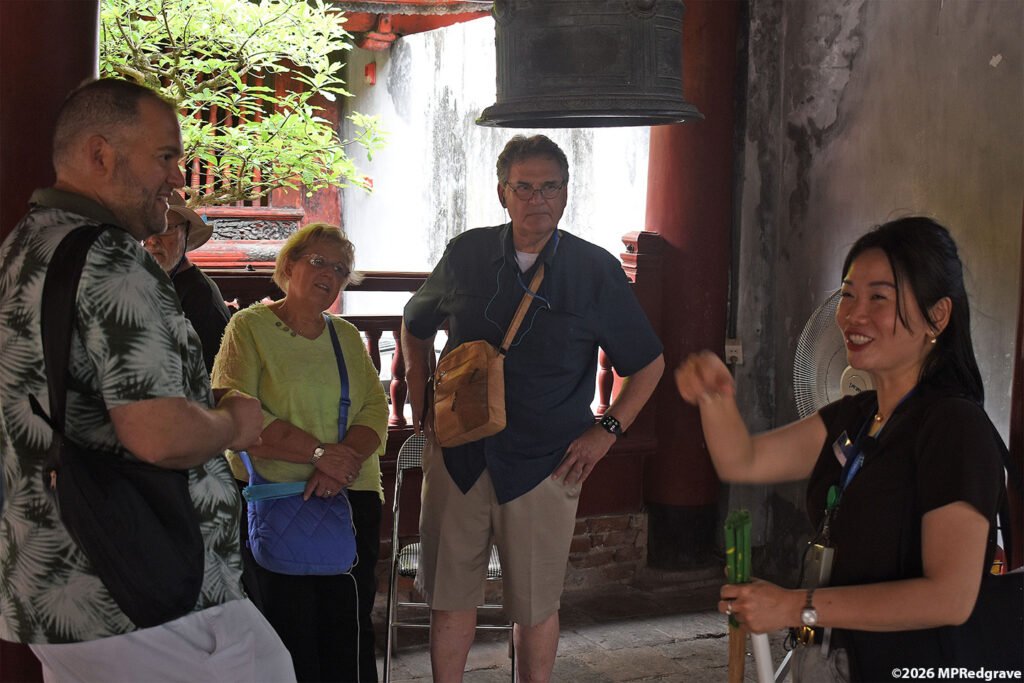
Here is Rose describing some of the finer points of Van Mieu and the imperial family’s devotion to Confucianism to Seth, while Jean and Michael looked on. I’ve met a lot of tour guides in my many travels and Rose is one of the best. She was knowledgeable, affable, eloquent, approachable, and just a joy to have lead our tour.
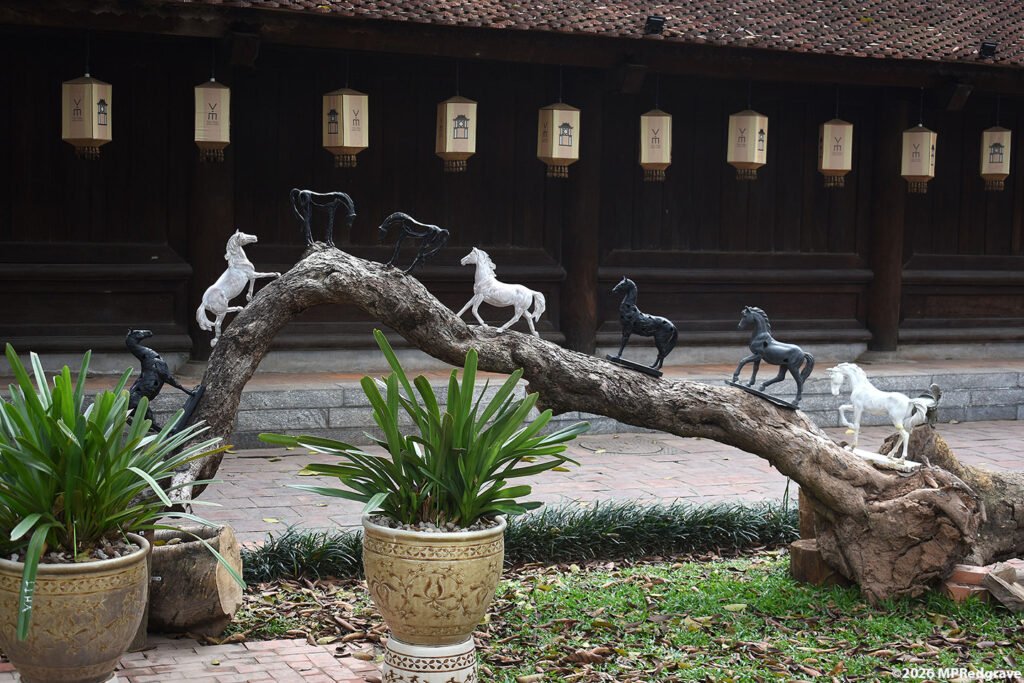
Laura, this picture is for you. I never saw a horse anywhere in Vietnam (which, of course, doesn’t mean they don’t exist, just that I never saw one!), but one of the monks (does Confucianism call them monks?) at Van Mieu obviously had a fascination with them. There must have been a few dozen carved horses behind the temple building. I just happened to peek over the fence as we were leaving and saw the carvings.