Vietnam and Cambodia
Hanoi, Wandering on My Own
I arrived at Hanoi’s Noi Bai Airport just after sunset after 4 flights and 35 hours of travel. I had slept for maybe 4 hours on the flight from Los Angeles to Hong Kong, but by no means was that enough. I was running strictly on adrenalin—and I knew it and expected it. My body and mind were insisting it was something like 4:00AM. My travel agent—and host of this adventure—Seth Wayne of Sail with Seth, had recommended that I have a company called Fast Track Vietnam meet me at the airport, shepherd me through passport control, and arrange for a car to take me to the hotel. They did exactly what they promised, exactly what my sleep-deprived addled brain needed.
The ride to the hotel was, well, not exactly frightening, but frequently startling. I admit there were a few times I flinched, absolutely certain I was about to witness a crash. But no crash ever happened. It’s as if all the drivers somehow were communicating with each other, missing each other by inches. Understand that lane markers in Hanoi apparently mean nothing, traffic signals are merely suggestions, and texting while driving is more common than not. And the traffic consists of 90% motorbikes, at least half of which have a rider with a cell phone in their left hand. And the motorbikes weave around constantly. Navigating traffic in Hanoi is like negotiating a continuously moving slalom course.
Once I got to the hotel—safe and sound (or as sound as one can be after being up for so long and having survived Hanoi traffic!)—all I wanted to do was sleep. I could barely put a sentence together. I slept a solid 8½ hours, and woke up the next morning ready to explore the city. My plan was to just walk around the neighborhood and (after joining some friends for lunch) that’s exactly what I did.
Here are some photos:

I was staying at a nice hotel in Hanoi’s Hoan Kiem district, aka, The French Quarter. Our group was to gather at the hotel the next day, but I always like to get to my adventure’s starting point at least a day early. That gives me some time to explore on my own, to say nothing of giving me some leeway to arrive on time should I get delayed on my way there.
My intention was to walk around the Hoan Kiem district, just to see what there is to see there. Armed with my camera and Google Translate set to Vietnamese on my phone, I headed out. On my way out of the hotel, though, I ran into Seth (of Sail with Seth) and he mentioned that he and a handful of other early arrivers were going out to get banh mi sandwiches for lunch. I was welcome to join if I wanted. Of course I did, exploration could wait until after food!
On our way to get the food, we walked past a primary school that had decorated the street in front of it with patriotic flags, specifically the gold star on a red background flag of Vietnam and the gold sickle on a red background flag of the Vietnamese Communist Party. I don’t know why I was surprised to see those flags. I admit I found them vaguely disturbing, perhaps because of a conflict long ceded to history. Times change.
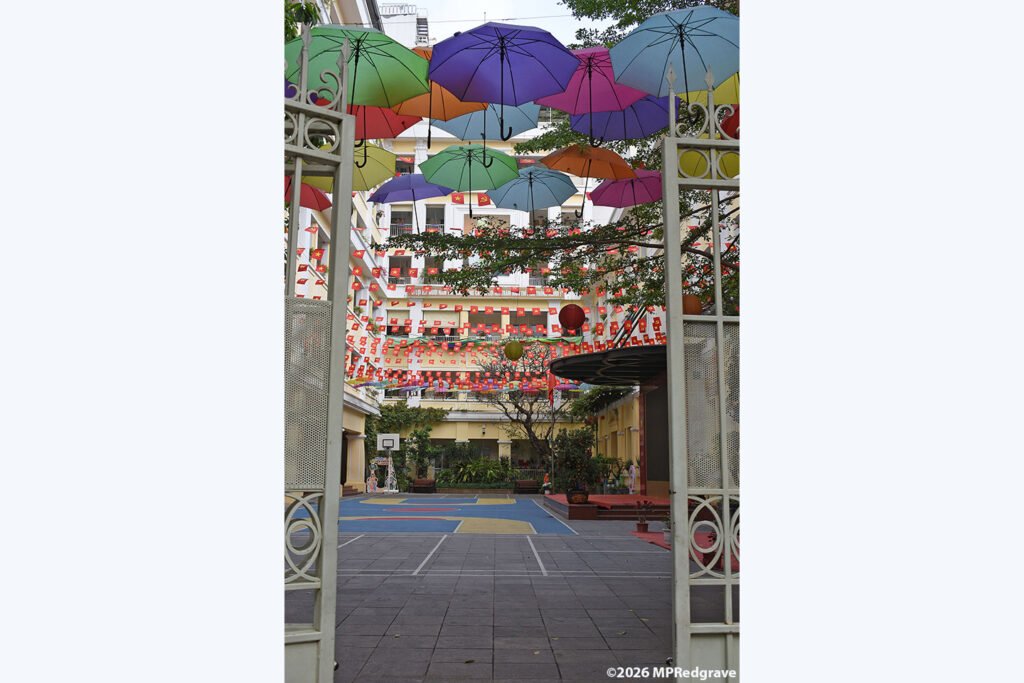
Between all the flags and the colorful umbrellas strung across the courtyard, Trang An Primary School looked like a cheery place for the children of the Hoan Kiem district to learn.

I didn’t know what this building was, but I was intrigued by the dozens of portraits displayed in its front garden (and even by the fact that it had a front garden—very unusual in this neighborhood!). I thought that maybe it was an art gallery or some type of school. But it was neither. Instead, Google Translate read the sign over the entry door and told me it was the Hoan Kiem district’s public library.
Notice that the colors of the library and the primary school in the previous photo are the same. I later found out that the golden yellow color is reserved for government buildings. No one else can paint their building that color.
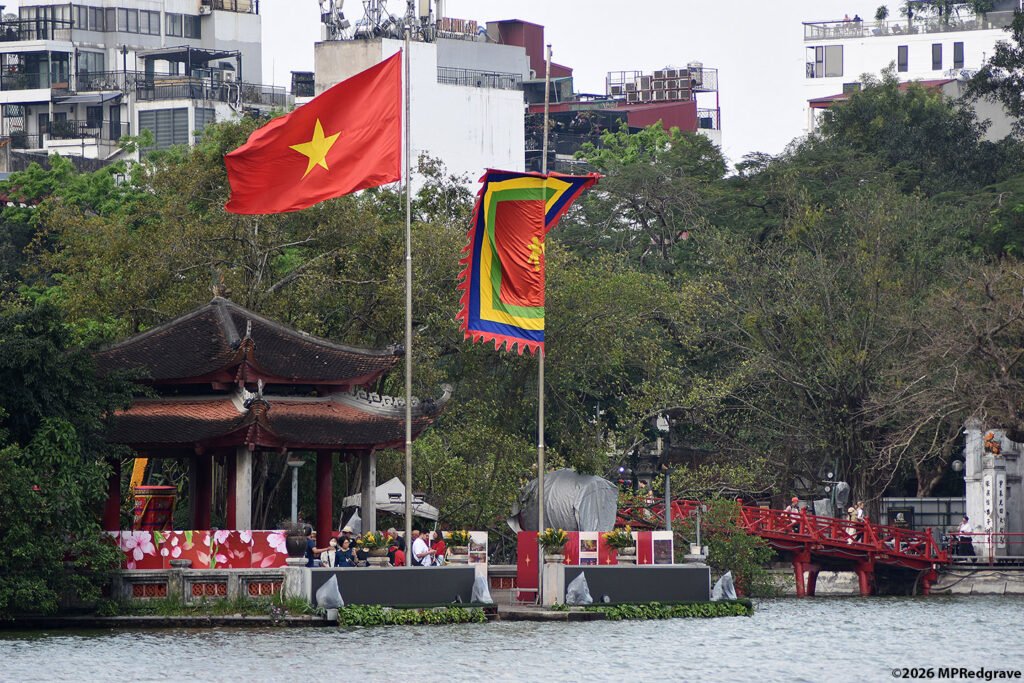
There is a large natural lake that occupies about 12 hectares (call it 30 acres) in the middle of the Hoan Kiem district of Hanoi. Naturally enough, it is named Hoan Kiem Lake. The lake has two small islands in it. At the north end, Jade Island is occupied by Ngoc Son Temple, a site dedicated to three sages of Confucianism and Taoism, as well as to one national hero. On the day I visited, the temple was under the protection of Buddhist monks. The large square banner on the right of the picture is the buddhists’ banner in Vietnam.

Across the broad boulevard called Pho Ly Thai To is this small temple dedicated to 11th century King Ly Thai To. I thought about crossing the boulevard, but the endless stream of motorbikes seemed to make that impossible. So I took this picture from across the Pho (Street in Vietnamese). The motobikes (they’re all small—I hesitate to call them motorcycles) kept coming and coming, so they were inevitably in my photo!
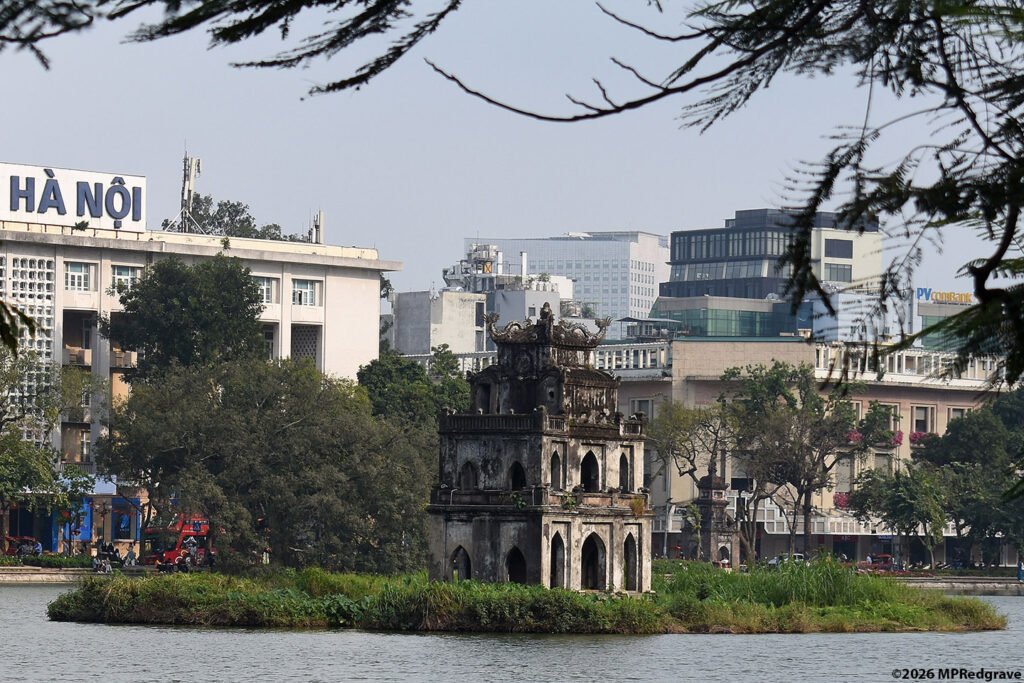
In the southern end of Hoan Kiem Lake, this small tower stands on the tiny Turtle Island. It was built in the late 19th century as a tribute to Le Lo’i, a 15th century king who overthrew the Chinese Ming rulers and restored independent Vietnamese rule. The current tower is the third building to stand on the island. The first was erected in the 15th century by the Le dynasty and served as a fishing cabin for the king. Two centuries later, the reigning king had the first building torn down and replaced it with a more modern structure. That second structure was removed by persons unknown sometime in the 18th century (the records are apparently sketchy) and the island was devoid of any structures for nearly a century.
The name of the current structure is Thap Rua, which simply means Turtle Tower in English, apparently named after the island. The building is now owned and maintained by the City of Hanoi. Despite appearances, the Hanoi government states that the building is in good condition.
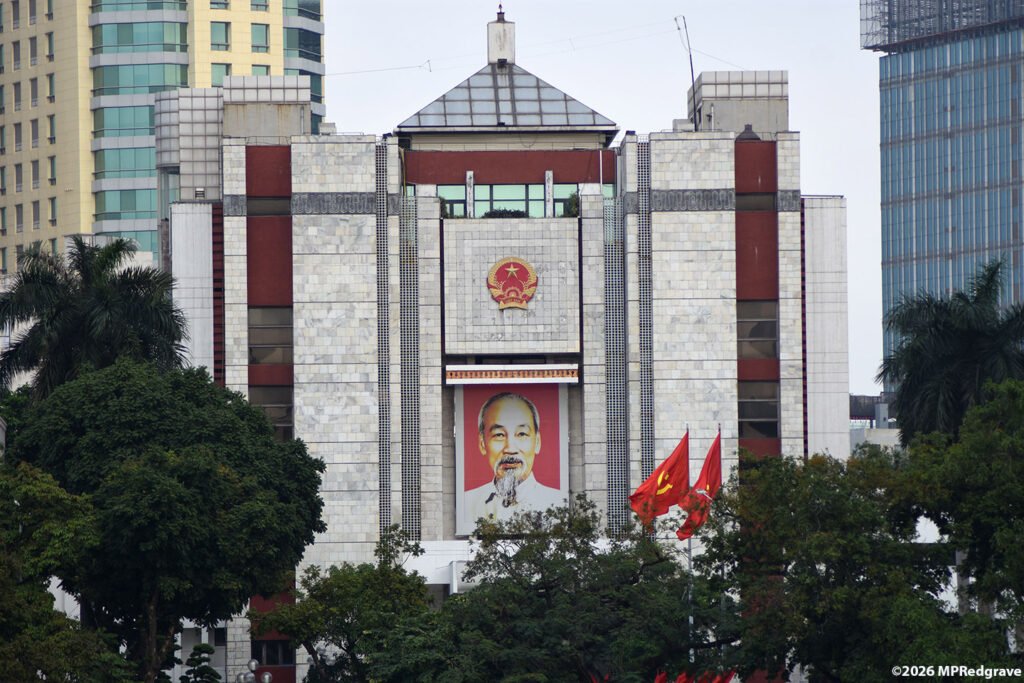
This building is the Hanoi People’s Committee Building. By any other name, it is City Hall. It is where all citizens of Hanoi go to do the usual governmental things—get permits and licenses, sign up for public services, and get public infrastructure fixed. Beyond the usual staff that actually run the city, the organization is lead by the People’s Committee, which is analogous to a City Council. The Hanoi People’s Committee has 22 members, one of whom is elected by the members as chairman, the chairman filling the same role as a mayor. One difference between Vietnam’s system and ours is that members of the People’s Committee are not directly elected by the people. Instead, they are elected by and responsible to the Hanoi People’s Council, a group of 125 people that are selected by direct election of all citizens of Hanoi over the age of 18. Anyone who is over the age of 18, is a resident of Hanoi, and is a citizen solely of Vietnam can run for a People’s Council seat. Oddly enough, at least to our way of doing elections, voters don’t pick one candidate from the list, but instead line out those they don’t want.

As I wandered the streets on my way back to the hotel, I saw a huge—largely empty—plaza that was dominated by this statue. Unfortunately, it was on the other side of a very broad street—Dinh Tien Hoang—and that street was filled with the usual steady stream of 90% motorbikes and 10% cars. But during my wander back from the banh mi restaurant, I had been paying attention to how people actually cross these busy streets. First, find a marked crosswalk, second step off the curb with purpose, and third continue across the street at a slow but steady pace until you reach the other side. Sure enough, you become another moving pole on the moving slalom all the drivers follow and traffic magically splits around you! I’ve got to tell you, it made me plenty nervous, but it worked! Try that in the US and you’ll get mowed down for sure!
So I made it to the plaza with the big statue no worse for wear. This plaza was actually a city park, Ly Thai To Park, named after Ly Thai To, the same 11th century king who has the temple dedicated to him on Pho Ly Thai Tho that I mentioned in a previous photo. Ly Thai To is revered in the Hanoi area. He gained control of Vietnam in 1009 and the next year moved Vietnam’s capital to what is now Hanoi, where it stayed for longer than 900 years. During his reign, Ly incorporated neighboring Champa (in what is now central Vietnam) and Dali (in China to the northwest of Vietnam) into Vietnam, enacted measures that significantly improved Vietnam’s economy, and introduced widespread adoption of Buddhism throughout Vietnam, all the while maintaining peaceful relations with the powerful Chinese Song Empire to Vietnam’s north. He was certainly a powerful and effective king.