Antarctica, Argentina, Uruguay, and Brazil
Antarctica, Fish Islands
In the afternoon of our third day in Antarctica, we visited the Fish Islands in our Zodiacs. Those islands were teeming with penguins, and shags, and skuas, and—well, you get the picture. The weather was bit sketchy, cold, with low clouds and occasional light rain or snow, and lousy light, but when you can get so close to such fascinating wildlife, it’s still completely worth the visit.
Here are some photos:

This Adélie penguin had just jumped out of the water when I took this picture. I caught him just as he was landing on the rocks. I am impressed by how sure-footed the penguins are, despite how clumsy their gait appears. The have no difficulty walking on the slippery, wet rocks and jumping from rock-to-rock as they climb up to get to their colonies.

This adolescent penguin was pecking at his mother’s beak, as if to say, “Gimme some food, Mom!” As I swung my camera up to catch the moment, Mom and child both stopped and looked squarely at me, as if to say, “What you lookin’ at?!”
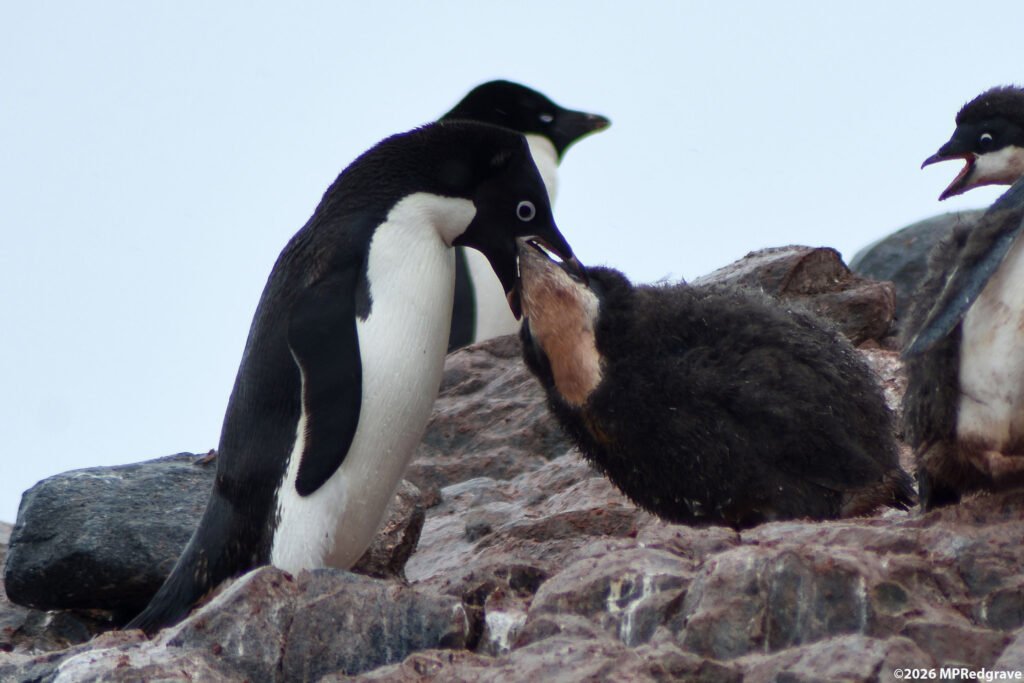
This down-covered chick did successfully get a meal from Mom. This picture also shows that the rookery is just coated with a layer of pinkish goo. This goo is—no surprise—penguin poop, but why pink? The Adélie’s primary food is krill, a small crustacean that is pigmented with the reddish compound “astaxanthin”. Adélies can’t digest this pigment, so it goes right through them and colors their droppings (ejectings?). The chicks can’t avoid getting covered in the pink goo until they are old enough to swim, and that doesn’t happen until they lose their down and grow their “swim” feathers.
I did read that the more brownish staining on a chick’s bib (the white area over the front of a chick’s neck) is not from poop, but is rather from the krill that Mom regurgitates to feed her chick. Let just say that the chicks are not particularly careful eaters.

I saw several penguins striking this pose, beak pointing straight up. There are several explanations about what this behavior means. Some say it’s a courtship display that males perform to attract females. Others say it’s a display of territoriality meant to lay claim to an area of the colony and keep other males out of that territory. Still others say it is simply the bigger males raising the level of their eyes so they have a better view of potential threats to their mates, nests, and offspring—primarily from skuas.
I would dismiss the first explanation, at least for now, because courtship happened months ago. The latter two are certainly possibilities. And, of course, it’s possible that all three are true, or none is true, or any combination in between. What I can say is that there were a lot of penguins displaying the behavior when we were circling their colonies in our Zodiacs.

We slowly passed one of the smaller islands that had a penguin colony on one side and an Antarctic shag colony on the other. The shag side of the island—so far as I could make out—was utter chaos. Shags were constantly landing, taking off, flapping their wings, and just getting in each other's way. At one point, many of the shags and penguins looked up at the same time. I looked up, too, but didn’t see anything. My best guess is that a South Polar Skua buzzed the island—and they go by fast!—looking for unguarded eggs or small chicks. Or maybe it was just a case of penguin see, penguin do, shag see, shag do!

This is a South Polar Skua. These birds like to steal unguarded eggs or chicks—they zipped over the colonies constantly.
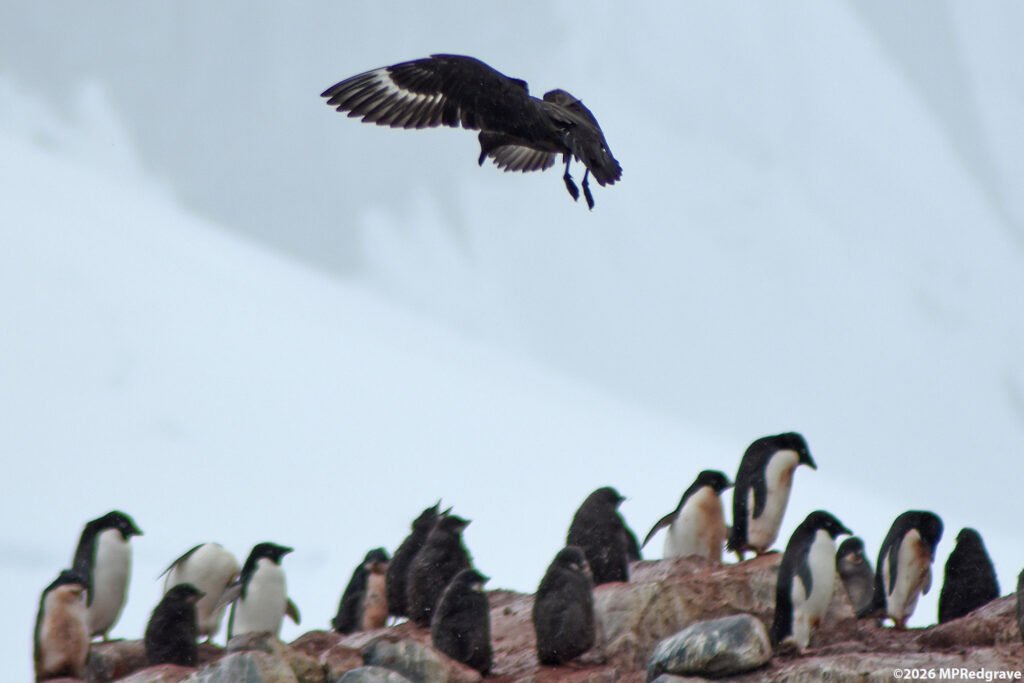
This South Polar Skua lowered the flaps and dropped the landing gear to do a slow flight over something that interested it. I guess it didn’t amount to anything, because the legs came up and the wings flattened out and he zoomed away.

Adélies, unlike Chinstraps or Gentoos, like to ride drift ice, which may help to explain why Adélies are so widely distributed in Antarctica. This little guy had this small iceberg all to himself.

Here’s another Adélie riding a piece of drift ice that it had all to its own.

This juvenile Antarctic Shag swam close by our Zodiac.

A while later, when it was snowing and the water was a bit rougher, this adult Antarctic Shag cruised by. Check out the blue eyes!
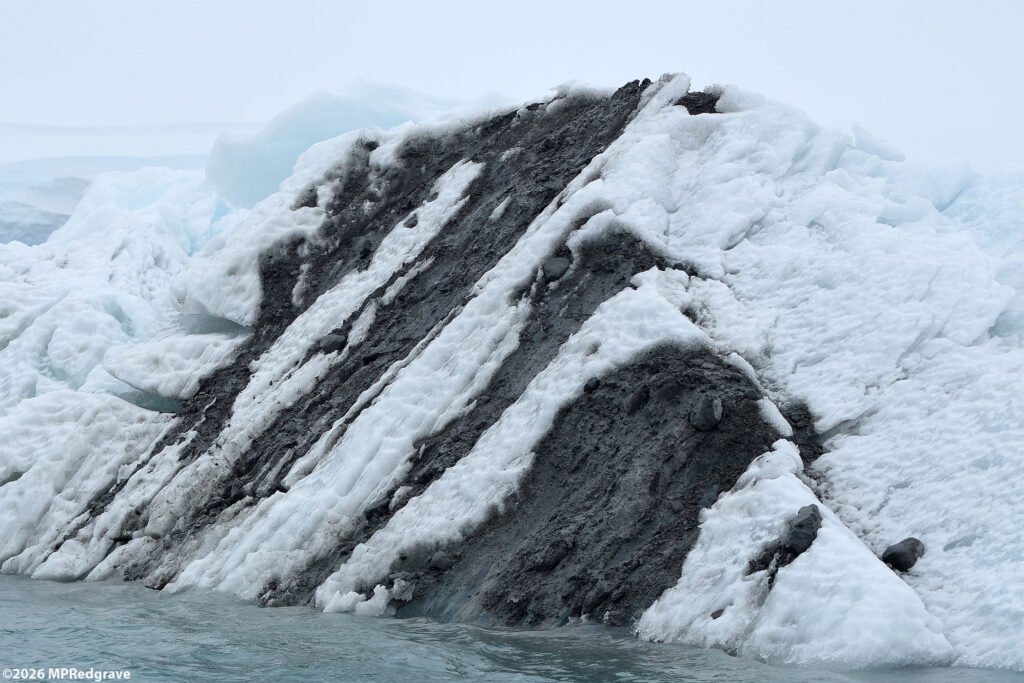
One of the icebergs we passed had these dark stripes on one side. The dark stripes are not ice, they are literally ground up rock. This iceberg is a glacial iceberg, where the side with the dark stripes was on the bottom (or possibly one of the sides) of the glacier. What we’re looking at is most likely the bottom of a chunk of glacier that scraped across rock on its way down the mountainside. Glaciers are immensely heavy and effectively gouge out the rock beneath the glacier as they flow ever so slowly downhill. At some point, this part of the glacier calved off, took its load of rock with it, and rolled onto its side so that rock stripes are no longer on the bottom.

This iceberg was unlike any other I’ve seen on this trip with such distinct thin blue stripes showing. So what’s going on here? I would say (and I am by no means an expert and this is just my opinion) that this is an old iceberg nearing the end of its existence. We know that the blue stripes are the result of a highly compressed compact crystalline ice structure that reflects predominately blue light and that the compact crystalline structure will break down once exposed to air. That leads me to think that a chunk of this iceberg calved off very recently, exposing the face we're seeing, a face that has rolled almost completely sideways from its original orientation. I think one could also surmise that the original ice—whether from a glacier or an ice shelf—experienced a regular change in the type of snow that fell on it, with some of it more susceptible to the crystalline reorganization required to produce the blue stripes. That would produce the “layer-cake” effect we see in this iceberg. It’s fascinating to think about.