Vietnam and Cambodia
Cambodia's Royal Palace
The next stop for the AMADara was Phnom Penh, the capital city of Cambodia. We would be there for 2 very full days—there was a lot to see! Phnom Penh is a city of 2.3 million people, easily the largest city in the country (the second largest, Siem Reap—our home base when we were exploring the Angkor plain—is one tenth the size of Phnom Penh).
Phnom Penh was founded in 1372 as a small trading post at the confluence of the Mekong and Sonle Tap Rivers. Shortly after the Khmer Empire collapsed in the early 1430s and the Khmer royalty was forced to abandon Angkor Thom, Phnom Penh became Cambodia’s capital, hosting a succession of Khmer kings who were essentially regional governors subservient to the Siamese (i.e., Thai) or the Vietnamese empires. Those empires vied for domination of the region, with Cambodia caught in the middle, for the next 400 years, at times forcing the Cambodian capital out of Phnom Penh.
In 1863, Khmer King Norodom, weary of being caught in the never-ending struggle between the Siamese and Vietnamese Empires, signed a treaty with France to protect Cambodia from its aggressive neighbors. Under the French protectorate, Norodom was able to move the capital back to Phnom Penh permanently, but in a “be-careful-what-you-wish-for” scenario, in 1887 the French consolidated Cambodia into French Indochina—Cambodia was once again subservient to a foreign power. Throughout all the centuries of foreign domination, though, the Khmer royalty somehow managed to maintain their tenuous claim to power and to the throne. That foreign domination finally ended in 1953 when Khmer King Norodom Sihanouk signed a treaty with the French that declared the Kingdom of Cambodia to be an independent nation.
Appropriately enough, the first site we visited in Phnom Penh was the Royal Palace, still the home of a Norodom king.
Here are some photos:

This stunning building is the Preah Tineang Tevea Vinnichay Mohai Moha Prasat in Khmer, but is known much more simply in English as the “Throne Hall”. The Throne Hall is where the Khmer king receives honored guests, hosts royal family weddings and other formal gatherings, and—when necessary—is the site of coronations.
We were not allowed in the Throne Hall, nor were we allowed to photograph the building’s interior. That’s too bad—the little bit I could see through the windows was striking.

The other major building in the public area of the Royal Palace is the Preah Vihear Preah Keo Morakot, known in English as the “Silver Pagoda”. The Silver Pagoda is the king’s official royal temple, but it also houses many of the nation’s treasures, including several bejeweled gold Buddha statues, as well as the striking “Emerald Buddha of Cambodia” and a near life-sized Buddha encrusted with nearly 10,000 diamonds. The building is called the “Silver Pagoda” because of the 5000 solid silver tiles (nearly 2½ pounds each!) inlaid in its floor.
We were allowed to enter the Silver Pagoda (after we removed our shoes), but, again, photography of the interior of the building was strictly forbidden.
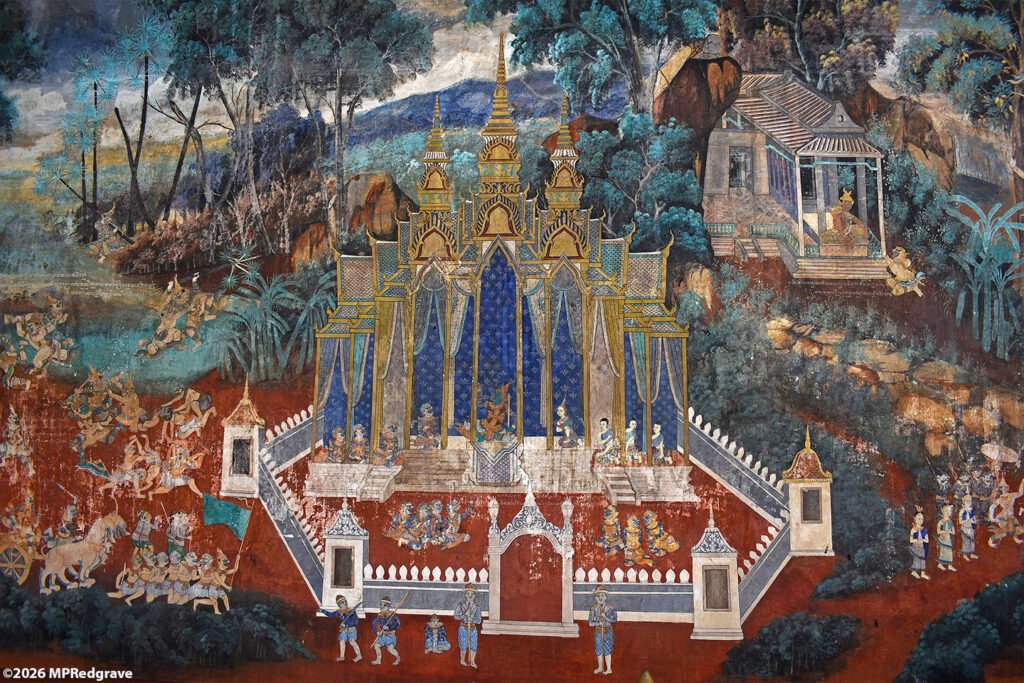
Between the Palace grounds surrounding the Throne Hall and those surrounding the Silver Pagoda is a wall. 642 meters of the Silver Pagoda side of that wall is painted with a recounting of the Reamker, the Cambodian interpretation of the Ramayana. The Cambodian version tells a very similar story to that of the Hindu Ramayana (see my Angkor Wat posts): Rama’s wife Sita is kidnapped by an evil demon, Ravana. Rama recruits a monkey-general, Hanuman, and his monkey army to help him rescue Sita. In the end, of course, Rama and Hanuman are successful, rescuing Sita and defeating Ravana.
This part of the painting shows much of the story. On the left, Hanuman is driving his monkey army to attack (and defeat) Ravana’s demon army. The evil Ravana—who is apparently blue in the Cambodian telling of the story—is seated, evidently uncomfortably, on his throne, while the lovely Sita kneels to his left. Also note that Ravana’s palace has some rather Cambodian architectural features—compare it to the Throne Hall or the Silver Pagoda.
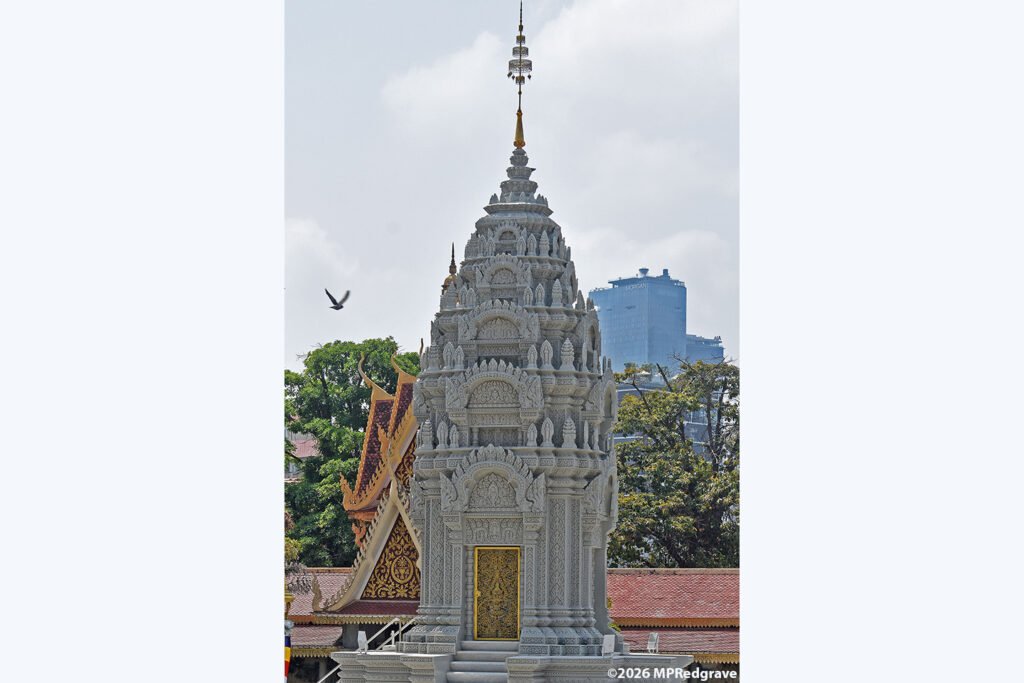
You may recall that during the Vietnam War the king of Cambodia was King Norodom Sihanouk. He was a statesman—his efforts resulted in a treaty with France that established the independence of the Kingdom of Cambodia—and an effective leader of the Khmer people, but he was also very much a family man. His most beloved daughter, Kantha Bopha, succumbed to leukemia as a young child. In her honor, Sihanouk had this stupa erected as a monument to and columbarium for Kantha Bopha. When Sihanouk died, he specified in his will that his remains were be placed next to his daughter’s in her stupa.
The current king of Cambodia is King Norodom Sihamoni, Sihanouk’s son. It is not a foregone conclusion that the king’s eldest son will become king when his father leaves the throne (Sihanouk abdicated). In Cambodia, when the throne is vacated, the Royal Council of the Throne is required to meet within 7 days to elect a new king-for-life. The Council is made up of Cambodia’s Prime Minister, the Presidents and Vice Presidents of the country’s Senate and Assembly, and the heads of Cambodia’s two most prominent Buddhist orders. Note that no member of the royal family is (necessarily) represented on the Council. The Council must then consider everyone who is 1) a male descendant of King Ang Duong (founder of the royal houses of Norodom and Sisowath), and 2) is at least 30 years old. Selection of the new king is by secret majority vote of the Council.
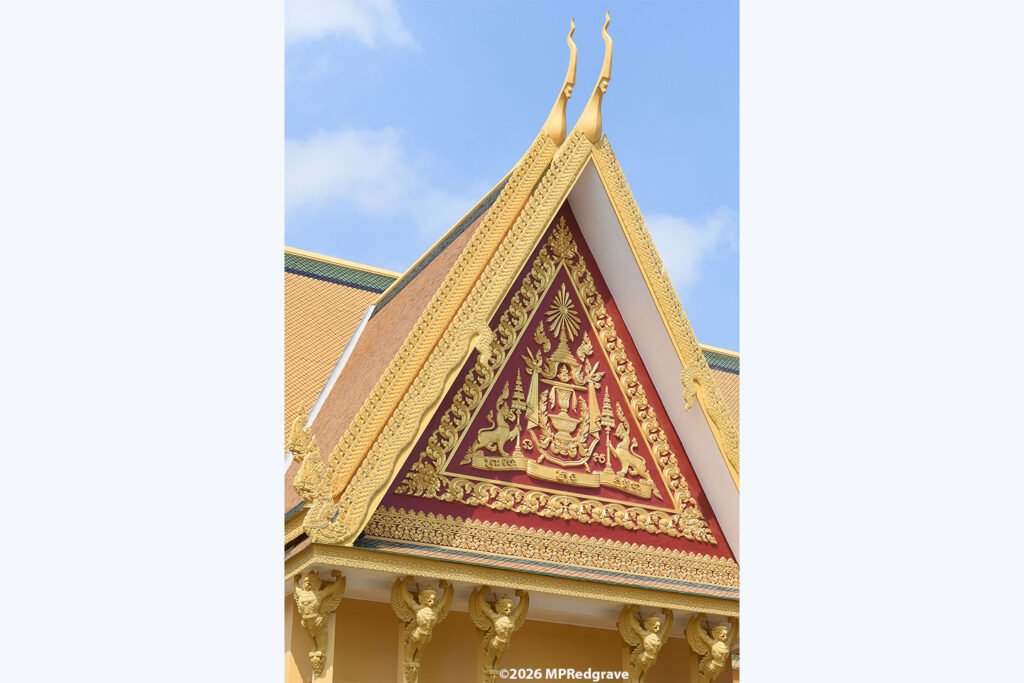
This side pediment of the Throne Hall shows some of the characteristics of the buildings in the Royal Palace. First, notice that the roof has multiple levels, with a choah phka at the peak of the gable. This pointy feature is intended to be the tip of the tail of a naga, the multi-headed serpentlike mythical creature that protects the building from evil spirits. Along the angled roofline valences, you can see yet other serpents, in this case single-headed nagas that exclusively protect the royal family. Below the pediment, supporting it, is a team of winged garudas, sworn enemies of the nagas. Oddly enough, the combination of nagas and garudas represents peace. Finally, the gold features within the red area of the pediment (at least in this pediment) represent the sacred majesty of the royal family.
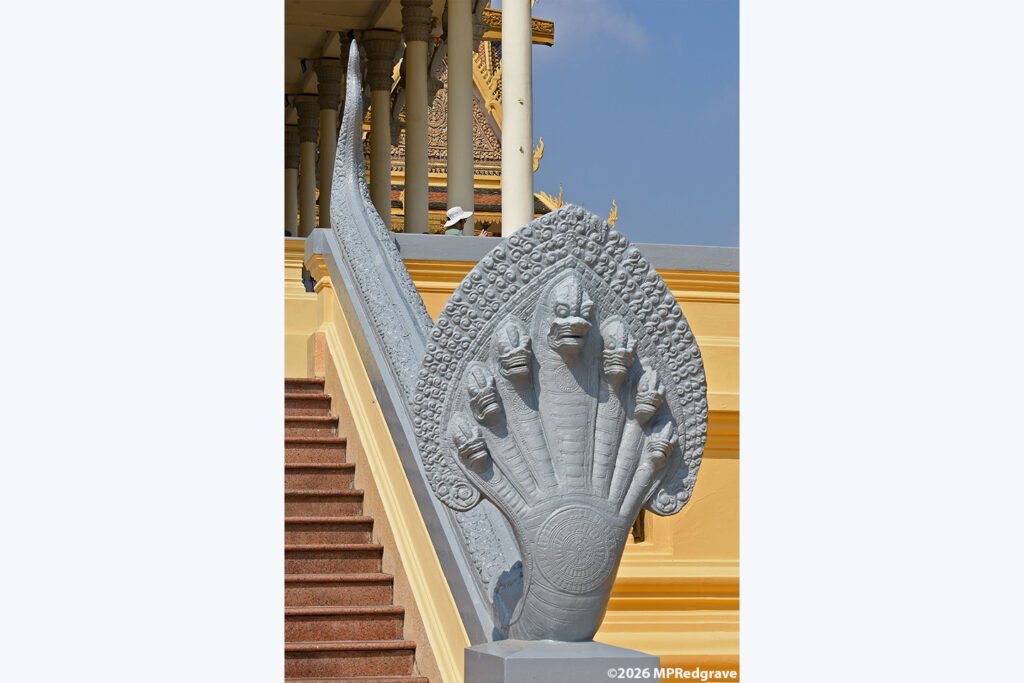
We’ve encountered this creature before at Angkor Wat. This one is seven-headed and you can see its entire body and tail. Recall that nagas are mythical creatures that protect and guide pilgrims in their attempt to cross between the earthly and divine realms. They also protect important buildings (the Throne Hall, in this case) from evil spirits.

This might look familiar to you—it’s a model of Angkor Wat. I was surprised to find it next to the Silver Pagoda at the Royal Palace. This model would have made describing Angkor Wat to you so much easier!
In this view, we’re looking at the east side of Angkor Wat (i.e., the side opposite from the entry causeway). Remember when I climbed the steep stairs up to the Bakan Gallery? In this model, that’s the closest left tower of the center 5 towers of the Bakan Gallery. The model clearly shows you the Outer Gallery, Middle Gallery, and the Inner (aka, Bakan) Gallery. I’m still pinching myself that I have actually been there for real!