Vietnam and Cambodia
Cambodia's National Museum
My next stop in Phnom Penh was the National Museum of Cambodia. The Museum is renowned for having a comprehensive collection of Khmer artifacts, from pre-history to present day.
Our tour guide assured us that photography was allowed, provided you didn’t use a flash. So off I went—ditching the group and guide, camera in hand—to see some cool stuff and get some good shots. And I think I did. Well, I got busted. After a couple of rooms, a guard came up to me, wagging her finger, saying, “No Pictures!!”. I pleaded that our tour guide had said it was allowed, but just got another finger wag. Okay, I wasn’t going to argue with her, but then I had a thought—I pulled out my cell phone and pointed to it. “Yes, that okay,” she said. So taking pictures with a camera that’s in a cell phone is okay, but taking pictures with a stand-alone camera is not. That made no sense at all to me, but I’ll follow whatever silly rule they may have. At least she didn’t make me delete the photos I already had on my camera!
Here are some photos, a mix from my camera and my cell phone:

The National Museum has played a crucial role in preserving Cambodia’s antiquities. Looting and vandalism have been problems for centuries at the country’s historic sites, but reached their peak in the 20th century when a lucrative market for original antiquities arose in Europe. The National Museum—ironically with support from the French—acted to stem the loss of these antiquities by removing them from their original locations and storing them in the Museum’s Phnom Penh facility. In some cases—think of the monkey-soldiers at Banteay Srei—the Museum created nearly exact replicas to replace the original antiquities in their original settings.
The current National Museum buildings opened in 1920 and, except for the Khmer Rouge years, have been in continuous operation ever since.

This life-sized polished sandstone statue of Vishnu is from Phnom Da, a ruined Hindu temple in southeastern Cambodia, near what is now the Vietnamese border. It’s thought that this work was created in the 6th century. Vishnu is depicted as having 8 arms (3 of which have broken off and been lost), representing his dominion over the 8 directions of the Hindu universe, what we would now call the points of the compass (i.e., East, Southeast, South, and so forth around the compass). In Hinduism, each of those directions is associated with its own deity, each of which has responsibility for maintaining order in a specific aspect of existence. For example, Indra is associated with East and is responsible for light and divine power. Together, the 8 deities are under the dominion of Vishnu, who has overall responsibility for preserving order in the universe.
Archaeological research suggests that the stone Phnom Da temple was constructed in the early 6th century under Khmer King Rudravarman and that this statue may date from his reign. There is evidence that long-lost wooden temples existed on the site well before then, perhaps as early as the 16th century BC.
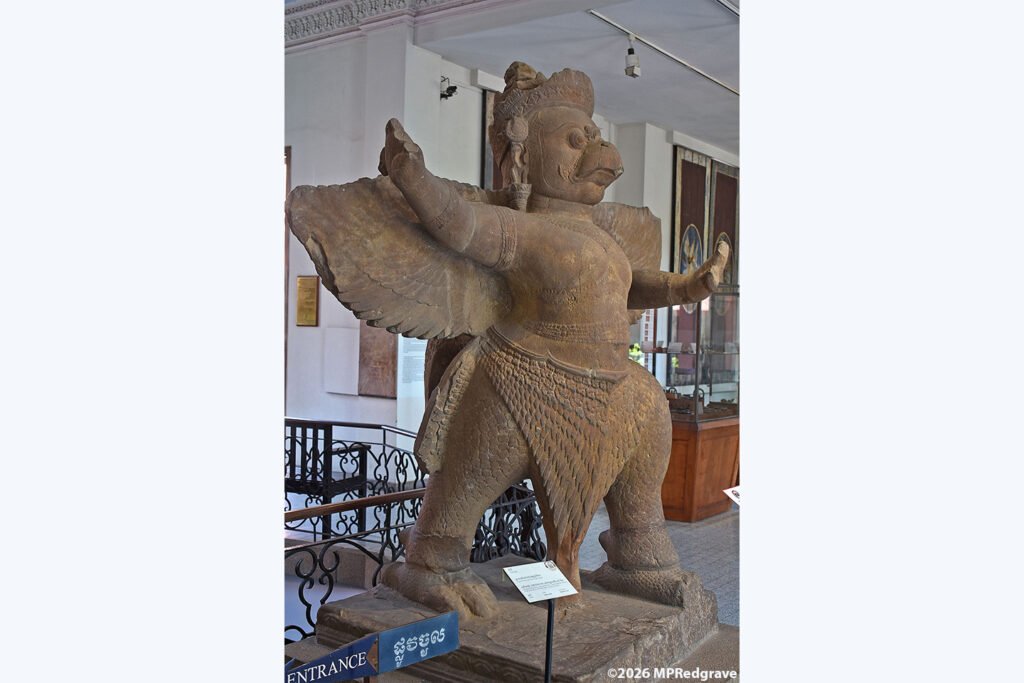
This statue of garuda, which you might recall is a mythical bird-like creature, is stout and stocky, not bird-like at all (you can compare it to the slimmer garudas we saw at the Royal Palace). It is an example of Koh Ker Style, a look to the statues that is found only in the Koh Ker area of Cambodia. Koh Ker, now completely in ruins, is a remote, jungle-covered archaeological site some 120 kilometers (call it 75 miles) north of Angkor. It was briefly the capital of the Khmer Empire, from 928 to 944 (some 200 years before Angkor Wat was built). Let me tell you the story of Koh Ker and I’ll connect it in the end with Koh Ker Style.
In 921, Jayavarman IV ruled the remote, sparsely populated area of Koh Ker, essentially as a provincial governor. When his grandfather, the Khmer king, died that year, Jayavarman IV laid claim to Khmer Empire’s throne, but his bid failed and the throne went instead to his cousin. Jayavarman did not accept that he had lost and declared himself king of the Khmer Empire anyway. He deemed that the new imperial capital was Koh Ker. When his cousin died in 928—a death most historians believe Jayavarman IV had a hand in—Jayavarman IV became the undisputed king of the Khmer Empire.
As undisputed king, Jayavarman IV immediately embarked on a building program to turn the jungle around Koh Ker into a capital that would rival Angkor. During his 13-year rule, he had on the order of 120 buildings constructed, of which 40-some were temples (the exact number is unknown because archaeologists are still uncovering the city of Koh Ker). One of those temples is the magnificent Prasat Prang, a 7-tiered 118-foot-tall pyramid that is thought to have been Jayavarman IV’s official state temple. The building effort continued until Jayavarman IV died in 941. His son (Harshavarman II) succeeded him, but stopped the building and died soon thereafter, in 944. His death, scholars say, was probably arranged by his uncle, Rajendravarman II (yes, the same Rajendravarman II of Banteay Srei), who ascended to the Khmer throne. Rajendravarman immediately moved the Khmer capital back to Angkor and abandoned Koh Ker.
Centuries passed and Koh Ker was mostly forgotten. It wasn’t until the late 19th century that French adventurers returned with stories of a lost city hidden in the dense jungle of northern Cambodia. The French then mounted an expedition to Koh Ker and found a trove of statues and reliefs. The expedition looted many of those treasures and took them to France (some can be seen today at the Musée Guimet in Paris).
Scholars in France examined the statues and realized they were that were unlike those found anywhere else in Cambodia. The figures from Koh Ker were large and heavy set, unlike the slimmer, more life-like figures found elsewhere. They coined the term “Koh Ker Style” to describe the stocky statues found at Koh Ker. It’s assumed that the statues at Koh Ker look the way they do because that’s how Jayavarman IV wanted them to look.
Because they are rare and unusual compared to the slimmer statues found elsewhere in Cambodia, Koh Ker Style statues are prized antiquities. Looting has been a constant problem ever since the French “found” Koh Ker in the 1880s and brought examples to Europe. Many of the looted examples are in European museums, but some are held in private hands. The looting and trading of Koh Ker Style antiquities is illegal under Cambodian law, but that doesn’t stop the trade or the loss of looted items smuggled out of the country. This example is secure in the National Museum, but those still in Koh Ker are largely unprotected because of the remoteness of the site and the difficulty of policing it.

This robust statue of the Hindu deity Ganesha is from the ruins of Koh Ker and is an example of the Koh Ker Style.
In Hindu mythology, Ganesha is the “son” of Shiva and Parvati. There are several stories about Ganesha’s creation and how he got his elephant head, but the most popular story seems to be that Parvati created Ganesha from turmeric paste and sandalwood to be her guard, but didn’t tell Shiva that she had done that. When Shiva arrived home, Ganesha challenged Shiva, not knowing who he was, and Shiva lopped his head off! Parvati was heartbroken, so Shiva looked around for another head for Ganesha, found an elephant, lopped its head off and attached it to Ganesha’s body, and breathed life back into Ganesha. Shiva’s breath also breathed divinity into Ganesha.
Ganesha is the Hindu god of new beginnings, wisdom, and success (often interpreted to be good luck). He is revered as the “remover of obstacles.” Ganesha is typically depicted as having anywhere from 4 to 8 arms, a rotund belly that’s out of proportion with the rest of his body, and, of course, an elephant’s head. In this Koh Ker Style interpretation, Ganesha is stout all over and, oddly, has only 2 arms.
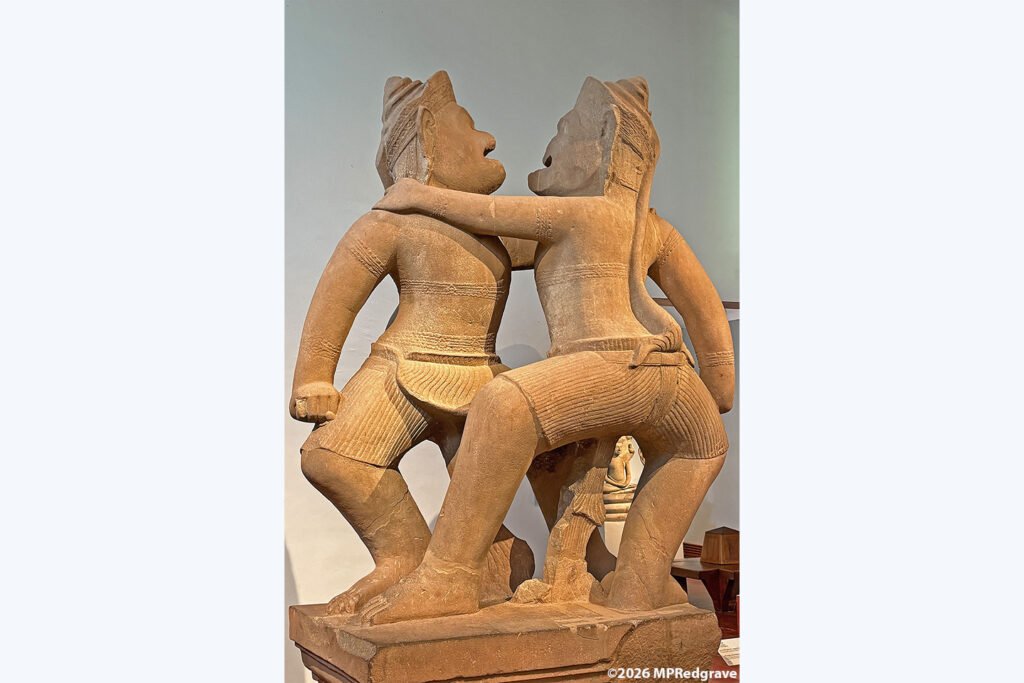
In another story from the Hindu epic, the Ramayana, two monkey-soldier brothers, Sugriva and Vali, came to blows with each other over a misunderstanding. Sugriva was the younger, more thoughtful diplomat of the two, whereas Vali was the pugnacious, hot-headed older brother who had become the King of Kishkindha. While Vali was battling a demon inside a dark cave, Sugriva saw blood pouring out of the cave’s opening. Sugriva assumed his brother had been killed, so he sealed the cave and reluctantly took the throne. Some time later, Vali, who had survived, returned to reclaim the throne, but found that his younger brother had taken the throne. Thinking he had been betrayed by his brother, Vali engaged in a fight with his brother, and that’s what’s depicted in this statue (from 11th century Angkor).
Just to complete the story, Vali was victorious in the fight, stole Sugriva’s wife, and exiled his brother to Rishyamukha Hill, a place that Vali could not go. Some time later, Sugriva encountered Rama (an avatar of Vishnu), who was on a quest to rescue his kidnapped wife, Sita, from an evil demon, and told Rama that his brother Vali had stolen his wife. Rama, angered at what Vali had done to Sugriva, entered into a pact with Sugriva to help Sugriva reclaim his wife provided Sugriva would have his army of monkey-soldiers help Rama rescue Sita. Rama, from afar, shot and killed Vali, stating that stealing one’s brother’s wife was unpardonable and reduced Vali to the status of a mere beast in the manner of the hunt (as opposed to hand-to-hand combat between equals). Rama saw to it that Sugriva was restored to the Kishkindha throne and reunited with his wife. He then left to rescue his own wife and took Sugriva’s monkey-soldiers with him, under the command of the monkey-soldier general, Hanuman. That’s quite a long story, but the Ramayana is an epic after all!
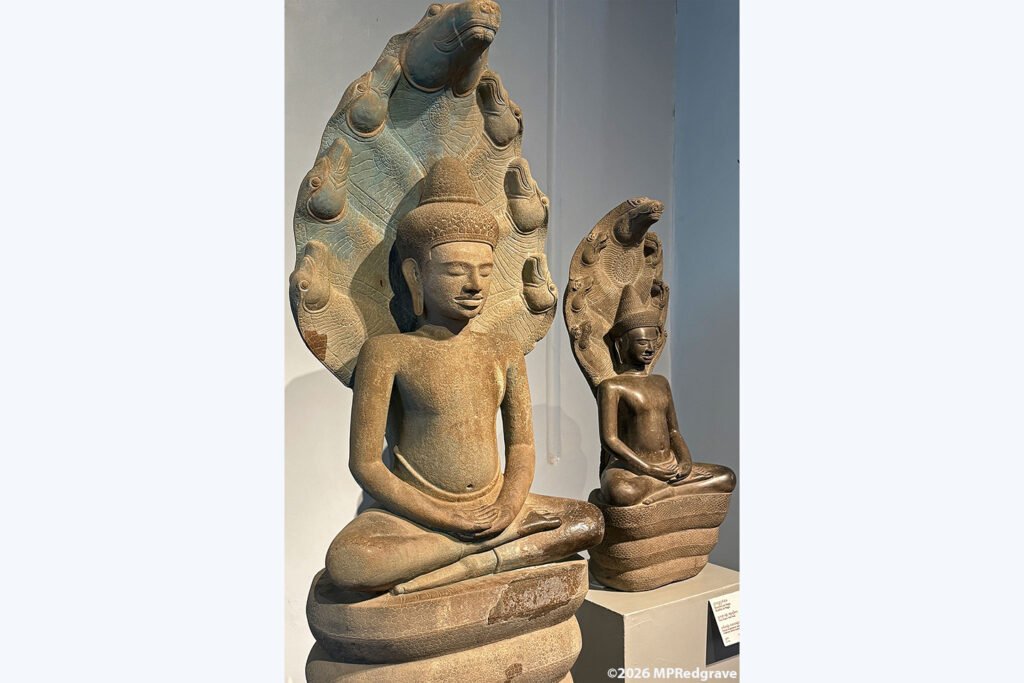
These two stone sculptures, while nearly identical, were created a century apart—13th century on the left, 12th on the right. Both are from Angkor, and each was rescued by the National Museum from a ruin in Angkor that had suffered looting.
Both statues depict the Buddha seated on the coils of Muchalinda, king of the nagas. If you’ve followed my travels, you’ve seen several nagas before. Recall that a naga is a Khmer mythical serpent-like creature that usually has 7 (sometimes more, sometimes fewer) heads arrayed in a fan. Nagas welcome and protect the worthy on their path from the human to the spiritual realms. Here, Muchalinda is protecting the Buddha from the harsh elements of the human realm while the Buddha is in deep meditation shortly before he achieved enlightenment.