Vietnam and Cambodia
The Bayon
When Jayavarman VII rose to the throne of the Khmer Empire in 1181, he successfully drove the Champa Empire from Khmer lands and re-established the capital of the Khmer Empire in Angkor Thom, about a mile north of Angkor Wat. Jayavarman VII, though, did not want to use Angkor Wat as his state temple—he was Buddhist and Angkor Wat was Hindu—so he had his own temple built in the center of Angkor Thom.
Jayavarman VII called his temple Jayagiri—Victory Mountain—but that name was forgotten after his reign ended and the site fell into ruin. In the late 19th century, a French explorer, Éttienne Aymonier, while performing a systematic survey of the ruins of Khmer Empire, dubbed the temple Le Bayon—probably a corruption of banyan, after Aymonier heard locals refer the site as the banyan site, after the banyan trees that grew there—and the name stuck. Today, the temple is known as The Bayon. Ironically, the original name of the temple was always there to be read in the temple’s Khmer script carvings.
Here are some photos:

This is The Bayon's east, main entrance, side. The first thing you may notice is how much more ruined The Bayon is compared to Angkor Wat. It was built of the same sandstone rock as was Angkor Wat, but many of the stones at The Bayon are highly eroded and many more stones there have fallen to the ground, both of which are rare at Angkor Wat. I have read that the different fates of the two temples have more to do with the different personalities of the two kings than anything else.
Suryavarman II’s Angkor Wat was meticulously planned and engineered and took many decades to construct. The foundation of the Angkor Wat temple was designed to support the temple’s immense weight and to provide a stable platform in both wet and dry conditions. The stones used at Angkor Wat were large and fitted precisely together to diminish the possibility of water intrusion and the erosion that could cause. Suryavarman II was willing to take the time and effort to build an enduring structure, one that resisted the ravages of time.
Jayavarman VII’s Jayagiri (original name of The Bayon) shows little in the way of long-term planning, with its haphazard array of hallways, rooms, and towers. Modern examination of the temple’s foundations suggests its engineering was likely to have been the result of an on-the-spot approach. In fact, much of the foundation of the initial temple simply reused the foundations of structures that were already on site, whether or not those foundations could support the new structure. Construction of the temple was continuous during Jayavarman VII’s 30-odd year reign, but often involved tearing down existing structures to build hastily planned new structures. The stones used at Jayagiri were small (at least by comparison to those used at Angkor Wat) and were not as carefully fitted. Water could seep between the stones, eroding and destabilizing them. But their advantages were that they were more easily handled, could more easily be changed, and cost less.
Jayavarman VII was said to be intolerant of minding details. He demanded that his wishes be carried out as quickly as possible, by whatever means necessary. That attitude led to the use of less careful construction techniques and the use of cheaper materials than we see at Angkor Wat. My guess is that Jayavarman VII would be entirely okay with that.
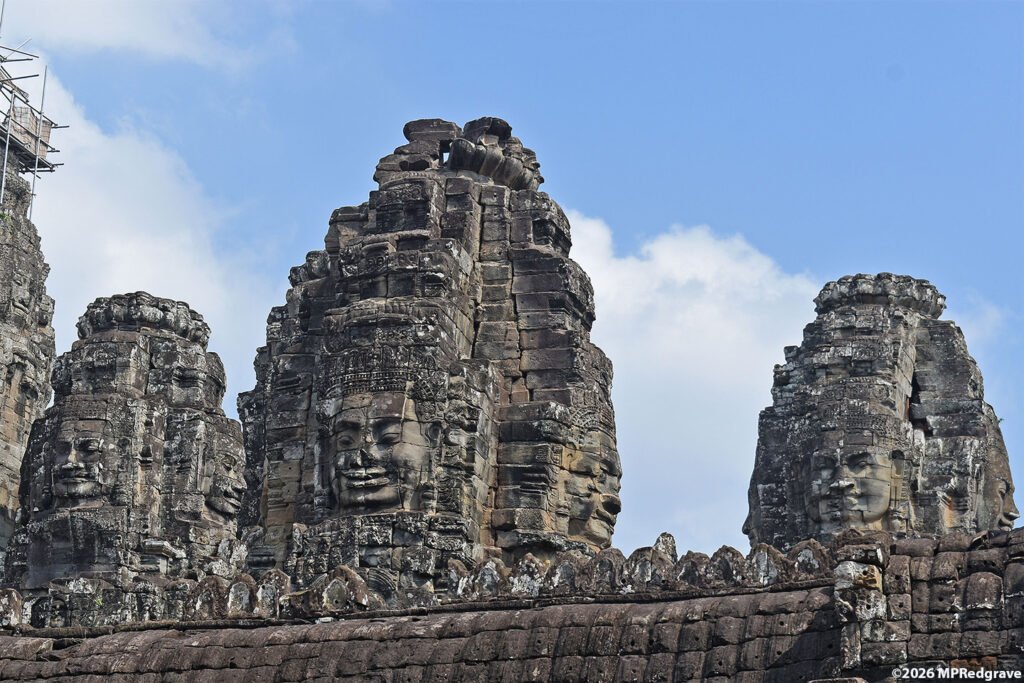
The Bayon, despite its status as the state temple, was very much a tribute to Jayavarman VII himself. By the time of his death, the Bayon had 54 of these 4-faced towers, one for each province of the Khmer Empire under Jayavarman VII’s rule. In the Mahayana Buddhism that Jayavarman VII subscribed to, the 4 faces represent the Bodhisattva Avalokitesvara, a compassionate spiritual being that delayed its own achievement of Nirvana to help others reach that realm. The 4 faces, each facing exactly north, east, south, or west, represent the Bodhisattva’s omniscience, divine authority, infinite mercy, and spiritual oversight.
You may notice that all of the faces of the Bodhisattva are the same—it’s the smiling face of Jayavarman VII. It seems he fancied himself to be the Bodhisattva Avalokitesvara himself, thereby claiming the Bodhisattva’s characteristics (the most important of which being divine authority, I’d bet) over each of the provinces in his rule. The man had an ego!

This is a stone sculpture on display at The Bayon of the Buddha seated on the coils of a naga. The naga is a Khmer mythical serpent-like creature that has 7 (or sometimes 9) heads arrayed in a fan. Nagas welcome and protect the worthy on their path from the human to the spiritual realms.
This sculpture is reminiscent of Buddhist mythology that describes the naga king, Muchalinda, protecting the Buddha from harsh elements while the Buddha was in deep meditation shortly before the Buddha achieved enlightenment. Look closely at the face in this sculpture. Yes, it’s Jayavarman VII again. Like I said, the man had an ego.

Jayavarman VII may have equated himself with the Bodhisattva Avalokitesvara, and even the Buddha, but there is no argument that he was one of the greatest Khmer kings. Under his rule, Jayavarman VII expanded the Khmer Empire to its greatest ever geographic extent, vastly expanded the Khmer roadway network, and built more than 100 hospitals scattered throughout the Empire, to say nothing of the dozens of Buddhist temples he had built throughout the Empire. And to top it all, Jayavarman VII, who took the throne at age 61, ruled well into his 90s.
One of Jayavarman VII’s greatest achievements was the large and accomplished army that he amassed. Led by the storied war elephants—the 12th century version of a tank—the Khmer army was invincible. This bas relief from The Bayon celebrates Jayavarman VII’s war-elephant-led army.

The Bayon is filled with long hallways that lead nowhere in particular. It’s as if there were no master plan for this temple (hint: there wasn’t one!).

As we walked through The Bayon, it wasn’t unusual to look through a doorway to see another doorway or—at least in this instance—two doorways to a dark windowless room. It also wasn’t unusual to see two openings into one room that were different sizes and at different floor levels. Obviously, speed of construction was the priority, not quality. But one thing every doorway had was a view of another tower with Jayavarman’s smiling face looking back at you!