Vietnam and Cambodia
Banteay Srei
The last Khmer Angkor-region temple that I will take you to is Banteay Srei (pronounced Bahn-tay Sray). Banteay Srei differs from the other temples we’ve visited in the Angkor plain in several ways. First, it is much older—it was completed in 967, almost 150 years before construction on Angkor Wat started. The 12th century (Angkor Wat era) Khmer Empire’s technological and cultural sophistication was second to none in the world, but in the 10th century (Banteay Srei era), the Khmer people were far less advanced. They lacked the engineering skill and social organization that the people who built Angkor Wat and The Bayon possessed, and Banteay Srei reflects that.
Banteay Srei is located about 15 miles (call it 25 kilometers) as-the-crow-flies northeast of Angkor Wat. Driving to Banteay Srei today from Angkor covers a distance about half again farther and takes the better part of an hour. In the 10th century, traveling from Angkor to Banteay Srei would have required either a long day’s walk or an equally long cart ride. The area around Banteay Srei has an entirely different feel than does the Angkor Thom/Angkor Wat area—it is much more rural, tucked away in the forest, not near any large population center. When it was constructed, the site was surrounded by a town, but that town never had a large population.
Banteay Srei is the only major temple in the Angkor region that wasn’t built by a Khmer king. Instead, it was commissioned by a pair of high-level courtiers—Vishnukumara and Yajnavaraha, who may have been brothers—both counsellors to King Rajendravarman II (who built his own temples in the center of Angkor—at least one of which was razed and built over by Jayavarman VII 200 years later!). I have to wonder if that’s why Banteay Srei was built in the hinterlands—was the land in Angkor proper reserved for royalty and mere courtiers could not build there? I can’t say for sure, but Banteay Srei’s location is unusual.
The most outstanding differences between Banteay Srei and the temples of Angkor, though, are the stone it was built from and its scale. The temples of Angkor were built using a grey sandstone (specifically a feldspathic arenite), but Banteay Srei was constructed with a red sandstone (a quartz arenite) that is harder, but more readily carved than is the grey sandstone. As a result, the carvings at Banteay Srei are deeper and more detailed—and more durable—than those in Angkor.
The final big difference between Banteay Srei and the Angkor structures is the scale of Banteay Srei. Banteay Srei is small. It covers less area, the buildings are more compactly arrayed on the site, and all of its structures are just smaller. It’s as if everything at Banteay Srei was built at 60% scale. Very odd.
Here are some photos:

Banteay Srei is a 10th century Hindu shrine that was built by two high-level counsellors, Vishnukumara and Yajnavaraha, to Khmer King Ravendravarman II. Yajnavaraha, who was Ravendravarman II’s primary teacher (aka, guru) and might have been Vishnukumara’s older brother, was the more public of the two counsellors and played a more visible role in the development of the temple. On its dedication in 967, it has been recorded that Yajnavaraha claimed that the temple was dedicated to the Hindu god Shiva, but that’s only maybe half true. Yajnavaraha was a devotee of Shiva, but Vishnukumara is believed to have been a devotee of the Hindu god Vishnu. Almost all surfaces of the temple are intricately carved and tell stories from Hindu mythology and sagas. Some of the carvings recite stories related to Shiva, while other carvings recite stories related to Vishnu—and yet other carvings are open to interpretation.
The current name of the temple, Banteay Srei, is the name the French gave to the site when they discovered it in 1914. The site’s original name is unknown. Some suggest it might have been named Isvarapura, the name of the town that surrounded it, though it’s not certain if the town gave the temple its name or vice versa. Others suggest it might also have been named Tribhuvanamaheswara, the term Yajnavaraha used to refer to the site, though it’s not clear if he meant that term to be a name or a description (it means “great lord of the threefold world”, which presumably refers to Shiva).
Banteay Srei is surrounded by a now mostly dry shallow moat on the north and south. That moat is crossed by a short causeway from the east that leads to the temple. To cross into the temple, one doesn’t go through the gopuram in the center of the near wall, instead you pass through the small openings on either side of the gopuram. And you had better duck—those openings are on the order of 4 feet high!
All of Banteay Srei is small. A comparison to Angkor Wat is illustrative. The area of the entire Banteay Srei site inside the wall is a bit less than 0.4 acre. For comparison, the area within Angkor Wat’s Bakan (i.e., Inner) Gallery is 0.9 acres—you could fit a bit more than two entire Banteay Srei temple grounds into the Bakan Gallery alone! That said, there are 12 separate buildings inside Banteay Srei’s wall. To make everything fit, those buildings feel like they are about 60% of normal size.

The center of Banteay Srei is defined by the Sanctuary and the 3 Towers. The 3 towers represent the Hindu Trimurti, the trinity of Hindu cosmology of Creation, Preservation, and Destruction, with each process represented by its own deity—Brahma is the creator, Vishnu is the Preserver, and Shiva is the Destroyer. The base of each tower contains its own temple, dedicated to one of the three Trimurti deities. Which tower is dedicated to which deity? I don’t know! I consulted 4 separate sources and got 4 different answers! One might guess that a tower’s carvings would tell us, but those carvings are apparently open to interpretation. So all I can say with any confidence is that the 3 towers represent the 3 highest-level gods of Hinduism.
In this view, you can only see 2 of the 3 towers. The third is blocked by the Sanctuary, the building in the middle right of this photo. The Sanctuary is the place the faithful must visit before entering the temple of their chosen deity. The idea is that once in the Sanctuary, one can protect oneself from outside influences, clearing one’s mind and heart before exposing oneself to the presence of the chosen deity. And if you were to choose to visit the Sanctuary and your chosen tower, you had better be ready to bend low—the doors into the Sanctuary and the towers are all of 1.08 meters tall, or about 42½ inches!
This photo also gives you a sense of just how crowded Banteay Srei is. It was very difficult to find a view that showed you these main structures without including other buildings. In this shot, for example, the building on the left is the South Library (called that for no reason other than that is what the French who discovered Banteay Srei called it!) and the building on the right is the gopuram to the inner square.

The Sanctuary and the Towers at Banteay Srei are guarded by carvings of the monkey soldiers described in the Hindu epic, the Ramayana. In that epic, Rama—an avatar of Vishnu—enlists the aid of Hanuman, the general of an army of monkey soldiers, to help him defeat an evil demon that had kidnapped Rama’s wife. At Banteay Srei, the monkey soldiers are still aiding Vishnu to ward off evil demons that may wish to enter the sacred Sanctuary and Towers.
The monkey soldier carvings you see here are actually faithful concrete replicas of the original carvings. Those carvings were too attractive to thieves and vandals in the 20th century, so the Cambodian government replaced what was left of them with the replicas in the 1960s. The 2 remaining intact original carvings are in the National Museum of Cambodia in Phnom Penh.
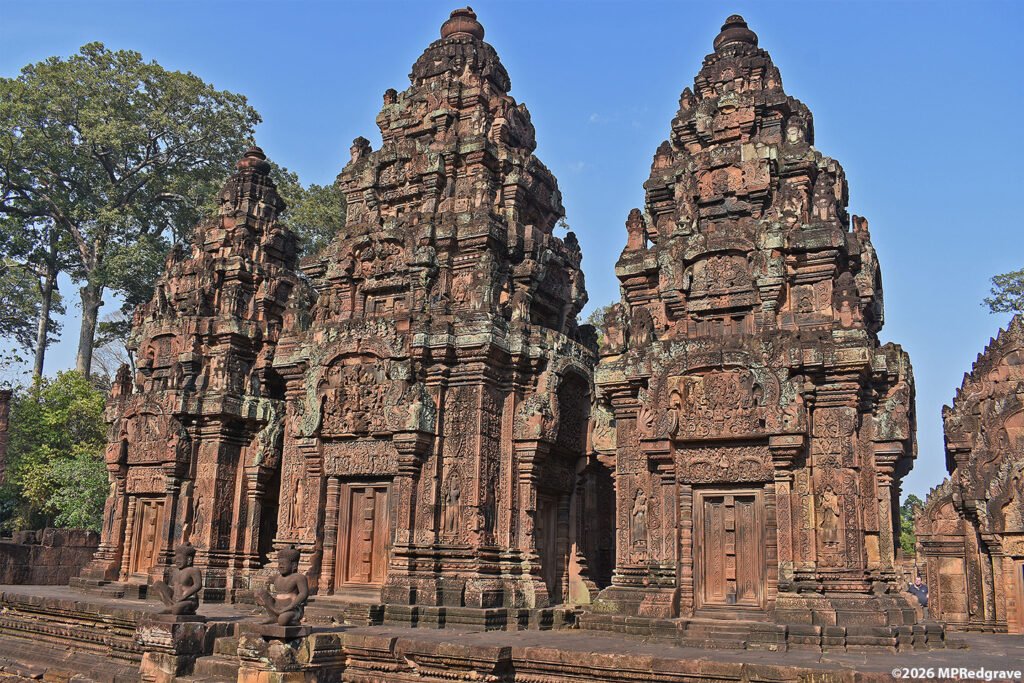
These are the 3 Towers at Banteay Srei, as seen here from the west in the late afternoon. Each tower represents one of the Hindu Trimurti, i.e., Brahma, Vishnu, or Shiva. Each tower has a small temple within its base. While it’s generally agreed that each tower is associated with one of those 3 deities, there’s little agreement about which tower is associated with which deity.
The towers are well proportioned, so it’s difficult to tell how tall they actually are. The answer is not very. The center tower, Banteay Srei’s tallest, from its base to its tip is only 9.8 meters, or about 32 feet tall. Angkor Wat’s center tower, for comparison, stands 72 feet above its base, and the shortest towers at The Bayon stand at least 40 feet above their bases.

When the French uncovered Banteay Srei in the early 20th century, they were stunned by the extraordinary quality of the carvings at the site. The red sandstone that Banteay Srei is built from is harder than the grey sandstone used at the Angkor sites, so it can be more deeply and more finely carved. It is also more durable, so the carvings are less affected by erosion and stand up to time better than does the grey sandstone.
Unfortunately, some of the carvings have been removed and now reside in French museums. The carvings that remain (and they are many), though, are fabulous. This carving, which I believe was a gopuram pediment, depicts Shiva and his consort Parvati riding their bull Nandi. The detail is phenominal!
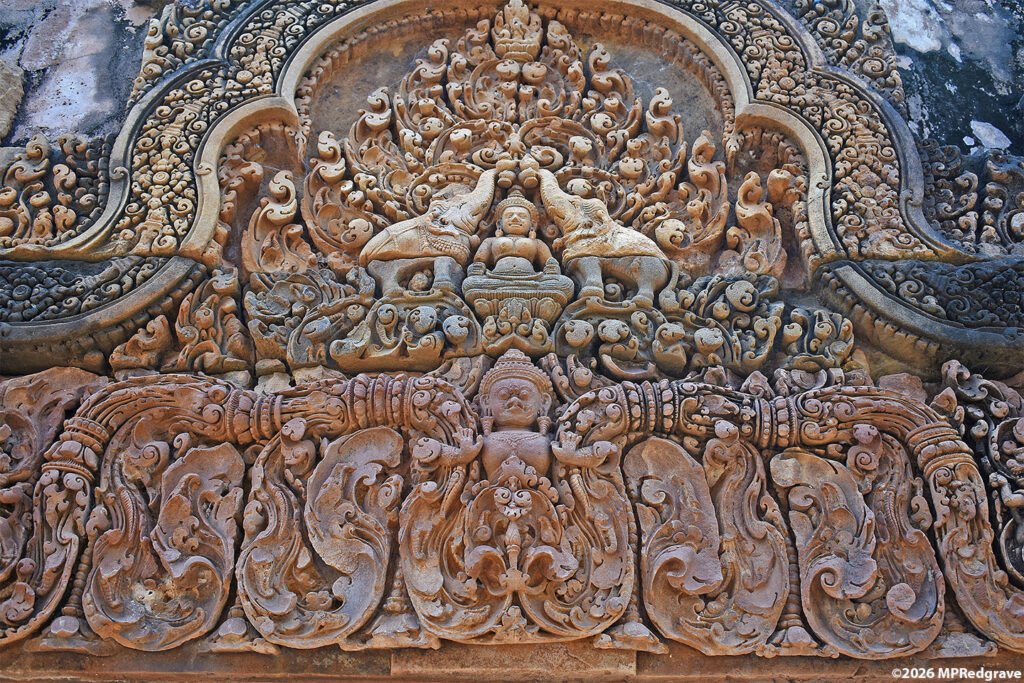
This carving, from another gopuram pediment, depicts Lakshmi, Vishnu’s consort, between two elephants that are pouring water over her from two pitchers that the elephants are holding with their trunks. Wow!
The name Banteay Srei can be translated from Khmer as either the “Citadel of Women” or the “Citadel of Beauty”. The name was given to the site by the French in 1914 because of the beauty and intricacy of the carvings and that many of those carvings depict female deities.

This naga was carved into the corner of the east gopuram of the central courtyard (i.e., where the Sanctuary and the Towers are). Nagas are Khmer mythical serpent-like creatures that have multiple heads (typically 7 or 9, but this one only has 5). Nagas are protective creatures that guard sacred spaces and assist visitors in crossing from the human to the divine realms.

There were several examples of this very tall tree in the forest surrounding Banteay Srei. I was intrigued by it not only because of its unusually tall stature—it towered above the surrounding trees—but also because every now and then I would see a person high up in one of the trees. What is this tree and what are those people doing up there?
The most common name for this tree across southeast Asia is the Yang Na tree, but in Cambodia it is called the Chheuteal tree (and, no, I have no idea how to pronounce that!). Its scientific name is Dipterocarpus alatus. These trees are typically 150-200 feet tall and have long, straight, stout trunks. As you can imagine, the wood from these trees, which is said to resemble mahogany, is highly prized, especially for construction, furniture, and cabinetry. So prized, in fact, that so many of these trees were felled that the species became internationally recognized as vulnerable and most southeast Asian countries passed laws prohibiting the felling of these trees.
And that led to the people being high up in the trees. Those brave souls climb the trees and cut side branches that are large enough to provide wood, but whose removal will not harm the tree (as allowed by regulation). They then carefully lower those branches to the ground with a block-and-tackle system. Needless to say, that wood is now rare and is so valuable it is treated with great care.
In the example in this picture, note the knobs on the trunk below the active branches. Those are places where branches have been harvested in the past.