Vietnam and Cambodia
Angkor Wat, Up to the Bakan Gallery
In my last Angkor Wat post, we entered onto the Angkor Wat grounds in the dark and saw Angkor Wat’s iconic silhouette emerge with the sunrise. In the daylight, we entered the temple itself in the Outer Gallery and passed through the Middle Gallery on our way to the Inner Gallery. It’s the Inner Gallery, which is commonly called the Bakan Gallery—“Bakan” means highest or most sacred in Khmer—with its five towers and the passageways between them, all perfectly aligned with the cardinal points of the compass, that defines Angkor Wat for me. I absolutely had to visit those towers and the Bakan Gallery. It wasn’t easy.
The Bakan Gallery and its five towers symbolize the five peaks of Mount Meru, a central concept of Hindu cosmology. Mount Meru is considered to be the stairway to Svarga, the celestial abode of the Hindu deities. Hinduism teaches that Mount Meru is the center of all universes—physical, metaphysical, and spiritual—and must be climbed to reach the home of the gods.
The Bakan Gallery of Angkor Wat does its best to represent the difficulty of reaching Mount Meru.
Here are some photos:

Here we’re looking up at the Southwest Tower of the Bakan Gallery, as seen from the courtyard between the Middle and Bakan Galleries. You can also see that someone is taking a picture from the central gopuram of the western gallery of the Bakan Gallery. I wondered if I could get there.
Today, we see the sandstone of Angkor Wat in unrelenting shades of grey, the color of the stone, with the occasional splash of gold from the sunlight. Researchers tell us, though, that during the 12th century reign of Suryavarman II, the builder of Angkor Wat, the walls, pillars, and ceilings of the temple were all brightly painted. Those researchers have painstakingly pried tiny flecks of material from Angkor Wat’s surfaces and determined that the temple was originally brightly decorated in red, orange, and black, with accents of gold leaf. Try to imagine how those colors would have changed what you see here. It must have been magnificent!

As we walked through the courtyard between Angkor Wat’s Middle and Bakan Galleries, I saw these female figures that were carved into the wall of the Middle Gallery and brightly illuminated by the early morning sun. They represent asperas, celestial nymphs who dance for the pleasure of the gods. There are over 1800 asperas carved into the walls of Angkor Wat and each is unique. Look closely—each figure has it own facial features, hair arrangement, and arm positions. The Khmer people have fully adopted the asperas as their own—they insist that the asperas represent the beauty and intelligence of Khmer women.

As we walked through the courtyard between the Middle and Bakan Galleries around to the east side of the temple, I finally saw how we were to climb up to the Bakan Gallery—there were stairs up to the Southeast Tower. And oh my, those stairs are steep! It looked like 3 stories nearly straight up! The “tourist” staircase you can see on the left wasn’t quite as iffy as the original stairs you can see on the right, though—the tourist staircase had handrails—but was every bit as steep. Going up would probably be okay, no worse than climbing a ladder, just don’t look down. But coming back down?!! Well, let’s worry about that later—I really want to go up there! So up I went.

As seen from the small open space just to the inside of the Northeast Tower, this is the Center Tower, the highest point of Angkor Wat, glowing in the sunshine. Can you imagine what this must have looked like when it was painted red, orange, and black, with gold leaf as accents and on all the small statues? Or it may have been even more spectacular—some records from the time of construction say the Center Tower was supposed to have been entirely covered in gold leaf! The idea was to make it appear that the Center Tower was shimmering in the sunshine. Alas, all we can do now is imagine it.
The Center Tower has alcoves on its four cardinal faces, i.e., those sides facing north, south, east, and west. Those alcoves now house Buddhist shrines.

Remember the photo in this post looking up at the Southwest Tower? I mentioned that you could see someone taking a picture from the central gopuram of the western side of the Bakan Gallery. This is that spot.
Out of the opening, you can see the central gopuram in the outer wall and the causeway leading to it.

This is the Buddhist shrine in the north alcove of Angkor Wat’s Center Tower.

This photo, looking southeast from the center gopuram of the Bakan Gallery’s south gallery, shows the center gopurams of the Outer Gallery and the Middle Gallery. Notice that the Middle Gallery sits a bit higher than does the Outer Gallery. Symbolically, those occupying the Middle Gallery were closer to the gods than were those utilizing the Outer Gallery.
The Outer Gallery—the first step on the symbolic ascent up Mount Meru—played an educational role with its hundreds of feet of bas relief “storyboards” that recited the myths and sagas of Hinduism. Although I didn’t see them, the Outer Gallery also has storyboard bas reliefs that describe, justify, and glorify Suryavarman II and his reign.
The Middle Gallery played a much different role. While it did contain spaces dedicated to the practice of Hinduism, much of it consisted of what was essentially office space, supporting the king’s bureaucracy and the staff needed to build and maintain Angkor Wat.
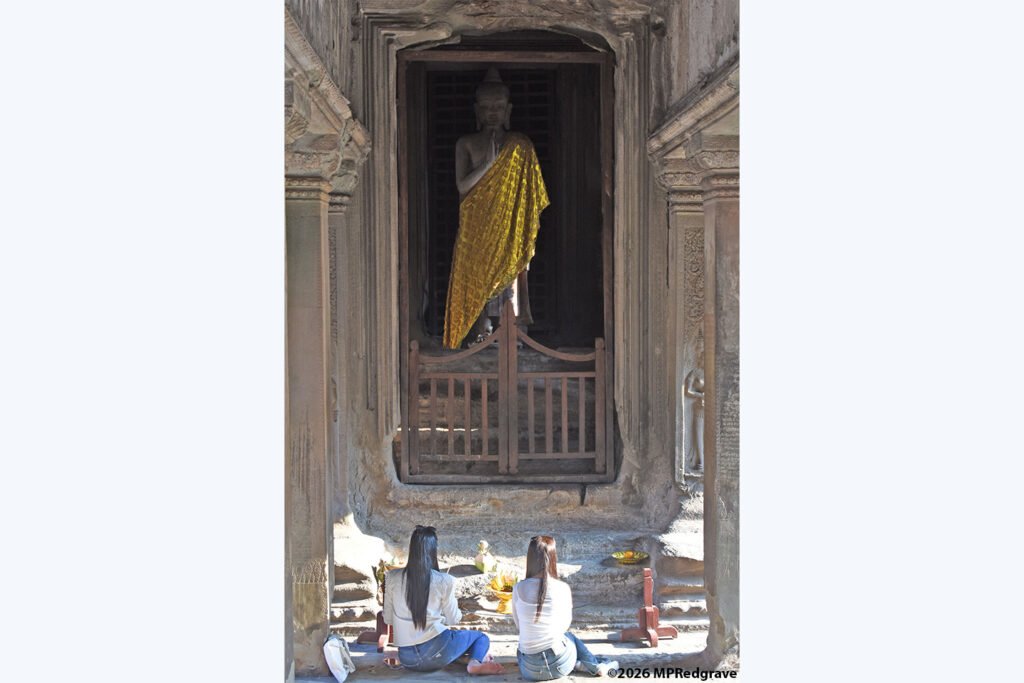
This is the Buddhist shrine in south alcove of Angkor Wat’s Center Tower.
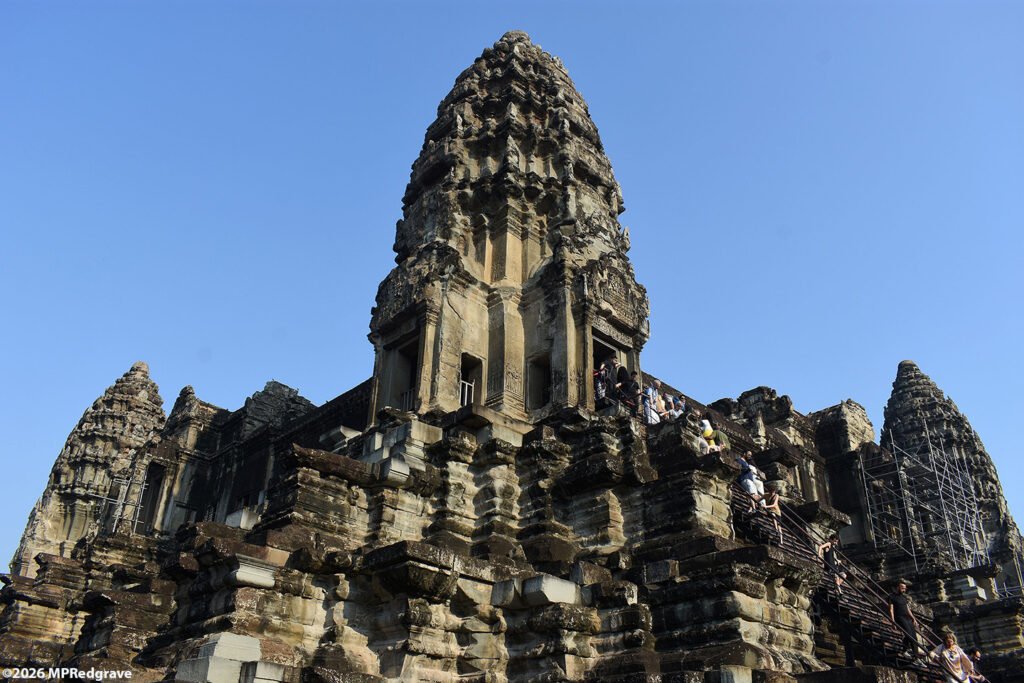
Coming back down the “tourist” stairs was much more challenging than going up. The stairs were so steep (said to be 70 degrees, and I believe that!) that it was impossible to place my foot onto a step without have ⅔ of it hanging off into thin air. And it was also impossible not to look down. After a single step, I realized the best way to get down the stairs was to go down sideways. One step at a time, I put my foot onto the next step sideways. All 41 steps. All the way to the bottom. It took a lot longer to go down those steps than it took to go up them. But should I ever find myself at Angkor Wat again, I wouldn’t hesitate for a moment to go up and down those stairs one more time!
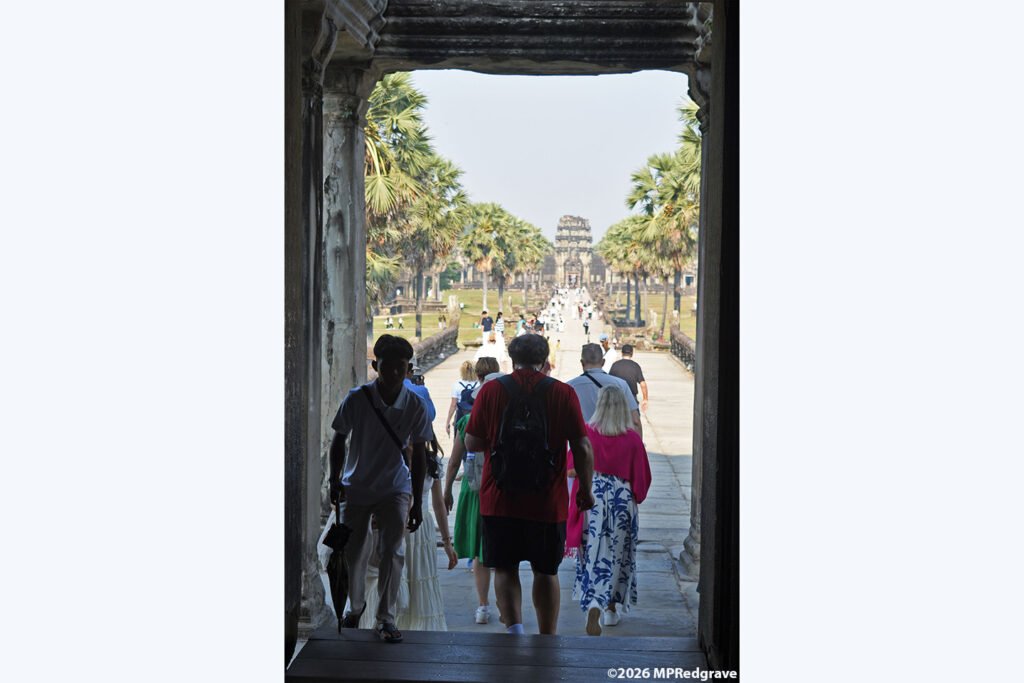
And then it was time to leave. It was a pinch-me moment. I had been to Angkor Wat, that remote place lost somewhere in the forests of Cambodia when I had first heard of it such a long time ago. It was now, to me, a real place, no longer a dreamed-of place. It took over half a century to get here. And it did not disappoint me in the least.
I trailed behind my Sail with Seth colleagues, just ahead of me here, not wanting to leave, not wanting the experience to be over.

I kind of dragged my feet on the way out, not just because I wanted to savor the experience of Angkor Wat just a bit longer, but also because now, in full sunlight, there was more to see. The scale of the Angkor Wat moat, for example, was in full view now. When we arrived in the pre-dawn darkness that morning, I had no real sense of how wide the moat is. In sunlight, I could see that it is huge, wider than many rivers I have known.
Crossing the moat, the causeway is guarded by nagas and singhas. In Khmer tradition, nagas are mythical multi-headed serpents that welcome we mere mortals to sacred places and assist us in crossing from the human to the divine realms. The singhas are mythical lions that look fiercely over the moat’s waters to frighten away evil spirits and protect the divinely-granted authority of Khmer kings.
And then my visit to Angkor Wat was truly over. It was bittersweet to leave, but there was much more to see and experience during this adventure. That said, it’s not everyday that one realizes a decades-old dream. I will always remember Angkor Wat.