Vietnam and Cambodia
Angkor Wat at Sunrise
Cambodia is the home to one of the world’s most magnificent historical structures, Angkor Wat. I was a teenager when I read about a huge overgrown archaeological site in the forests of Cambodia. Under all the vegetation and neglect was a massive and nearly forgotten shrine, something called Angkor Wat. That memory stuck with me over the years and cemented into my mind as a place I would love to see in person one day. A quarter of a century later, I was pleased when I read that UNESCO was organizing an effort to uncover and restore the site, but I really didn’t think I would ever actually set foot there. Astonishingly, three decades after that, here I was, exploring the grounds of Angkor Wat.
Angkor Wat is by far the largest religious complex in the world (it is nearly 4 times larger than Vatican City, for example). Its grounds cover 402 acres, the centerpiece of which is its iconic 5-towered sandstone temple that stands high over the flat Angkor plain. To get to the temple, you approach from the west and cross a 620-foot wide, 13-foot deep rectangular moat that completely surrounds the site. Once past the moat, you need to pass through a 15-foot high outer wall by way of a gopuram (an ornamental entrance to a Hindu temple). The outer wall also completely surrounds the temple, forming a 2¼-mile long rectangle.
Once inside the outer wall, a 1200-foot causeway leads you to the temple. The temple itself is made up of 3 concentric rectangular galleries, the center of which—the Bakan Gallery—has 4 towers at its corners and a taller central tower. All of the galleries are precisely aligned with a cardinal compass direction (i.e., West, North, East, or South). As one proceeds from the outer gallery into the temple, each gallery is at a higher level—with the final level being the height of the central tower—and the steps between the galleries become steeper. Hindu devotees believe that the increasing height and steepness of the ascent through the galleries to the central tower represent the ever-increasing difficulty of ascending to the kingdom of the gods.
Angkor Wat was built in the early 12th century during the reign of the strong and effective Khmer Empire King Suryavarman II as a state temple dedicated to the Hindu god Vishnu. Over a span of 3 decades, work proceeded on Angkor Wat, producing the temple and grounds one can see today. In 1150, though, Suryavarman II died and rule passed to a succession of weak Khmer kings, none of whom had any interest in paying the cost of maintaining Angkor Wat. In 1177, the Champa Empire (from today’s southern Vietnam) invaded and conquered the Angkor plain area of the Khmer Empire. The Champa neglected Angkor Wat.
In 1181, the Khmer Empire throne passed to Jayavarman VII, who proved to be a powerful and effective king. He successfully drove the Champa from Khmer lands and established Angkor Thom (just over a mile away from Angkor Wat) as the new Khmer capital. Jayavarman VII, however, was Buddhist, and did not favor re-establishing the Hindu Angkor Wat as the state temple. Instead, he had the Buddhist Bayon built as his state temple. As a gesture to his wife Indradevi, who had converted Jayavarman VII from Hinduism to Buddhism before his succession to the throne, Jayavarman VII re-dedicated Angkor Wat as a Buddhist temple.
Angkor Wat lay, if not completely abandoned, then neglected for centuries until the late-20th century UNESCO effort led to its restoration. The site, though, has been continuously occupied by Buddhist clergy since Jayavarman VII’s re-dedication of Angkor Wat to Buddhism in 1181. This, in turn, led to those areas of Angkor Wat that the monks used to be maintained and, more importantly, to the knowledge of the site never having been completely lost.
Here are some photos:

We arrived at Angkor Wat in pitch darkness, about an hour before sunrise. Using only flashlights, we found our way to Angkor Wat’s entrance, the gopuram in the west outer wall. Outside of the wall—at least in the darkness—you have no sense of what lies beyond, no hint of Angkor Wat’s iconic towers.
The west entry and the causeway to the temple point exactly east, directly into the sunrise on the equinoxes. We were there well after the vernal equinox, so the sun should rise somewhat to the left of where the causeway pointed.
Slowly, the faint dawn light revealed those iconic towers.
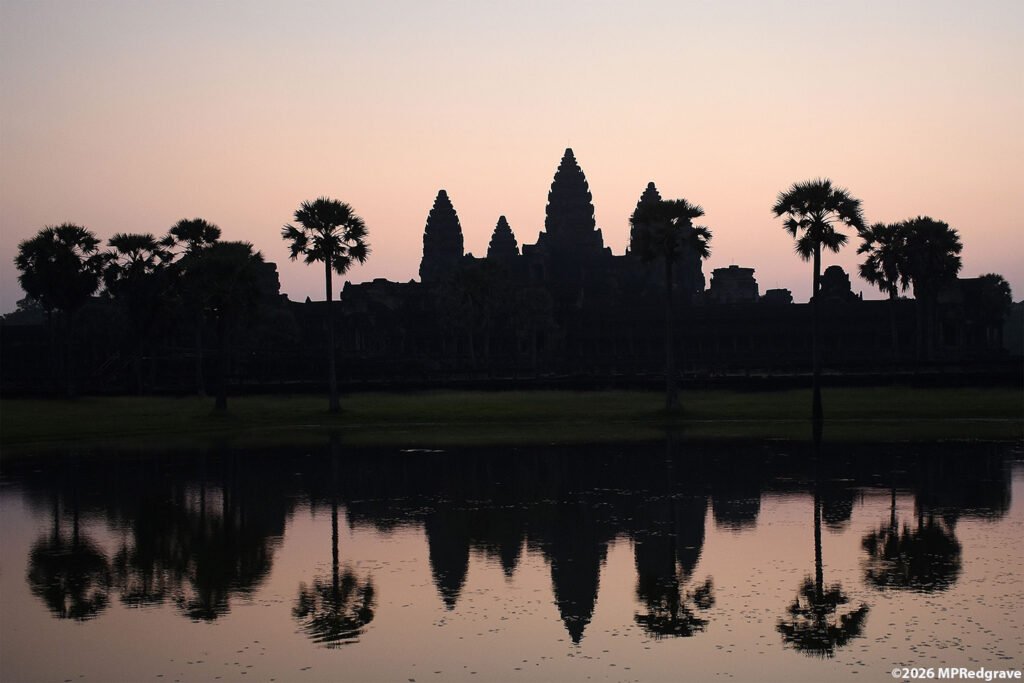
The causeway to the temple is flanked by ponds on either side. I knew the exact time of the sunrise and wanted to position myself so that the sun was rising directly behind Angkor Wat’s central tower. Luckily, the bank on the west side of the south pond had a place where I could wait in exactly the right spot.
This is Angkor Wat at the moment the sun peeked over the horizon.
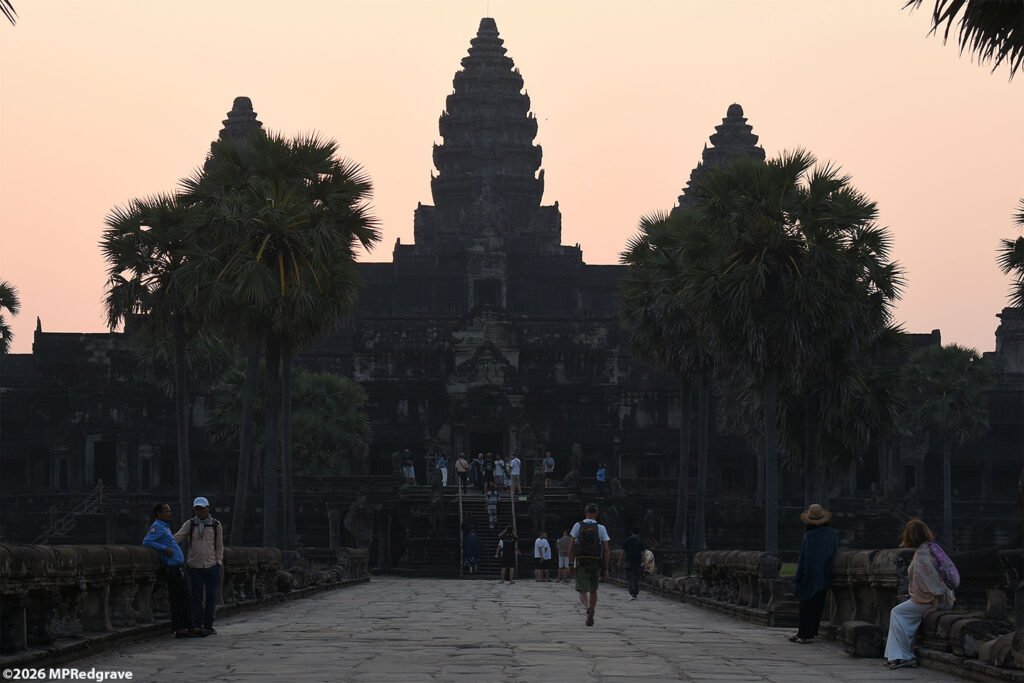
Back on the causeway, just minutes after sunrise, there was just enough light to see some of the details of Angkor Wat’s temple.

A few minutes later, I found myself standing just outside of the northwestern gopuram of Angkor Wat’s outer gallery. Notice that we needed to climb some steps to get to the outer gallery’s level. As we proceeded through the temple to the middle and inner galleries, we would need to climb more steps. This symbolizes, in a very real way, the effort, in the Hindu builders’ eyes, of getting increasingly closer to the kingdom of the gods.

These are the northern towers of Angkor Wat’s 5 towers. The towers are laid out in a quincunx—think of the 5 dots on a die showing the number 5—with four shorter towers in the corners and one taller tower exactly in the center. The towers in the corners are exactly at the northeast, northwest, southwest, and southeast corners of the temple’s inner gallery.
What you’re seeing here are, from left to right, the northeast and northwest towers, with the north wing of the inner gallery between them. Little did I know that I would soon be walking that gallery!

This long colonnade extends from the outer gallery’s northwestern gopuram (where I entered the Angkor Wat temple) due south to the outer gallery’s western gopuram (the one in the center of west gallery). Believe me, it’s not as boring as it looks—go to the next photo…
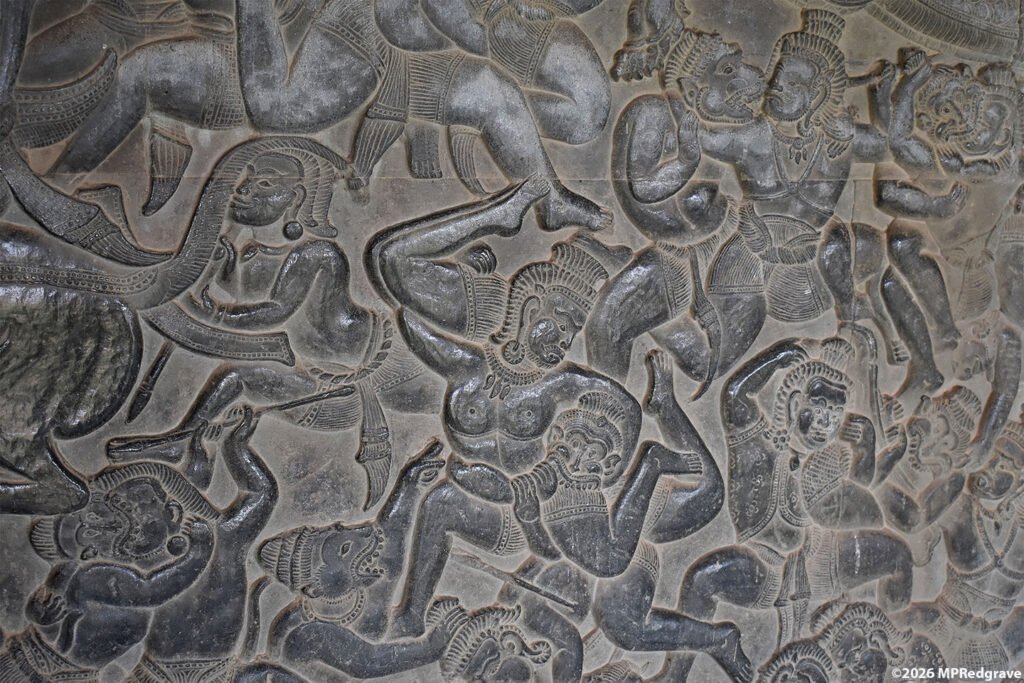
The interior walls of the entire outer gallery are covered in bas relief depictions of Hindu myths and sagas. As we walked slowly through the outer gallery’s West Gallery, I stopped over and over again trying to make out exactly what I was seeing. Section after section (and there are hundreds of them!) depicted scenes of what I later found out were from ancient Sanskrit epics that are revered in Hinduism.
This depiction shows soldiers fighting in the Battle of Kurukshetra—a story on its surface of two families battling for a kingdom, sometimes with the assistance of a Hindu deity or two—as narrated in the Mahabharata, one of the revered Sanskrit epics. Part of the Mahabharata’s narration of the Battle—the Bhagavad Gita—is a sacred text in Hinduism said to be the words of the god Krishna himself.
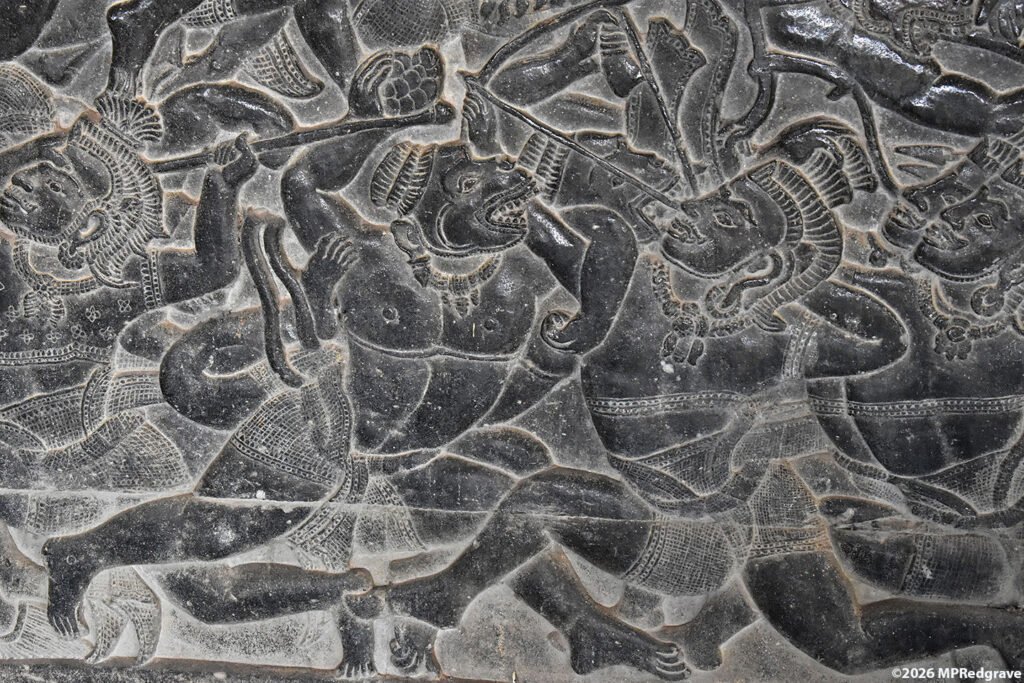
Farther along in the outer gallery’s West Gallery, I saw this image of what I thought was a monkey-headed soldier fighting with a human soldier. It turned out that this was a depiction of the Battle of Lanka as narrated in the revered Sanskrit epic, the Ramayana. In the Battle of Lanka, Lord Rama (an avatar of the Hindu god, Vishnu—to whom Khmer King Suryavarman II, the builder of Angkor Wat, was devoted) seeks assistance from the monkey-soldier general Hanuman and his army of monkeys and bears to defeat the evil demon Ravana and his demon army to rescue his wife from captivity on Ravana’s island, Lanka.
This depiction shows the monkey-soldier general, Hanuman, fighting not with a human, but rather with one of the demon soldiers that serve Ravana, the evil demon who is holding Lord Rama’s wife captive.
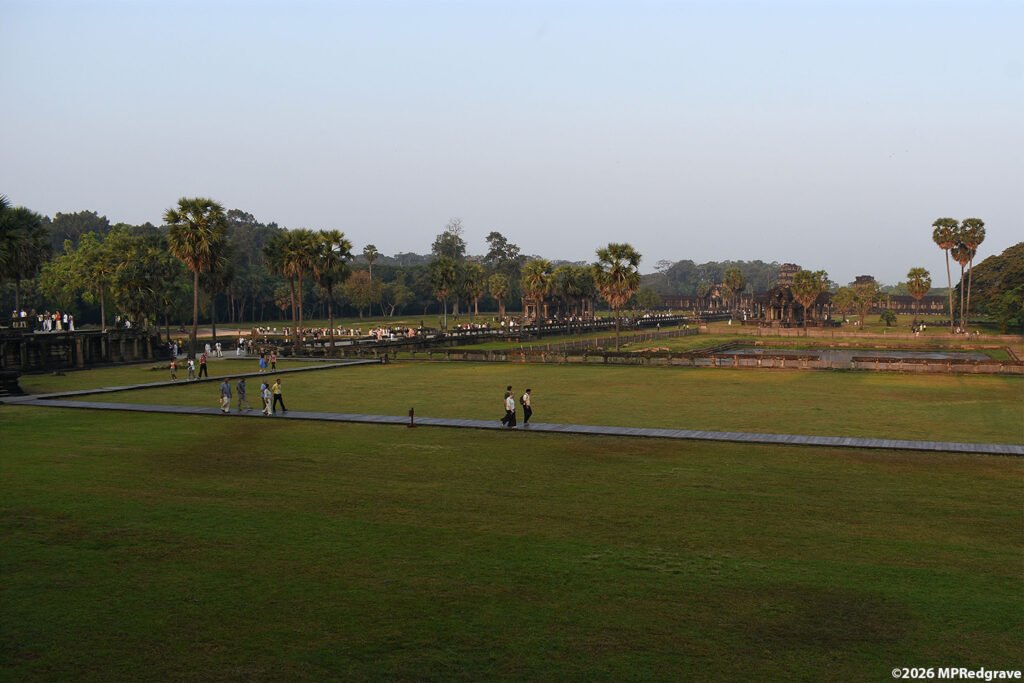
In previous photos, I talked about the causeway we needed to cross to reach the temple. Here, from the temple’s outer gallery, we’re looking back across that causeway to the outer wall and the gopuram that one needs to go through to enter (or I suppose exit in this view) the temple grounds. In this photo, the causeway runs from the left center of the picture to the brown structure halfway between the center of picture and its right edge. The tall part of the brown structure is the gopuram.

In the gopuram of Angkor Wat’s outer gallery’s West Gallery, I found this carving that was very unlike the expansive, but shallow bas reliefs outside of the gopuram. Try as I might, I couldn’t find a name for this type of carving, but it certainly stood out as different from the bas reliefs. It was much more 3-dimensional than the flatter bas reliefs and more intricately carved, and the figures depicted were much smaller (maybe 3 inches tall). I wish I knew more about these carvings—if you know more, please comment below.

This is one of a small handful of Buddhist shines I saw in the middle gallery of Angkor Wat. All were brightly colored—in stark contrast to the drab monotones of the sandstone walls—with a statue mounted on an altar. As best I could tell, the monks had simply decorated existing alcoves without any structural changes, leaving the original Hindu architecture as it has always been.
For this photo, I waited for the monk to finish picking up what I assumed was his prayer mat, but he never moved. At the time, I supposed that his pose was deliberate, perhaps some form of meditation. On closer examination of the photo I took, though, I think he was repairing the mat and was just very fit and flexible and could hold that position for a long time. There’s no way I could stay that bent over for very long at all!
That’s it for this post. In the next post, we’ll move ever farther inside of Angkor Wat, all the way to the temple’s highest inner gallery—and what it took to get there!