Antarctica, Argentina, Uruguay, and Brazil
Antarctica, Whales!
On our 4th day in Antarctica, after a brief stop at the southernmost point of our voyage, we turned back north along the western side of Hansen Island and into Hanusse Bay. Around 6 pm, the ship suddenly slowed and the captain announced that whales had been spotted ahead. OMG, was he right! Off our port side, for maybe the next half hour, Humpback Whales were surfacing and diving almost continuously.
Here are some photos:

When a Humpback Whale dives, it uses its powerful pectoral flippers to force its head nearly straight down. It arches its back and finally exposes its flukes above the water. The whale completes the entire dive sequence in a wonderfully fluid single smooth motion.

These whales seemed to be focused on feeding, which meant they stayed underwater most of the time. They would surface briefly to breathe and then would immediately dive. That meant it was difficult to get a shot of the front end of a whale—you just don't know where they'll surface and their head is only at the surface for a few seconds before they dive again. I was lucky with this shot. This whale surfaced very nearby the ship and I heard it blow, and I managed to get this shot just a moment before it dived. What you're seeing is the whale's head coming almost directly at you. It's blowhole is at its highest point, right at the center of the picture. The rows of bumps on its head are tubercles, which anatomically are enlarged hair follicles. While it's not known for certain, it's thought that the tubercles serve a sensory function, allowing the whale to detect motion and vibrations in the water.

Almost directly in front of me, the whale dove nearly straight down.

This whale swam past me with this left flipper held nearly straight out of the water. Maybe he was waving at us?

Here's another whale a bit later that also surfaced with its pectoral fin out of the water. It quickly rolled so its back was up (it's belly is toward us here) and then dived out of site. By the way, the scaley things sticking out of its flipper are barnacles. Virtually all Humpbacks have barnacles on their flippers. It's not known why for sure, but Humpbacks have been observed using them to strike Orcas.

The Humpbacks were engaging in what's called "bubble-net feeding." They would dive and then swim upward in a tight spiral, all the while releasing air from their blowholes. This creates a curtain of rising bubbles that forces krill and small fish upward within the ring of bubbles, concentrating them near the surface. The whales then swim through the center of the bubble ring and scoop up their meal. I saw this happen a couple of times (you could see the rings of bubbles at the surface) and was so fascinated by it that I didn't get a photo! Oops! What I did get was the aftermath. The whales didn't scoop up 100% of the krill and fish they drove upwards, so the sea birds (gulls, probably Kelp Gulls) would concentrate in these circles where the bubble rings were to catch an opportunistic feast.

Sometimes I would see a pair of whales swimming together. This pair had just started a side-by-side dive, displaying the iconic "humped" backs that give the Humpbacks their name. My guess is that they were working together to create a bubble net.

Here's another pair, just a bit farther away, slightly out of sequence with each other.
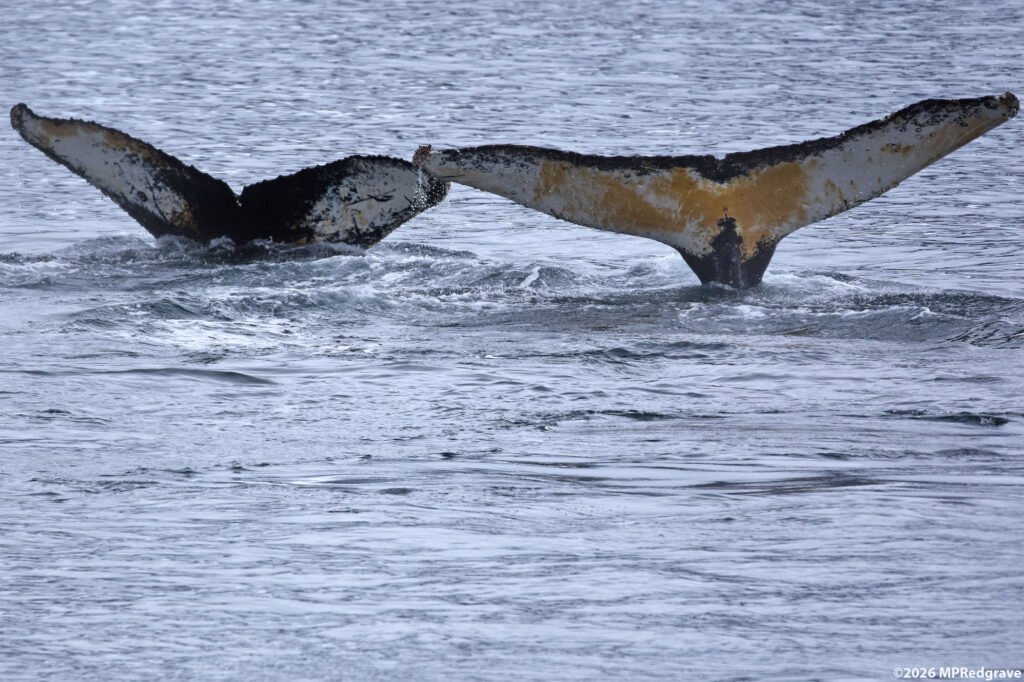
The undersides of Humpback flukes have varying degrees of white pigmentation, from barely any to completely white. Each individual animal has its own pattern of fluke pigmentation, just like a fingerprint in people. Researchers use these patterns to identify individual whales. The yellow color in the flukes of the whale on the right isn't pigmentation. Instead, it's from diatoms that temporarily adhere to a whale's flukes.

As we were leaving the their feeding area, this whale surfaced and dived close to the ship, as if to say "Goodbye." I felt like saying "Goodbye and thank you for putting on such a magnificent show!"