Antarctica, Argentina, Uruguay, and Brazil
Antarctica, Georges Point
In the afternoon of our first full day in Antarctica, we arrived at Georges Point on Rongé Island. It was an exciting stop, because this time we would actually get out of the Zodiacs and step ashore.
Here are some photos:

Georges Point on Rongé Island was our first landing in Antarctica. While the World Voyager lay at anchor offshore—partially hidden here behind an iceberg—we boarded our Zodiacs for the short ride ashore. And we were very lucky about the weather! It was sunny and relatively warm (in the 40s, I’d like to say), but tucked inside our parkas it's kind of hard to know what the temperature is!

As we left the ship, I noticed this oddly shaped iceberg. It looked as if it had ice “mushrooms” growing out of it. Very odd. How did it manage to get that shape?
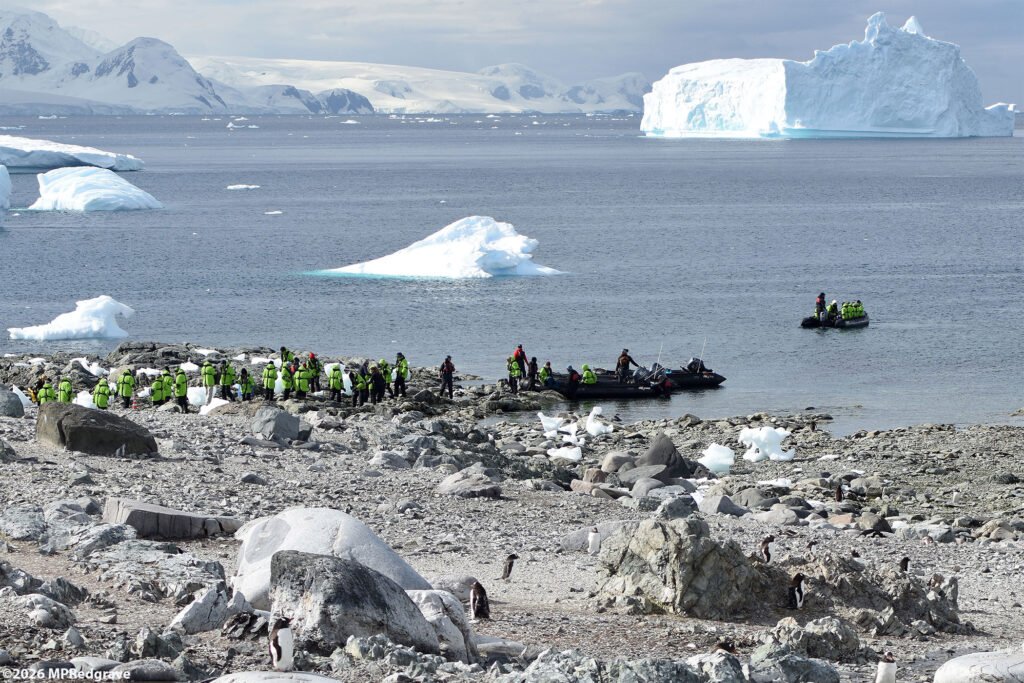
Landings in Antarctica can be a bit challenging. There are no docks, no walkways, just natural rocks and usually water to go through. You sit on the pontoon of the Zodiac whenever you’re onboard (they are very strict about that!). To get off the Zodiac, you scootch your backside to as far to the front as you can get, then swing your legs toward the boat’s stern over the pontoon and then into the water (the heavy and high rubber boots that Atlas provides do a great job of keeping your feet dry). Then you splash your way onto the rocky shore, being careful where you place your feet so you don’t slip. To get back onto the Zodiac, you reverse the process. I thank my lucky stars that at 72 I am fit enough to do this without assistance and with a bit of grace (Mary will laugh when she reads that!), but some of our group have difficulty with the process. The Atlas staff are terrific at providing instruction and assistance to those who need it without making anyone feel bad or embarrassed. I heartily applaud the Atlas staff!

After a short walk from the landing site, I looked around and there were penguins everywhere!

The penguins paid absolutely no heed to us, they just went about their usual business—which apparently included standing still so this parka-clad biped could photograph them! The penguins at Georges Point are Gentoo Penguins. Gentoos—the origin of the name isn’t known—are a bit bigger than the Chinstraps we saw at Melchior earlier in the day, typically standing just under 3 feet tall. While they have a swaying, waddling, not quite clumsy gait on land, in the water they are master swimmers. They have been clocked at over 20 miles per hour while swimming, making them the fastest of all penguins. Their wings may look awkward and pretty useless on land, but in the water, they use them like flying birds use their wings in the air.

I caught this little guy dozing off. On land, Gentoo penguins typically sleep standing up, but they don’t sleep for long. Instead, they engage in microsleeps where they drop off for as little as a few seconds. Researchers have estimated that Gentoos can have thousands of microsleeps a day. It’s thought that this is an adaptation to prevent predation of their eggs and young by skuas, petrels, and kelp gulls. I also read that there is some as yet inconclusive evidence that suggests that outside of their breeding season, Gentoos on land have longer microsleeps, on the order of a few minutes, which lends some credibility to the notion that shorter microsleeps during their breeding season is, in fact, a strategy to protect their offspring.
Gentoo penguins can also sleep when they’re in the water. They are naturally buoyant, so float with no effort. They also microsleep when in the water, the thought being that this allows them to rest while staying alert to the presence of leopard seals or orcas, the primary predators of adult Gentoo penguins.

Inside the penguin colony, I found this Weddell Seal fast asleep. He was out. He would occasionally scratch himself with one of his front flippers, but in the few minutes I watched him, his eyes never opened. The Weddell Seal is an opportunistic predator of Gentoo penguins, and I suspect the penguins would scatter if he moved, but in the short time I watched him, the penguins appeared to take no notice of him.
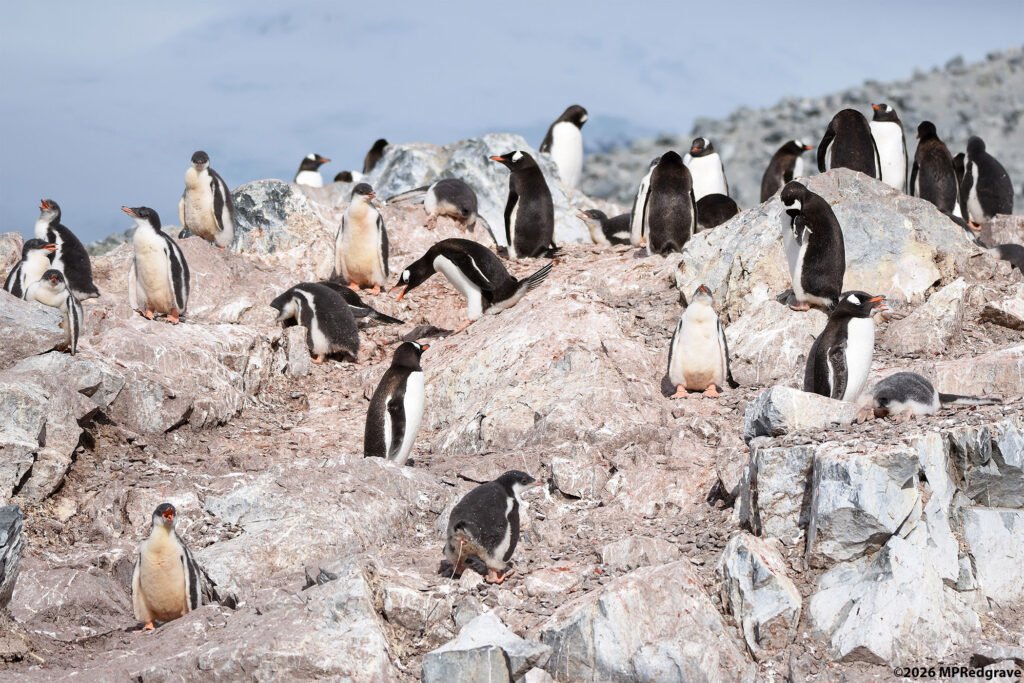
This photo will give you sense of daily life in a Gentoo penguin. There are several individuals that are taking 40 winks (or given their penchant for microsleep, 4 winks?), a few on the left carrying on a conversation, a couple in the center having a rather vocal dispute, and one in the foreground that is, well, shall we say, “visiting the loo”? I did not know that that was in this shot when I took it, but now that I see it, it does open the door to talk about an unusual penguin behavior.
Before this Antarctic adventure, I read a bit about the penguins I may see in Antarctica. One of the many things I learned is that several species, including the Gentoo, get rid of their waste in a projectile manner. It’s thought they do this so that their waste is not underfoot in their nesting area (though, of course, it may land in another’s nesting area, which may lead to an interaction like what we see in the center of the photo!). They also use projectile wasting as a defensive strategy. If they feel threatened, penguins can spin around and project waste onto what threatens them. What I read warned that if you get too close to a penguin, back off because if you don’t it may very well spin around and spray you with its poop. Yuck! Needless to say, I kept my distance!
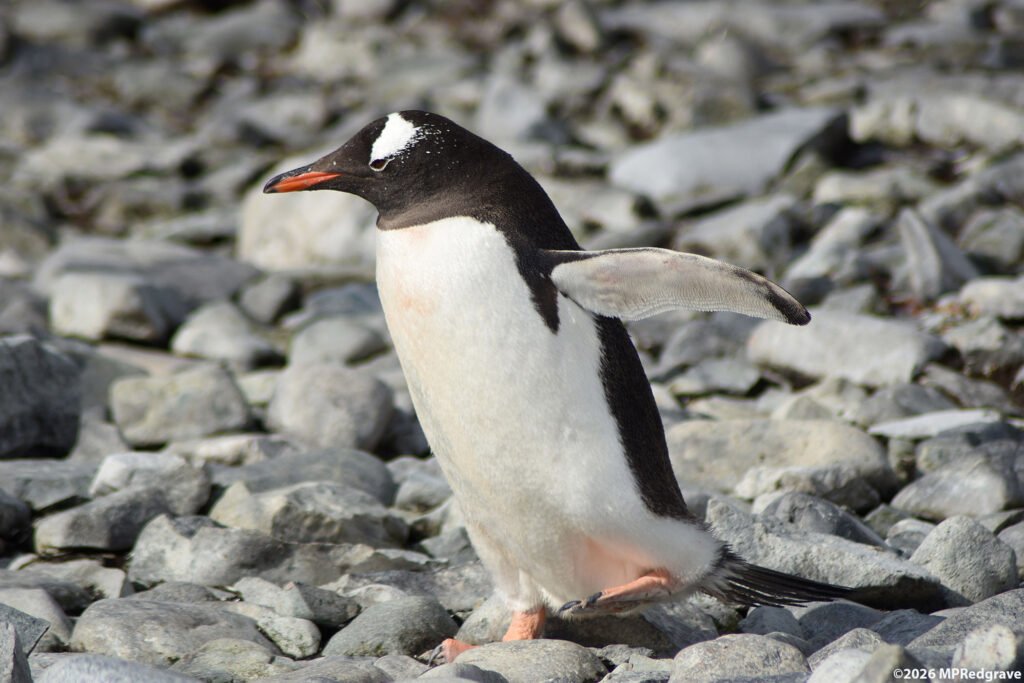
I enjoyed watching the Gentoos walking. They kind of rock from side-to-side as the waddle along, using their wings to balance themselves.

Though they walk stiffly and appear to be awkward, the Gentoos are surprisingly flexible. This guy chose to look behind himself and moved his body very little to do so. Instead, he turned his head around until he was looking almost directly backwards. Wow, I wish I could do that!
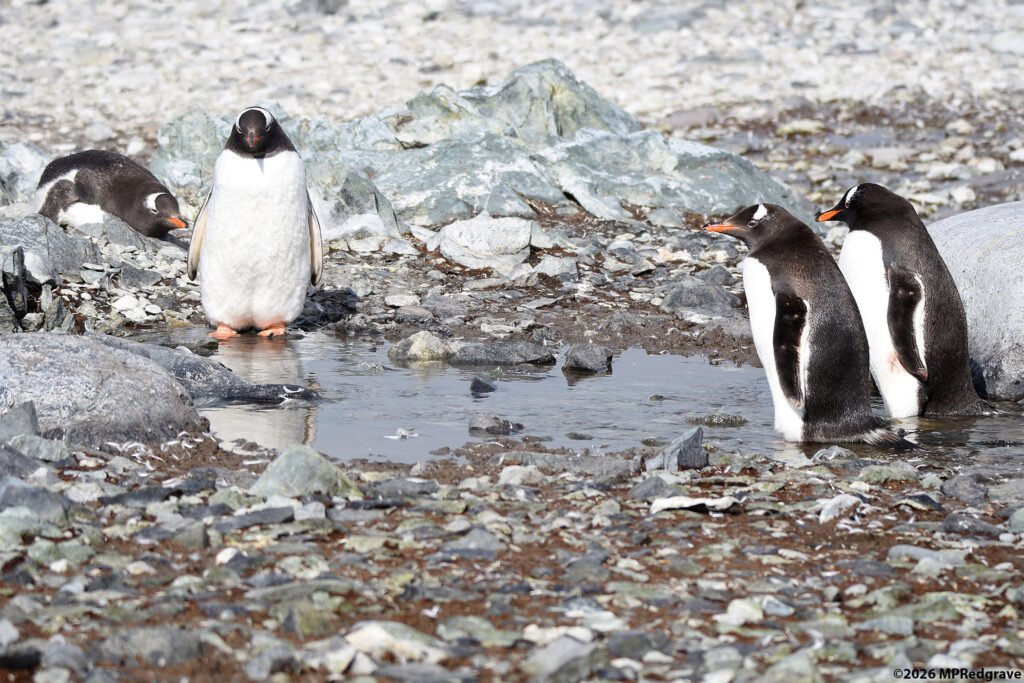
These guys were just hanging out in the meltwater stream that ran through the colony.

As I was walking back to the landing area to catch the Zodiac back to the ship, I had to take one more photo of a Gentoo. This guy posed for me.

The path to get back to the Zodiacs went through that meltwater stream that our little friends were standing in. I looked down, expecting to just see clear water—but something moved. The stream was filled with tiny brown spotted creatures, no more than a half-inch long. At first, I thought they were some kind of tiny fish, but nothing I read supported that notion. My guess—and it is only a guess—is that these are krill (probably immature krill), the creature that forms the bottom of the animal food chain for so many Antarctic creatures.